Kemetic Tradition
Anubis
AN-yoo-bis (Egyptian: Anpu, Inpu)
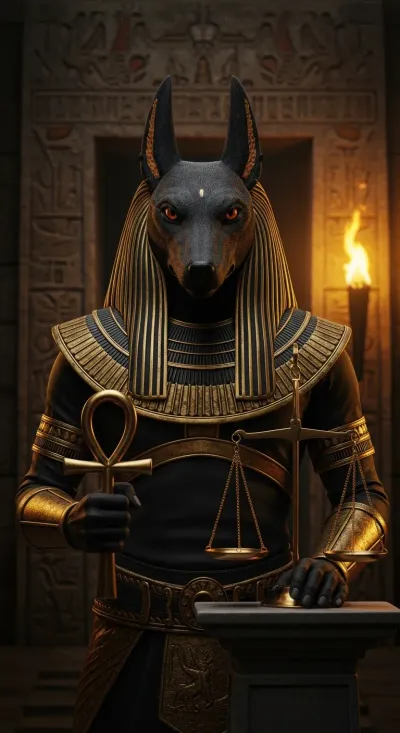
The jackal-headed Egyptian god of embalming, mummification, and the threshold between life and death — who guides souls through the Duat and steadies the scales at the Weighing of the Heart.
Anubis (Egyptian Anpu, Inpu) is the jackal-headed god who stands at every threshold between life and death. He is the divine embalmer who prepared Osiris’s body for resurrection; the guide who leads souls through the Duat; the steady hand at the scales of judgment. No Egyptian died without invoking Anubis’s name — his titles appear in every funerary text in the corpus, from the oldest Pyramid Texts to the latest papyri.
The divine embalmer
The myth preserved in Legends of the Gods identifies Anubis as the one who, aided by Isis and Nephthys, gathered the dismembered pieces of Osiris and performed the first mummification. This act established the entire Egyptian funerary tradition: mummification was understood not as preservation of a corpse but as a ritual re-enactment of Osiris’s restoration, with the deceased playing the role of Osiris and the embalmer playing the role of Anubis. The chief embalmer at actual mummification workshops wore the jackal mask of Anubis for precisely this theological reason.
The Weighing of the Heart
Book of the Dead Chapter 125 — perhaps the most famous image in Egyptian art — shows Anubis steadying the scales in the Hall of Two Truths. He is not the judge (that role belongs to Osiris, with Thoth recording) but the measurer: his black jackal hands rest on the pillar of the balance, ensuring the scales are true. The juxtaposition of his black coloring against the golden scales encodes theological meaning: black (kem) signifies the fertile Nile silt and resurrection, not death or evil. Anubis’s black form is a symbol of regenerative power.
He Who Is on His Mountain
One of Anubis’s oldest titles is Imy-ut — “He Who Is in the Place of Embalming” — and Khenty-Amentiu — “Foremost of the Westerners.” The west was the direction of the setting sun, of death, and of the entrance to the Duat. Egyptian Ideas of the Future Life by Budge explains how Anubis’s role as guardian of the necropolis was established from the earliest dynastic period: the jackals who were observed at the edges of desert burial grounds were understood as manifestations of Anubis watching over the dead.
Anubis in practice
In Kemetic reconstructionism, Anubis is approached in contexts of death, grief, healing of grief, ancestor work, and any situation involving threshold or transition. He is not a fearsome deity but a compassionate one — the steady hand that guides, not the overwhelming force that overwhelms. The Liturgy of Funerary Offerings provides traditional formulae for addressing him when making offerings for the dead. His altar welcomes black candles, pure water, incense, and offerings of bread and beer — the same offerings given to the Akhu (blessed ancestors) in his care.
Related Terms
Ba
The Egyptian concept of the individual soul or personality — depicted as a human-headed bird, it carries the person's unique character and can fly between the tomb and the world of the living after death, seeking food and light.
KemeticDuat
The Egyptian underworld — the realm of cosmic transformation through which Ra navigates each night in his barque and through which every human soul travels after death on the way to judgment and the Field of Reeds.
KemeticIsis
The Egyptian goddess of magic, healing, motherhood, and resurrection — she gathered the dismembered body of Osiris, mastered the secret name of Ra, and became the universal mother of the Greco-Roman world.
KemeticKa
The Egyptian concept of the life-force or vital double — the invisible duplicate created alongside the body at birth by Khnum, sustained by food offerings in death, and the part of the person that inhabits the tomb and receives the living's gifts.
KemeticMa'at (goddess)
The Egyptian goddess personifying truth, justice, and cosmic order — her ostrich feather is the standard against which every human heart is weighed at death, and her presence sustains the universe.
KemeticOsiris
The Egyptian god of resurrection, the afterlife, and divine kingship — first king of Egypt, murdered and dismembered by Set, restored by Isis, and made eternal judge of the dead in the Duat.
KemeticThoth
The ibis-headed Egyptian god of writing, magic, the moon, and sacred knowledge — divine scribe who records the judgment of the dead at the Weighing of the Heart and gave humanity the gift of hieroglyphs.
KemeticWeighing of the Heart
The Egyptian ceremony of postmortem judgment in which the deceased's heart is weighed against the feather of Ma'at — if lighter, the soul enters paradise; if heavier, it is devoured by the monster Ammit and ceases to exist.