Kemetic Tradition
Geb
GEB (Egyptian: Geb, sometimes Keb)
The Egyptian earth god who forms the ground beneath all life — husband of Nut the sky, father of Osiris, Isis, Set, and Nephthys, whose laughter shakes the earth and whose body is the black soil of Egypt.
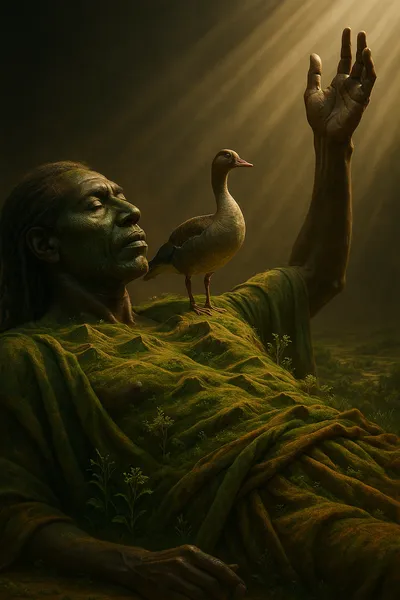
Geb (Egyptian Geb) is the Egyptian earth — not a god who rules the earth from above, but the earth itself made divine. He is depicted as a man lying on the ground, sometimes with a goose on his head (his sacred animal, giving him the epithet “the Great Cackler”), his body dark green or black to indicate fertile soil. He is the husband of Nut the sky and the father of the four greatest deities in Egyptian mythological history: Osiris, Isis, Set, and Nephthys.
The earth and the sky separated
The myth of Geb and Nut’s separation — found in Legends of the Gods — is one of Egypt’s fundamental cosmogonic narratives. At the beginning, Geb and Nut lay locked in inseparable embrace, leaving no room for creation between them. Shu (air), commanded by Ra-Atum, thrust himself between them, lifting Nut high to become the sky while Geb lay beneath as the earth. The tension of their eternal separation — Geb always reaching upward, Nut arching over him but unable to descend — became the creative space of the world: the gap between earth and sky where all life unfolds.
Father of the royal line
As father of Osiris and Isis, Geb stands at the head of the mythological royal genealogy that the pharaohs claimed as their inheritance. The Pyramid Texts invoke him repeatedly as the ancestor-earth who supports and legitimates the royal dead. The earth’s fertility — the black Nile silt that made Egypt the gift of the river — was understood as Geb’s body expressing its creative power. To be buried in the earth was, in one sense, to return to the father.
Geb’s laughter and the earthquake
The epithet “the Great Cackler” connects to one of Geb’s creation myths: his great cackle — the cosmic goose’s honk — broke the primordial silence and called the primordial egg into being, from which Ra himself hatched. Earthquakes were understood as Geb laughing. This gives the earth a personality: active, sometimes disruptive, capable of sudden force.
Geb in practice
Geb is acknowledged in Kemetic practice in contexts of grounding, earthly stability, and the cycle of planting and harvest. Offerings are made directly to the earth — poured into soil, left at the base of a tree. The Book of the Dead Spell 30B invokes Geb in the context of the heart’s judgment, asking the earth-father to support rather than indict the soul. He is an ancestral deity in the deepest sense: the ground itself beneath every living thing.
Related Terms
Isis
The Egyptian goddess of magic, healing, motherhood, and resurrection — she gathered the dismembered body of Osiris, mastered the secret name of Ra, and became the universal mother of the Greco-Roman world.
KemeticNephthys
The Egyptian goddess of death, twilight, and the threshold between life and death — sister of Isis who mourned Osiris at the edge of the world and whose lamentation has the power to protect and restore the dead.
KemeticNut
The Egyptian sky goddess whose star-spangled body arches over the earth as the vault of heaven — she swallows the sun each night and gives birth to it each morning, and shelters the dead in her embrace.
KemeticOsiris
The Egyptian god of resurrection, the afterlife, and divine kingship — first king of Egypt, murdered and dismembered by Set, restored by Isis, and made eternal judge of the dead in the Duat.
KemeticRa
The self-created supreme solar deity of ancient Egypt, who sails the solar barque across the sky each day and through the underworld each night to be reborn as Khepri at dawn.
KemeticSet
The Egyptian god of storms, the desert, and necessary chaos — murderer of Osiris and antagonist of Horus, yet also Ra's indispensable defender against the serpent Apep in the nightly underworld passage.