Kemetic Tradition
Horus
HOR-us (Egyptian: Heru)
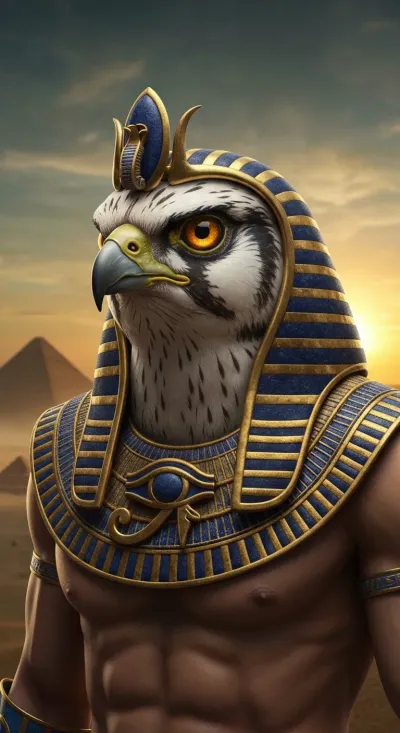
The falcon-headed Egyptian god of kingship and the sky, son of Osiris and Isis, who avenged his father's murder by Set and whose living form was embodied in every ruling pharaoh.
Horus (Egyptian Heru) is the falcon-headed god of the sky and kingship, son of Osiris and Isis, and the divine model for every pharaoh who ever ruled the Two Lands. The living king was Horus incarnate; the dead king became Osiris. This theological framework — the most durable political theology in the ancient world — bound together kingship, death, and resurrection into a single coherent system that endured for three thousand years.
The Eye of Horus
Among Horus’s most important mythological contributions is the Wedjat — the Eye of Horus, injured by Set in their cosmic conflict and healed by Thoth. The Pyramid Texts and Book of the Dead Chapter 112 preserve the mythology of this sacred eye, which became the primary amulet of protection and healing in Egyptian religion. When offerings were given to the gods, they were described as “the Eye of Horus” — giving the gods an aspect of divine wholeness. The lunar phases were understood as the waxing and waning of the healed and injured eye respectively.
Horus the Elder and Horus Son of Isis
Egyptian tradition distinguished at least two major forms of Horus. Heru-Ur (Horus the Elder) is a cosmic deity predating the Osirian narrative — a sky god who embodied the entire vault of heaven, his right eye the sun and his left the moon. Harsiese (Horus Son of Isis) is the child who grows in the papyrus marshes, hidden from Set, and eventually challenges his uncle for the throne of his father. The Legends of the Gods preserves the long and legally complex trial before the assembly of the gods — Ra initially favoring Set, the tribunal eventually awarding the throne to Horus after eighty years of dispute.
The royal theology
Development of Religion and Thought in Ancient Egypt by Breasted traces how the identification of the living pharaoh with Horus formed the bedrock of Egyptian political theology. The pharaoh’s Horus name — the first and oldest of his five royal names — declared him to be Horus made manifest. In death, the pharaoh merged with Osiris, and the new pharaoh ascended as the new Horus. This cycle was not merely symbolic; it was the mechanism by which cosmic order (Ma’at) was maintained in the political world.
Horus in practice
In Kemetic reconstructionism, Horus is invoked for protection, justice, and the assertion of legitimate authority. His symbol — the falcon or the Wedjat eye — is among the most recognizable of Egyptian sacred images. The Book of the Dead Chapter 112 is a useful meditation text on wholeness and healing. Horus is also a deity of overcoming adversity: his entire mythology is a story of a child who was supposed to have been eliminated, who survived, grew, and ultimately prevailed.
Related Terms
Anubis
The jackal-headed Egyptian god of embalming, mummification, and the threshold between life and death — who guides souls through the Duat and steadies the scales at the Weighing of the Heart.
KemeticDuat
The Egyptian underworld — the realm of cosmic transformation through which Ra navigates each night in his barque and through which every human soul travels after death on the way to judgment and the Field of Reeds.
KemeticIsis
The Egyptian goddess of magic, healing, motherhood, and resurrection — she gathered the dismembered body of Osiris, mastered the secret name of Ra, and became the universal mother of the Greco-Roman world.
KemeticMa'at (goddess)
The Egyptian goddess personifying truth, justice, and cosmic order — her ostrich feather is the standard against which every human heart is weighed at death, and her presence sustains the universe.
KemeticOsiris
The Egyptian god of resurrection, the afterlife, and divine kingship — first king of Egypt, murdered and dismembered by Set, restored by Isis, and made eternal judge of the dead in the Duat.
KemeticRa
The self-created supreme solar deity of ancient Egypt, who sails the solar barque across the sky each day and through the underworld each night to be reborn as Khepri at dawn.
KemeticSet
The Egyptian god of storms, the desert, and necessary chaos — murderer of Osiris and antagonist of Horus, yet also Ra's indispensable defender against the serpent Apep in the nightly underworld passage.