Kemetic Tradition
Khnum
k'NOOM (Egyptian: Ḫnmw)
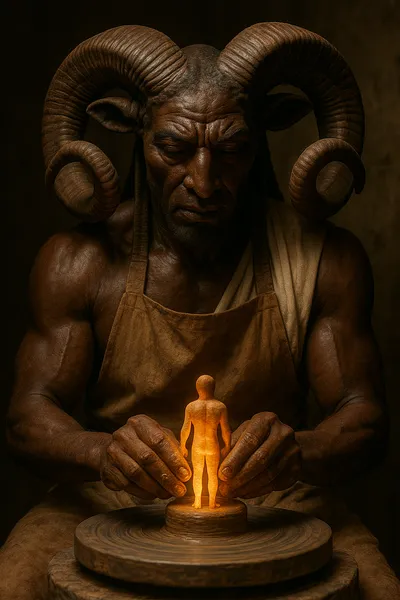
The ram-headed Egyptian creator god of Elephantine who fashions every human body and its Ka on his potter's wheel at the moment of conception, and controls the annual Nile inundation from his cavern at the First Cataract.
Khnum (Egyptian Ḫnmw) is the ram-headed creator god of Elephantine — the island at the First Cataract of the Nile, the ancient southern boundary of Egypt — who fashions the bodies of human beings and their Ka (spiritual double) on his divine potter’s wheel at the moment of their conception. He is one of the oldest creators in the Egyptian tradition, and his theology is among the most intimate: where Ra creates the cosmos through solar force and Ptah creates through divine thought, Khnum creates the individual person, shaping each human being by hand as a potter shapes clay.
The potter’s wheel of creation
Legends of the Gods describes Khnum at his wheel: the ram-headed god spinning the clay, forming the physical body and simultaneously forming the Ka — the life-force double — that will accompany the person through life and death. This dual creation is theologically significant: Khnum does not create a body and add a spirit to it; he creates both simultaneously, integrated from the first moment. The body is not the container of the soul; they are formed together, of the same divine clay, inseparable.
Lord of the Nile’s inundation
At Elephantine, Khnum controlled the Nile flood. The Pyramid Texts invoke him as the god who releases the annual inundation from his cavern beneath the First Cataract — the flood that brought the black silt to Egypt and made the land fertile. Development of Religion and Thought in Ancient Egypt traces the theology of the Nile as a divine gift controlled by Khnum: without his releasing the waters, Egypt would starve; with his generosity, the Two Lands would flourish for another year.
Khnum-Ra and the cosmic craftsman
In syncretism with Ra, Khnum became Khnum-Ra — the creative solar force that fashions new life at each sunrise, paralleling Khnum’s role in fashioning new humans at each conception. This merging elevated Khnum from a regional Nile deity to a cosmic craftsman deity standing alongside Ptah as a principle of embodied, material creation through skilled labor.
Khnum in practice
Khnum is appropriate to invoke at births, at creative projects involving physical making, and in practices concerning bodily health and the body’s inherent wholeness. He is a deity of embodiment — the theological insistence that the body matters, that it was shaped by divine hands with care. Offerings include clay objects, bread, water from the Nile or a river, and the work of hands. The Book of the Dead Chapter 142 includes his name among the creators addressed in the funerary tradition.
Related Terms
Duat
The Egyptian underworld — the realm of cosmic transformation through which Ra navigates each night in his barque and through which every human soul travels after death on the way to judgment and the Field of Reeds.
KemeticGeb
The Egyptian earth god who forms the ground beneath all life — husband of Nut the sky, father of Osiris, Isis, Set, and Nephthys, whose laughter shakes the earth and whose body is the black soil of Egypt.
KemeticHeka
The Egyptian principle of sacred, creative speech and magic — a primordial cosmic force older than the gods themselves, by which the universe was spoken into being and by which correctly spoken words carry genuine transformative power.
KemeticKa
The Egyptian concept of the life-force or vital double — the invisible duplicate created alongside the body at birth by Khnum, sustained by food offerings in death, and the part of the person that inhabits the tomb and receives the living's gifts.
KemeticNut
The Egyptian sky goddess whose star-spangled body arches over the earth as the vault of heaven — she swallows the sun each night and gives birth to it each morning, and shelters the dead in her embrace.
KemeticOsiris
The Egyptian god of resurrection, the afterlife, and divine kingship — first king of Egypt, murdered and dismembered by Set, restored by Isis, and made eternal judge of the dead in the Duat.
KemeticPtah
The mummiform Egyptian god of Memphis who created the universe through divine thought and authoritative speech — patron of all craftsmen, architects, sculptors, and makers, and creator-god of the Memphite theological tradition.
KemeticRa
The self-created supreme solar deity of ancient Egypt, who sails the solar barque across the sky each day and through the underworld each night to be reborn as Khepri at dawn.