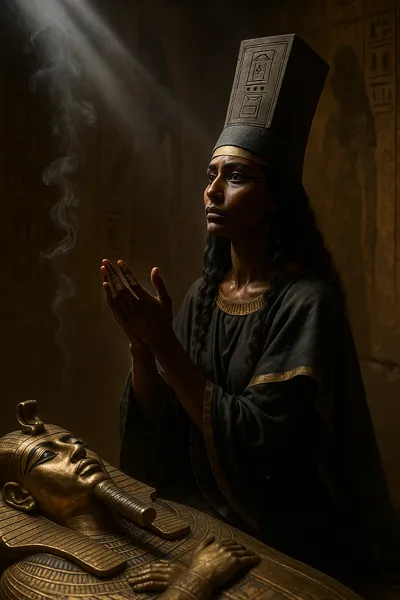
Kemetic Tradition
Nephthys
NEF-this (Egyptian: Nebt-het, 'Lady of the House')
The Egyptian goddess of death, twilight, and the threshold between life and death — sister of Isis who mourned Osiris at the edge of the world and whose lamentation has the power to protect and restore the dead.
Nephthys (Egyptian Nebt-het, “Lady of the House”) is the sister of Isis and Osiris, wife of Set, and the divine guardian of the threshold between life and death. Where Isis embodies the force of active love and magical power, Nephthys embodies the darker mystery: she is the goddess of endings, of the night that precedes dawn, of the liminal space where the living and the dead touch. Yet she is not a goddess of destruction — she is a protector. She stands at the edge of the world so that others do not fall off it.
The lamentation and the gathering
The Pyramid Texts contain the earliest version of what The Burden of Isis preserves in full: the lamentation of Isis and Nephthys over the murdered Osiris. The two sisters search together, mourn together, and work together to restore the dead god. Nephthys’s role in the Legends of the Gods is consistently that of the devoted helper: she mourned, she gathered, she protected. Where Isis wielded the great magical power of restoration, Nephthys provided the love and faithfulness without which that power would have had nothing to restore.
The paradox of Set’s wife
Nephthys is theologically paradoxical: she is Set’s wife, yet she aids Isis (Set’s enemy) in restoring Osiris (Set’s victim). She conceived Anubis with Osiris — the divine child of death born from the union of life’s force and death’s lady. This makes Nephthys a figure of divided loyalties resolved in favor of truth and love: she chose Isis’s side despite her marriage to Set. The Book of the Dead places her consistently among the protective deities, never among the forces of chaos.
Guardian of the deceased
In funerary iconography, Nephthys typically appears at the foot end of the coffin (Isis at the head), her arms spread in the wings of protection. Egyptian Ideas of the Future Life by Budge describes how the four Sons of Horus — who protect the organs in their canopic jars — were paired with guardian goddesses, with Nephthys protecting Hapy (the baboon-headed jar protecting the lungs). She guards the threshold of breath, the first thing lost in death.
Nephthys in practice
In Kemetic reconstructionism, Nephthys is invoked at the death of loved ones, in grief rituals, in contemplation of endings and thresholds, and in ancestor work. The Burden of Isis provides the most direct scriptural source for working with her: reading the lamentation aloud over what has been lost honors both her and the nature of loss itself. Her altar welcomes dark colors, water, and the spoken names of the dead.
Related Terms
Akhu
The blessed ancestors in Kemetic religion — the plural of Akh, the transfigured justified dead who dwell in the Field of Reeds, remain present to the living through offerings and name-speaking, and can intercede for those who remember them.
KemeticAnubis
The jackal-headed Egyptian god of embalming, mummification, and the threshold between life and death — who guides souls through the Duat and steadies the scales at the Weighing of the Heart.
KemeticDuat
The Egyptian underworld — the realm of cosmic transformation through which Ra navigates each night in his barque and through which every human soul travels after death on the way to judgment and the Field of Reeds.
KemeticIsis
The Egyptian goddess of magic, healing, motherhood, and resurrection — she gathered the dismembered body of Osiris, mastered the secret name of Ra, and became the universal mother of the Greco-Roman world.
KemeticOsiris
The Egyptian god of resurrection, the afterlife, and divine kingship — first king of Egypt, murdered and dismembered by Set, restored by Isis, and made eternal judge of the dead in the Duat.
KemeticSet
The Egyptian god of storms, the desert, and necessary chaos — murderer of Osiris and antagonist of Horus, yet also Ra's indispensable defender against the serpent Apep in the nightly underworld passage.
KemeticThoth
The ibis-headed Egyptian god of writing, magic, the moon, and sacred knowledge — divine scribe who records the judgment of the dead at the Weighing of the Heart and gave humanity the gift of hieroglyphs.
KemeticWeighing of the Heart
The Egyptian ceremony of postmortem judgment in which the deceased's heart is weighed against the feather of Ma'at — if lighter, the soul enters paradise; if heavier, it is devoured by the monster Ammit and ceases to exist.