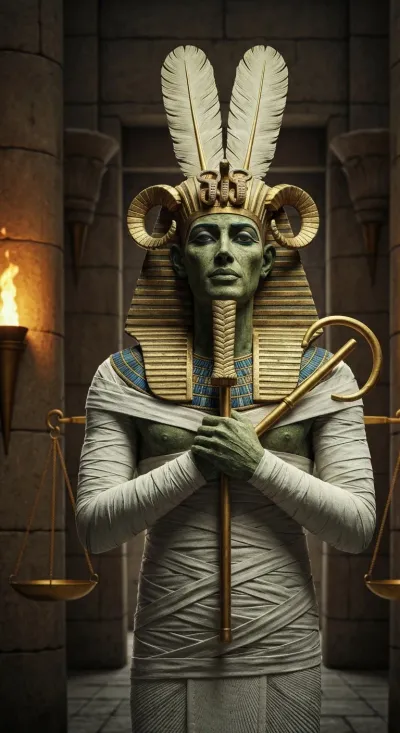
Kemetic Tradition
Osiris
OH-sigh-ris (Egyptian: Usir, Wesir)
The Egyptian god of resurrection, the afterlife, and divine kingship — first king of Egypt, murdered and dismembered by Set, restored by Isis, and made eternal judge of the dead in the Duat.
Osiris (Egyptian Usir, Wesir) is the first and greatest king of Egypt in the mythological record — a deity who brought civilization and law to humanity, was murdered by his jealous brother Set, and through the love of his wife Isis became the lord of the Duat and the judge of every soul that passes into eternity. His story is the most complete and emotionally resonant myth in the ancient Egyptian corpus, and it carries a theological claim of enormous depth: death is not an ending but a transformation; love that acts can overcome even dismemberment; and how one lives is weighed, quite literally, against the cosmic standard of truth.
The myth of death and gathering
The core narrative preserved in Legends of the Gods and the Pyramid Texts: Osiris ruled as a beneficent king. His brother Set, consumed by jealousy, murdered him and scattered his body across Egypt in fourteen pieces. Isis and her sister Nephthys searched the length of the Two Lands, gathering each piece. Aided by Anubis’s funerary arts and Thoth’s sacred knowledge, Isis breathed life temporarily back into the restored body, conceived Horus, and then Osiris descended permanently to rule the Duat as lord of the dead. What died became more powerful in death — Osiris as judge of souls holds more cosmic authority than Osiris as living king ever did.
Osiris and the grain
An equally ancient layer of Osirian theology identifies him with the grain cycle. His death is the burying of seed in the dark earth; his resurrection is the green shoot breaking ground. His black or green skin encodes this: black for the fertile Nile silt (the kemet, the black land, that gives Egypt its name), green for the vegetation of new life. Development of Religion and Thought in Ancient Egypt traces how this agricultural theology merged with the royal theology, giving Osiris a double claim: he is the king who dies and the grain that rises, both patterns of cyclical renewal.
The Weighing of the Heart
In the Hall of Two Truths, Osiris sits enthroned as the final judge. Every soul who enters the Duat faces the scales: their heart on one side, the feather of Ma’at on the other. Anubis steadies the balance; Thoth records the result; forty-two divine assessors interrogate the soul. Book of the Dead Chapter 125 preserves the full ceremony, including the Negative Confessions spoken before each assessor. If the heart is lighter than or equal to the feather, the soul is declared maa kheru — “true of voice,” vindicated — and welcomed into the Field of Reeds. If heavier, the monster Ammit devours it: the “second death,” annihilation.
This judgment is the theological center of Osirian religion, and Breasted’s Development of Religion and Thought traces how it was originally a royal privilege (only the pharaoh became Osiris in death) before being democratized in the First Intermediate Period, when ordinary Egyptians began claiming Osirian identification for themselves.
Osiris in practice
In Kemetic reconstructionism, Osiris governs ancestor veneration, ethical self-examination, and contemplation of personal transformation. His altar colors are black and green; his offerings include grain, bread, beer, green vegetables, and pure water. The practice of regularly working through the 42 Negative Confessions — found in Book of the Dead Chapter 125 — is one of the most direct Osirian spiritual disciplines available: an ethical inventory taken not in preparation for death, but to keep the living heart light.
Related Terms
Akh
The transfigured Egyptian spirit — the luminous, immortal being that a justified soul becomes after the Ka and Ba are united following the successful judgment at the Weighing of the Heart.
KemeticAnubis
The jackal-headed Egyptian god of embalming, mummification, and the threshold between life and death — who guides souls through the Duat and steadies the scales at the Weighing of the Heart.
KemeticBa
The Egyptian concept of the individual soul or personality — depicted as a human-headed bird, it carries the person's unique character and can fly between the tomb and the world of the living after death, seeking food and light.
KemeticDuat
The Egyptian underworld — the realm of cosmic transformation through which Ra navigates each night in his barque and through which every human soul travels after death on the way to judgment and the Field of Reeds.
KemeticField of Reeds
The Egyptian paradise (Aaru) — the eternal realm of abundance, peace, and divine company where the justified dead, having passed the Weighing of the Heart, live as glorified Akhu in a perfected version of the Egyptian homeland.
KemeticHorus
The falcon-headed Egyptian god of kingship and the sky, son of Osiris and Isis, who avenged his father's murder by Set and whose living form was embodied in every ruling pharaoh.
KemeticIsis
The Egyptian goddess of magic, healing, motherhood, and resurrection — she gathered the dismembered body of Osiris, mastered the secret name of Ra, and became the universal mother of the Greco-Roman world.
KemeticKa
The Egyptian concept of the life-force or vital double — the invisible duplicate created alongside the body at birth by Khnum, sustained by food offerings in death, and the part of the person that inhabits the tomb and receives the living's gifts.
KemeticMa'at (goddess)
The Egyptian goddess personifying truth, justice, and cosmic order — her ostrich feather is the standard against which every human heart is weighed at death, and her presence sustains the universe.
KemeticSet
The Egyptian god of storms, the desert, and necessary chaos — murderer of Osiris and antagonist of Horus, yet also Ra's indispensable defender against the serpent Apep in the nightly underworld passage.
KemeticWeighing of the Heart
The Egyptian ceremony of postmortem judgment in which the deceased's heart is weighed against the feather of Ma'at — if lighter, the soul enters paradise; if heavier, it is devoured by the monster Ammit and ceases to exist.