Kemetic Tradition
Ptah
PTAH (Egyptian: Ptḥ)
The mummiform Egyptian god of Memphis who created the universe through divine thought and authoritative speech — patron of all craftsmen, architects, sculptors, and makers, and creator-god of the Memphite theological tradition.
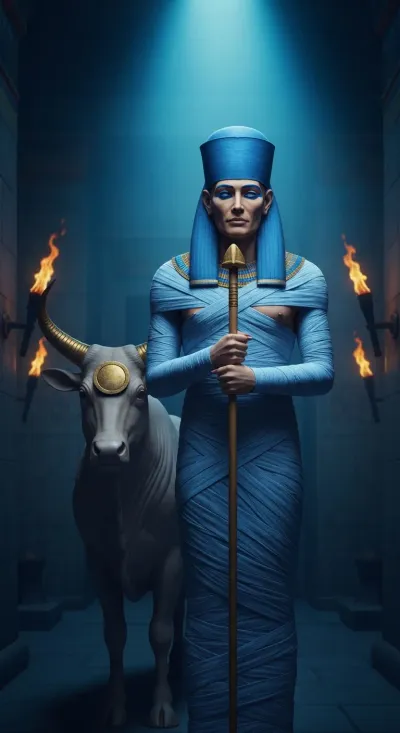
Ptah (Egyptian Ptḥ) is the mummiform creator-god of Memphis — depicted always wrapped in a tight mummy shroud, holding a combined was-djed-ankh scepter, his head shaved clean, his face calm and utterly still. Where Ra creates through solar force and Atum creates through self-extension, Ptah creates through a different mechanism entirely: thought and word. The Memphite Theology, preserved on the Shabaka Stone and summarized in Development of Religion and Thought in Ancient Egypt, declares that Ptah conceived every existing thing in his heart (the seat of thought in Egyptian physiology) and brought it into being through the authoritative utterance of his mouth. Creation is an act of divine mind speaking itself into reality.
The Memphite Theology
Breasted’s Development of Religion and Thought in Ancient Egypt devotes substantial analysis to the Memphite Theology as a theological counterweight to Heliopolis’s solar creation myth. Where Ra-Atum creates through physical self-extension (he produces Shu and Tefnut from himself), Ptah creates through intelligence and language. This made Ptah the theological foundation for heka — sacred speech — and for all arts that require the mind to conceive before the hands can make. Ptah thought the gods into existence; Ptah spoke the names of all things; the world was his sustained thought made permanent through utterance.
Patron of all makers
Every craftsman in Egypt worked under Ptah’s authority: the sculptor who carved a divine image, the architect who designed a temple, the carpenter, metalworker, jeweler, and weaver. The reason is theological: all making is a participation in Ptah’s original creative act. To make something well — to bring a plan from mind to matter — is to echo the divine pattern. The priests of Ptah were not merely religious functionaries; they maintained the tradition of sacred craftsmanship that connected all making to the original creation.
Ptah-Sokar-Osiris
In the funerary sphere, Ptah merged with Sokar (the Memphite god of the necropolis) and then with Osiris to form the composite deity Ptah-Sokar-Osiris — a triune figure governing the full cycle of death, passage, and resurrection. Egyptian Ideas of the Future Life by Budge discusses how this composite deity embodied the Memphis funerary theology: Ptah as creative potential, Sokar as the dark earth of death, Osiris as the force of resurrection.
Ptah in practice
Ptah is the patron invoked before any act of significant making — writing a book, building a house, creating an image, crafting a tool. His traditional offerings include water, incense, and craft objects representing the practitioner’s work. A sculptor might offer a small clay figure; a writer, a finished page. The theological idea is that offering the fruit of one’s craft to Ptah both honors the divine source of making and dedicates the work to the principle of truth-in-form that Ptah embodies.
Related Terms
Heka
The Egyptian principle of sacred, creative speech and magic — a primordial cosmic force older than the gods themselves, by which the universe was spoken into being and by which correctly spoken words carry genuine transformative power.
KemeticMa'at (goddess)
The Egyptian goddess personifying truth, justice, and cosmic order — her ostrich feather is the standard against which every human heart is weighed at death, and her presence sustains the universe.
KemeticNetjer
The Egyptian word for 'god' or 'divine force' — a theologically complex term describing divine reality as multiple, overlapping, and capable of merging, with no single Netjer monopolizing divine power.
KemeticOsiris
The Egyptian god of resurrection, the afterlife, and divine kingship — first king of Egypt, murdered and dismembered by Set, restored by Isis, and made eternal judge of the dead in the Duat.
KemeticRa
The self-created supreme solar deity of ancient Egypt, who sails the solar barque across the sky each day and through the underworld each night to be reborn as Khepri at dawn.
KemeticSekhmet
The lioness-headed Egyptian goddess of solar wrath, plague, and healing — the Eye of Ra who was sent to destroy humanity and then became the patroness of physicians who healed what her pestilence caused.
KemeticThoth
The ibis-headed Egyptian god of writing, magic, the moon, and sacred knowledge — divine scribe who records the judgment of the dead at the Weighing of the Heart and gave humanity the gift of hieroglyphs.