Kemetic Tradition
Set
SET (also Seth, Sutekh)
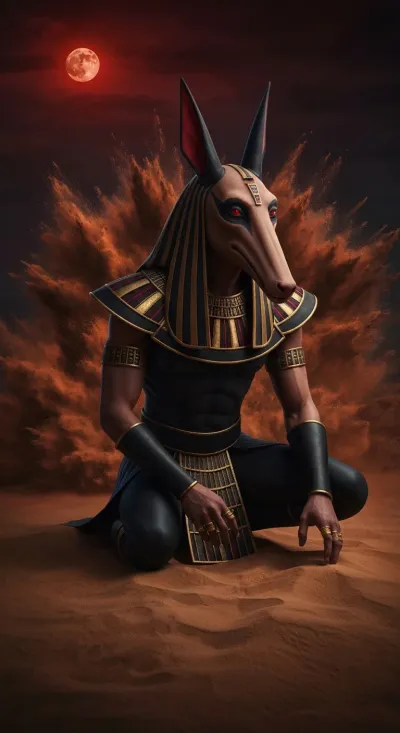
The Egyptian god of storms, the desert, and necessary chaos — murderer of Osiris and antagonist of Horus, yet also Ra's indispensable defender against the serpent Apep in the nightly underworld passage.
Set (also Seth, Sutekh) is the most theologically complex deity in the Egyptian pantheon — a god who committed the defining crime of mythological history (the murder and dismemberment of Osiris) and yet remains cosmically necessary. He is the only god powerful enough to defend Ra’s barque against the serpent Apep. Without Set, the sun would not rise. Egyptian religion does not resolve this paradox by declaring Set evil and dismissing him; it holds the tension, recognizing that some forces required for order are themselves dangerous, violent, and outside the normal moral calculus.
The red land and the storm
Set governs the desert (deshret, the red land) as opposed to the fertile black soil of the Nile valley. He is lord of storms, foreign lands, and the uncontrolled forces at the margins of civilization. His animal — the “Set animal,” a creature never fully identified by modern scholarship, with a long curved snout and squared ears — appears in iconography from the earliest dynastic period. The Pyramid Texts already show Set in a complex dual role: both a source of royal power and the adversary of Horus.
The murder of Osiris and the long war
Legends of the Gods preserves the central myth: Set murdered Osiris, his own brother, out of jealousy for the throne of Egypt, and dismembered the body to prevent resurrection. The subsequent conflict between Horus (Osiris’s son and avenger) and Set played out over eighty years of divine tribunal, as described in Ancient Egyptian Legends. Ra initially favored Set — the older, more powerful god — but the assembly ultimately judged in Horus’s favor. Set was not destroyed but assigned to the desert margins and to Ra’s barque, his prodigious strength redirected toward cosmic defense.
Set as defender of Ra
This redirection is theologically crucial. The Book of Am-Tuat and The Book of Gates both depict Set standing at the prow of Ra’s night barque with his spear, driving back Apep as the barque passes through each of the twelve hours of the Duat. Without Set’s violence, chaos would prevail. Development of Religion and Thought in Ancient Egypt by Breasted identifies this role as the key to understanding Set: he is the principle of violent, necessary force that must exist at the boundary between order and absolute dissolution. He is chaos in service of order.
Set in practice
Set is honored in Kemetic reconstructionism by those who work with storm, with difficult boundaries, or with the forces of necessary disruption. He is also appropriate for warriors, for those fighting genuine injustice, and for those at the margins of their communities. His offerings traditionally include red foods, strong incense, and objects of iron. Working with Set requires acknowledging his full complexity — he cannot be domesticated into a simple protector deity; his mythology insists that his power comes precisely from his capacity for destruction.
Related Terms
Duat
The Egyptian underworld — the realm of cosmic transformation through which Ra navigates each night in his barque and through which every human soul travels after death on the way to judgment and the Field of Reeds.
KemeticHorus
The falcon-headed Egyptian god of kingship and the sky, son of Osiris and Isis, who avenged his father's murder by Set and whose living form was embodied in every ruling pharaoh.
KemeticIsfet
The Egyptian cosmic principle of chaos, falsehood, injustice, and disorder — the permanent opponent of Ma'at, embodied in the serpent Apep, and increased in the world by every act of violence, deception, and oppression.
KemeticIsis
The Egyptian goddess of magic, healing, motherhood, and resurrection — she gathered the dismembered body of Osiris, mastered the secret name of Ra, and became the universal mother of the Greco-Roman world.
KemeticMa'at (goddess)
The Egyptian goddess personifying truth, justice, and cosmic order — her ostrich feather is the standard against which every human heart is weighed at death, and her presence sustains the universe.
KemeticNephthys
The Egyptian goddess of death, twilight, and the threshold between life and death — sister of Isis who mourned Osiris at the edge of the world and whose lamentation has the power to protect and restore the dead.
KemeticOsiris
The Egyptian god of resurrection, the afterlife, and divine kingship — first king of Egypt, murdered and dismembered by Set, restored by Isis, and made eternal judge of the dead in the Duat.
KemeticRa
The self-created supreme solar deity of ancient Egypt, who sails the solar barque across the sky each day and through the underworld each night to be reborn as Khepri at dawn.