Kemetic Tradition
Thoth
THOTH (rhymes with 'both'; Egyptian: Djehuty)
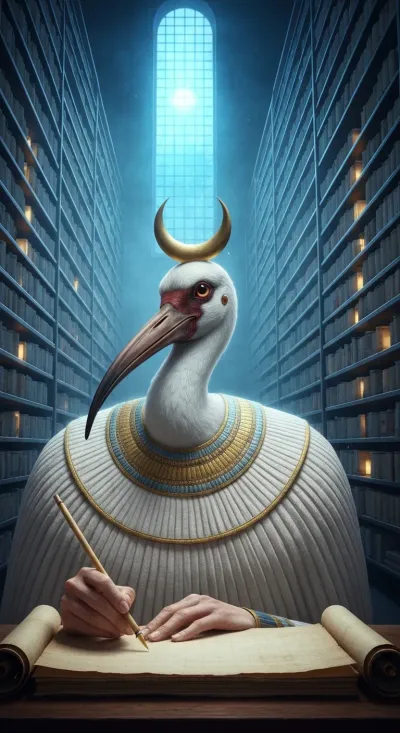
The ibis-headed Egyptian god of writing, magic, the moon, and sacred knowledge — divine scribe who records the judgment of the dead at the Weighing of the Heart and gave humanity the gift of hieroglyphs.
Thoth (Egyptian Djehuty) is the ibis-headed scribe of the gods — the divine intelligence who records every cosmic event, maintains the balance of Ma’at, heals the injured Eye of Horus, adjudicates divine disputes, and gave humanity the art of writing. His dual nature as moon-god and scribe encodes a deep theological connection: the moon, which measures time by its cycles and illuminates what the sun leaves in darkness, is the natural emblem of the god who counts, records, and reveals.
The scribe of Ma’at
In the Hall of Two Truths, at the Weighing of the Heart, Thoth stands with his palette and stylus. After Anubis steadies the scales and the result is read, Thoth records it. Book of the Dead Chapter 125 and its famous vignette show him in this role: the ibis-headed god writing the verdict that will determine whether the soul enters the Field of Reeds or is devoured by Ammit. Nothing escapes his ledger. The theological point is that the universe is not morally indifferent — every action is witnessed, weighed, and recorded by a divine intelligence that neither forgets nor is deceived.
Healer and arbiter
Legends of the Gods records Thoth’s role in the conflict between Horus and Set: when neither side could prevail and the divine tribunal was deadlocked, Thoth found the solution; when Horus lost his eye to Set’s attack, Thoth performed the healing. Ancient Egyptian Legends preserves the episode where Thoth descended from Ra’s barque to heal the infant Horus stung by a scorpion — teaching Isis the healing spell, giving her the words of power that would become the template for Egyptian medicine. In Egyptian Magic, Thoth is the source from whom all heka formulas ultimately derive: he authored the sacred texts at the beginning of time.
Lord of the moon and of cycles
The moon’s phases — waxing and waning — were understood by the Egyptians as the filling and emptying of the healed Eye of Horus, and Thoth presided over this monthly cycle. As moon-god, he governed measurement: the lunar calendar, the division of time into months, the reckoning of seasons. The Wisdom of the Egyptians by Budge addresses Thoth’s role in cosmic calculation and his patronage of all who work with number, word, and measure.
Thoth in practice
Thoth is the natural patron of scribes, scholars, lawyers, teachers, doctors, and all who work with the written word or sacred knowledge. His offerings include papyrus (or paper), ink, books, a scribe’s palette or pen. Egyptian Magic demonstrates that invoking Thoth’s name gave ancient magicians access to the full weight of divine recorded wisdom. The standard Kemetic address is Dua Djehuty! — praise to Djehuty — and the most appropriate act of Thoth-worship is, fittingly, to write something true.
Related Terms
Book of the Dead
The Egyptian collection of funerary spells, prayers, and declarations — placed in the coffin or on the mummy — that gave the deceased the knowledge and words of power needed to navigate the Duat and reach the Field of Reeds.
KemeticHeka
The Egyptian principle of sacred, creative speech and magic — a primordial cosmic force older than the gods themselves, by which the universe was spoken into being and by which correctly spoken words carry genuine transformative power.
KemeticHorus
The falcon-headed Egyptian god of kingship and the sky, son of Osiris and Isis, who avenged his father's murder by Set and whose living form was embodied in every ruling pharaoh.
KemeticIsis
The Egyptian goddess of magic, healing, motherhood, and resurrection — she gathered the dismembered body of Osiris, mastered the secret name of Ra, and became the universal mother of the Greco-Roman world.
KemeticMa'at (goddess)
The Egyptian goddess personifying truth, justice, and cosmic order — her ostrich feather is the standard against which every human heart is weighed at death, and her presence sustains the universe.
KemeticOsiris
The Egyptian god of resurrection, the afterlife, and divine kingship — first king of Egypt, murdered and dismembered by Set, restored by Isis, and made eternal judge of the dead in the Duat.
KemeticRa
The self-created supreme solar deity of ancient Egypt, who sails the solar barque across the sky each day and through the underworld each night to be reborn as Khepri at dawn.
KemeticWeighing of the Heart
The Egyptian ceremony of postmortem judgment in which the deceased's heart is weighed against the feather of Ma'at — if lighter, the soul enters paradise; if heavier, it is devoured by the monster Ammit and ceases to exist.