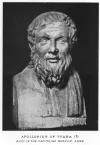
Hellenic · Apollonius of Tyana · 24 of 28
The Life of Apollonius: Book V (Part 1)
CHAPTER 1
Now in regard to the Pillars which they say Heracles fixed in the ground as limits of the earth, I shall omit mere fables, and confine myself to recording what is worthy of our hearing and of our narrating. The extremes of Europe and Libya border on a strait sixty stadia wide, through which the ocean is admitted into the inner seas. The extremity of Libya, which bears the name Abinna, furnishes a haunt of lions, who hunt their prey along the brows of the mountains which are to be seen rising inland, and it marches with the Gaetuli and Tingae, both of them wild Libyan tribes; and it extends as you sail into the ocean as far as the mouth of the river Salex, some nine hundred stadia, and beyond that point a further distance which no one can compute, because when you have passed this river Libya is a desert which no longer supports a population. But the promontory of Europe, known as Calpis, stretches along the inlet of the ocean and tight hand side distance of six hundred stadia, and terminates in the ancient city of Gadeira.
CHAPTER II
Now I myself have seen among the Celts the ocean tides just as they are described; and after making various conjectures about why so vast a bulk of waters recedes and advances, I have come to the conclusion that Apollonius discerned the real truth. For in one of his letters to the Indians he says that the ocean is driven by submarine influences or spirits out of several chasms which the earth afford both underneath and around it, to advance outwards, and to recede again, whenever the influence or spirit, like the breath of our bodies, gives way and recedes. And this theory is confirmed by the course run by diseases in Gadeira; for at the time of high water the souls of the dying do not quit the bodies, and this would hardly happen, he says, unless the influence or spirit I have spoken of was also advancing towards the land. They also tell you of certain phenomena of the ocean in connection with the phases of the moon, according as it is born and reaches fulness and wanes. These phenomena I verified, for the ocean exactly keeps pace with the size of the moon, decreasing and increasing with her.
CHAPTER III
And whereas the day succeeds the night and night succeeds the day in the land of the Celts by a very slow diminution of the darkness and of the light respectively, as in this country, in the neighborhood of Gadeira on the contrary and of the Pillars, it is said that the change bursts upon the eyes all at
once, like a flash of lightning. And they also say that the Islands of the Blessed are to be fixed by the limits of Libya where they rise towards the uninhabited promontory.
CHAPTER IV
Now the city of Gadeira is situated at the extreme end of Europe, and its inhabitants are excessively given to religion; so much so that they have set up an altar to old age, and unlike any other race they sing hymns in honor of death; and altars are found there set up to poverty, and to art, and to Heracles of Egypt, and there are others in honor of Heracles the Theban. For they say that the latter advanced against the neighboring town of Erythea, on which occasion he took captive Geryon and his cows; the other, they say, in his devotion to wisdom measured the whole earth up to its limits. They say moreover that there is a Hellenic culture at Gadeira, and that they educate themselves in our own fashion; anyhow, that they are fonder of the Athenians than of any other Hellenes, and they offer sacrifice to Menestheus the Athenian, and from admiration of Themistocles the naval commander, and to honor him for his wisdom and bravery, they have set up a brazen statue of him in thoughtful attitude and, as it were, pondering an oracle.
CHAPTER V
They say that they saw trees here such as are not found elsewhere upon the earth; and that these
were called the trees of Geryon. There were two of them, and they grew upon the mound raised over Geryon: they were a cross between the pitch tree and the pine, and formed a third species; and blood dripped from their bark, just as gold does from the Heliad poplar. Now the island on which the shrine is built is of exactly the same size as the temple, and there is not a rough stone to be found in it, for the whole of it has been given the form of a polished turning-post. In the shrine they say there is maintained a cult both of one and the other Heracles, though there are no images of them; altars however there are, namely, to the Egyptian Heracles two of bronze and perfectly plain, to the Theban, one of stone; on the latter they say are engraved in relief hydras and the mares of Diomedes and the twelve labors of Heracles. And as to the golden olive of Pygmalion, it too is preserved in the temple of Heracles, and it excited their admiration by the clever way in which the branch work was imitated; and they were still more astonished at its fruit, for this teemed with emeralds. And they say that the girdle of Teucer of Telamon was also exhibited there of gold, but how he ever sailed as far as the ocean, or why he did so, neither Damis by his own admission could understand nor ascertain from the people of the place. But he says that the pillars in the temple were made of gold and silver smelted together so as to be of one color, and they were over a cubit high, of square form, resembling anvils; and their capitals were inscribed with letters which were neither Egyptian nor Indian nor of any kind which he could decipher. But Apollonius, since the priests would tell him nothing, remarked: "Heracles
of Egypt does not permit me not to tell all I know. These pillars are ties between earth and ocean, and they were inscribed by Heracles in the house of the Fates, to prevent any discord arising between the elements, and to save their mutual affection for one another from violation."
CHAPTER VI
They tell also of how they sailed up the river Baetis, which throws no little light upon the nature of the ocean. For whenever it is high tide, the river in its course remounts towards its sources, because apparently a current of air drives it away from the sea. And the mainland of Baetica, after which the river is called, is the best by their account of any continent; for it is well furnished with cities and pastures, and the river is brought by canals through all the towns, and it is very highly cultivated with all sorts of crops; and it enjoys a climate similar to that of Attica in the autumn season when the mysteries are celebrated.
CHAPTER VII
The conversations which Apollonius held about things which met his eyes were, according to Damis, many in number, but the following he said deserve to be recorded. On one occasion they were sitting in the temple of Heracles and Menippus gave a laugh, for it happened that Nero had just come to his mind, "And what," he said, "are we to think of this splendid fellow? In which of the
contests has he won wreaths of late? Don't you think that self-respecting Hellenes must shake with laughter when they are on their way to the festivals?" And Apollonius replied: "As I have heard from Telesinus, the worthy Nero is afraid of the whips of the Eleans; for when his flatterers urged him to win at Olympia and to proclaim Rome as the victor, he answered: 'Yes, if the Eleans will only not depreciate me, for they are said to use whips and to look down upon me.' And many worse bits of nonsense than this forecast fell from his lips. I however admit that Nero will conquer at Olympia, for who is bold enough to enter the lists against him? But I deny that he will win at the Olympic festival, because they are not keeping it at the right season. For custom requires that this should have been held last year, but Nero has ordered the Eleans to put it off until his own visit, in order that they may sacrifice to him rather than to Zeus. And it is said that he has announced a tragedy and a performance on the harp for people who have neither a theater nor a stage for such entertainments, but only the stadium which nature has provided, and races which are all run by athletes stripped of their clothes. He however is going to take the prize for performances which he ought to have hidden in the dark, for he has thrown off the robes of Augustus and Julius and has dressed himself up in the garb of an Amoebeus or a Terpnus. What can you say of such a record? And then he betrays such a meticulous care in playing the part of Creon and Oedipus, that he is afraid of falling into some error, of coming in by the wrong door, or of wearing the wrong dress, of using the wrong scepter; but he has so entirely forgotten his own dignity and that of
the Romans, that instead of carrying on the work of making laws, he has taken to singing, and strolls like a player outside the gates within which the Emperor ought to take his seat on his throne, deciding the fate of land and sea. There are, O Menippus, several troupes in which has inscribed himself as an actor. What next? Supposing any one of these actors quitted the theater after playing Oenomaus or Cresphontes, so full of his part as to want to rule others, and imagine himself to be a tyrant, what would you say of him? Surely you would recommend a dose of hellebore and the taking of drugs of a kind that clear the intellect? Well, here is the man himself who wields absolute power, throwing in his lot with actors and artists, cultivating a soft voice and trembling before the people of Elis or of Delphi; or if he does not tremble, yet misrepresenting his art so thoroughly as [not] to anticipate he will be whipped by the people over whom he has been set to rule. What will you say of the unhappy people who have to live under such a scum? And in what light do you think the Hellenes regard him? Is it as a Xerxes burning their houses down or as a Nero singing songs? Think of the supplies they have to collect for his songs, and how they are thrust out of their houses and forbidden to own a decent bit of furniture or slave. Think of how Nero picks out of every other house women and children, to gratify his infamous desires, and of the horrors they will suffer over them, of the crop of prosecutions which will be brought, and without dwelling upon the rest, just fix your attention upon those which will arise out of his theatrical and singing ambitions. This is what you hear: 'You did not come to listen to Nero,' or: 'You were
present, but you listened to him without enthusiasm, 'You laughed,' or 'You did not clap your hands, 'or 'You have not offered a sacrifice in behalf of his voice not prayed that it may be more splendid than ever at the Pythian festival.' You can imagine that the Greeks will endure whole Iliads of woe at these spectacles. For I have long ago learned by the revelation of heaven that the Isthmus will be cut through and will not be cut through, and just now, they say, it is being cut." Here Damis took him up and said: "As for myself, O Apollonius, I think this scheme of cutting through the Isthmus excels all other undertakings of Nero, for you yourself see how magnificent a project it is." "I admit," he said, "that it is, O Damis; but it will go against him that he never could complete it, that just as he never finished his songs, so he never finished his digging. When I review the career of Xerxes, I am disposed to praise him not because he bridged the Hellespont, but because he got across it; but as for Nero, I perceive that he will neither sail his ships through the Isthmus, nor ever come to an end of his digging; and I believe, unless truth has wholly departed from among men, that he has retired from Hellas in a fit of panic."
CHAPTER VIII
At this time a swift runner arrived at Gadeira, and ordered them to offer sacrifices for the good tidings, and to sing hymns in honor of Nero who had thrice won the prize at Olympia. In the city of Gadeira indeed they understood the meaning of the victory, and that there had been some famous contest in
[paragraph continues] Arcadia; for, as I said before, the people of Gadeira affect Hellenic civilization. But the cities in the neighborhood of Gadeira neither knew what the Olympic Festival was, nor what a contest nor an arena meant; nor did they understand what they were sacrificing for, but they indulged in the most ridiculous suppositions, and imagined that it was a victory in war that Nero had won and that he had taken captive some men called Olympians; for they had never been spectators either of a tragedy or of a harp-playing performance.
CHAPTER IX
Damis indeed speaks of the singular effect which a tragic actor produced upon the minds of the inhabitants of Ipola, which is a city of Baetica, and I think the story is worthy of being reproduced by me. The cities were multiplying their sacrifices in honor of the Emperor's victories, for those at the Pythian festival were already anounced, when an actor of tragedy, who was one of those that had not ventured to contend for the prize against Nero, was on a strolling tour round the cities of the west, and by his histrionic talent he had won no small fame among the less barbarous of the populations, for two reasons, firstly because he found himself among people who had never before heard a tragedy, and secondly because he pretended exactly to reproduce the melodies of Nero. But when he appeared at Ipola, they showed some fear of him before he ever opened his lips upon the stage, and they shrank in dismay at his appearance when they
saw him striding across the stage, with his mouth all agape, mounted on buskins extra high, and clad in the most wonderful garments; but when he lifted up his voice and bellowed out loud, most of them took to their heels, as if they had a demon yelling at them. Such and so old-fashioned are the manners of the barbarians of that country.
CHAPTER X
The governor of Baetica was very anxious to have a conversation with Apollonius, and though the latter said that his conversation must seem tedious to any but philosophers, the other insisted in his demand. And as he was said to be a worthy person and detested the mimes of Nero, Apollonius wrote to him a letter asking him to come to Gadeira; and he, divesting himself of all the pomp of authority, came with a few of his most intimate friends. They greeted one another, and no one knows what they said to one another in an interview from which they excluded the rest of the company; but Damis hazards the opinion that they formed a plot against Nero. For after three days spent in private conversations, the governor went away, after embracing Apollonius, while the latter said: "Farewell, and do not forget Vindex." Now what was the meaning of this? When Nero was singing in Achaea, Vindex is said to have stirred up against him the nations of the West, and he was a man quite capable of cutting out the strings which Nero so ignorantly twanged. For he addressed a speech, inspired by the loftiest sentiments which a man can feel against a tyrant, to the troops which he
commanded, and he declared in it that Nero was anything rather than a harpist, and a harpist rather than a sovereign. And he taxed him with madness and avarice and cruelty and wantonness of every kind, though he omitted to tax him with the cruelest of crimes; for he said that he had quite rightly put to death his mother, because she had borne such a monster. Apollonius, forecasting how all this must be, had accordingly brought into line with Vindex the governor of a neighboring province, and so all but took up arms himself in behalf of Rome.
CHAPTER XI
But as matters in the west were in such an inflamed condition, Apollonius and his friends returned thence towards Libya and the Tyrrhenian land; and, partly on foot and partly by sea, they made their way to Sicily, where they stopped at Lilybaeum. Then they coasted along to Messina and to the Straits, where the junction of the Tyrrhenian Sea with the Adriatic gives rise to the dangers of the Charybdis. Here they say they heard that Nero had taken to flight, tough Vindex was dead; and that various claimants were snatching at the throne, some from Rome itself, and others from various countries. Now when his companions asked him what would be the issue of these events, and who would gain possession of the throne, he answered: "Many Thebans will have it." For he compared the pretenders, namely, Vitellius and Galba and Otho, in view of the short lease of power which they enjoyed, to Thebans, for it was only during a very short time that they held dominion over the Hellenic world.
CHAPTER XII
That he was enabled to make such forecasts by some divine impulse, and that it is no sound inference to infer, as some people do, that our hero was a wizard, is clear from what I have already said. But let us consider these facts also: wizards, whom for my part I reckon to be the most unfortunate of mankind, claim to alter the course of destiny, by having recourse either to the torture of lost spirits or to barbaric sacrifices, or to certain incantations or anointings; and many of them when accused of such practices have admitted that they were adepts in such practices. But Apollonius submitted himself to the decrees of the Fates, and only foretold that things must come to pass; and his foreknowledge was gained not by wizardry, but from what the gods revealed to him. And when among the Indians he beheld their tripods and their dumb waiters and other automata, which I described as entering the room on their own accord, he did not ask how they were contrived, nor did he ask to be informed; he only praised them, but did not aspire to imitate them.
CHAPTER XIII
Now when they reached Syracuse a woman of a leading family was brought to bed of such a monster as never any woman had delivered of before: for her child had three heads, and each head had a neck of its own, but below them was a single body. Of the vulgar and stupid interpretations of this prodigy, one was that it signified the impending ruin
of Sicily—for it has three headlands—unless the inhabitants composed their feuds and could live together in peace; for as a matter of fact several of the cities were at variance both with themselves and with one another, and such a thing as orderly life was unknown in the island. Another explanation was that Typhon, a many-headed monster, was threatening Sicily with his violence. But Apollonius said: "Go, O Damis, and look if the child is really made up as they say." For the thing was exposed to public view for the miracle-mongers to exercise their ingenuity upon it. When Damis reported that it was a three-headed creature and of the male sex, Apollonius got together his companions and said: "It signifies three emperors of Romans, whom yesterday I called Thebans; and not one of them shall enjoy complete dominion, but two of them shall perish after holding sway in Rome itself, and the third after doing so in the countries bordering upon Rome; and they shall shuffle off their masks more quickly than if they were tragic actors playing the part of tyrant." And the truth of his statement was almost immediately revealed; for Galba died in Rome itself, just after he grasped the crown; and Vitellius died after only dreaming of the crown; and Otho died among the Gauls of the west, and was not even accorded a public funeral, but lies buried like any private person. And Fate's episode was past and over within a single year.
CHAPTER XIV
Next they came to Catana, where is Mount Etna; and they say that they heard from the inhabitants of
the city a story about Typho being bound on the spot and about fire rising from him, and this fire sends up the smoke 1 of Etna; but they themselves came to more plausible conclusions and more in keeping with philosophy. And they say that Apollonius began the discussion by asking his companions: "Is there such a thing as mythology?" "Yes, by Zeus," answered Menippus, "and I mean by it that which furnishes poets with their themes." "What then do you think of Aesop?" "He is a mythologist and writer of fables and no more." "And which set of myths show any wisdom?" "Those of the poets," he answered, "because they are represented in the poems as having taken place." "And what then do you think of the stories of Aesop?" "Frogs," he answered, "and donkeys and nonsense only fit to be swallowed by old women and children." "And yet for my own part," said Apollonius, "I find them more conducive to wisdom than the others. For those others, of which all poetry is so fond, and which deal with heroes, positively destroy the souls of their hearers, because the poet relates stories of outlandish passion and of incestuous marriages, and repeats calumnies against the gods, of how they ate their own children, and committed crimes of meanness, and quarreled with one another; and the affectation and pretense of reality leads passionate and jealous people and miserlike and ambitious persons to imitate the stories. Aesop on the other hand had in the first place the wisdom never to identify himself with those who put such stories into verse, but took a line
of his own; and in the second, like those who dine well off the plainest dishes, he made use of humble incidents to teach great truths, and after serving up a story he adds to it the advice to do a thing or not to do it. Then, too, he was really more attached to truth than the poets are; for the latter do violence to their own stories in order to make them probable; but he by announcing a story which everyone knows not to be true, told the truth by the very fact that he did not claim to be relating real events. And the poet, after telling his story, leaves a healthy-minded reader cudgeling his brains to know whether it really happened; whereas one who, like Aesop, tells a story which is false and does not pretend to be anything else, merely investing it with a good moral, shows that he has made use of the falsehood merely for its utility to his audience. And there is another charm about him, namely, that he puts animals in a pleasing light and makes them interesting to mankind. For after being brought up from childhood with these stories, and after being as it were nursed by them from babyhood, we acquire certain opinions of the several animals and think of some of them as royal animals, of others as silly, of others as witty, and others as innocent. And whereas the poet, after telling us that there are 'many forms of heavenly visitation' 1 or something of the kind, dismisses his chorus and departs, Aesop adds an oracle to his story, and dismisses his hearers just as they reach the conclusion he wished to lead the up to.
CHAPTER XV
And as for myself, O Menippus, my mother taught me a story about the wisdom of Aesop when I was a mere child, and told me that he was once a shepherd, and was tending his flocks hard by a temple of Hermes, and that he was a passionate lover of wisdom and prayed to Hermes that he might receive it. Many other people, she said, also resorted to the temple of Hermes asking for the same gift, and one of them would hang on the altar gold, another silver, another a herald's wand of ivory, and others other rich presents of the kind. Now Aesop, she said, was not in a position to own any of these things; but he saved up what he had, and poured a libation of as much milk as a sheep would give at one milking in honor of Hermes, and brought a honeycomb and laid it on the altar, big enough to fill the hand, and he thought too of regaling the god with myrtle berries, or perhaps by laying just a few roses or violets at the altar. 'For,' said he, 'would you, O Hermes, have me weave crowns for you and neglect my sheep?' Now when on the appointed day they arrived for the distribution of the gifts of wisdom, Hermes as the god of wisdom and eloquence and also of gain and profit, said to him who, as you may well suppose, had made the biggest offering: 'Here is philosophy for you'; and to him who had made the next handsomest present, he said: 'Do you take your place among the orators'; and to others he said: 'You shall have the gift of astronomy or you shall be a musician, or you shall be an epic poet and write in heroic metre, or you shall
be a writer of iambics.' Now although he was a most wise and accomplished god he exhausted, not meaning to do so, all the various departments of wisdom, and then found that he had quite forgotten Aesop. Thereupon he remembered the Hours, by whom he himself had been nurtured on the peaks of Olympus, and bethought him of how once, when he was still in swaddling clothes, they had told him a story about the cow, which had a conversation with the man about herself and about the earth, and so set him aflame for the cows of Apollo. Accordingly he forthwith bestowed upon Aesop the art of fable called mythology, for that was all that was left in the house of wisdom, and said: "Do you keep what was the first thing I learnt myself." Aesop then acquired the various forms of his art from that source, and the issue was such as we have seen in the matter of mythology.
CHAPTER XVI
Perhaps I have done a foolish thing," went on Apollonius, "for it was my intention to recall you to more scientific and truer explanations than the poetical myths given by the vulgar of Etna; and I have let myself be drawn into a eulogy of myths. However, the digression has not been without a charm of its own, for the myth which we repudiate is not one of Aesop's stories, but belongs to the class of dramatic stories which fill the mouths of our poets. For they say that a certain Typho or Enceladus lies bound under the mountain, and in his death agony breathes out this fire that we see. Now I admit that
giants have existed, and that gigantic bodies are revealed all over earth when tombs are broken open; nevertheless I deny that they ever came into conflict with the gods; at the most they violated their temples and statues, and to suppose that they scaled the heaven and chased away the gods therefrom—this it is madness to relate and madness to believe. Nor can I any more respect that other story, though it is more reverent in its tone, to the effect that Hephaestus attends to his forge in Etna, and that there is there an anvil on which he smites with his hammer; for there are many other mountains all over the earth that are on fire, and yet we should never be done with it if we assigned to them giants and gods like Hephaestus.
CHAPTER XVII
"What then is the explanation of such mountains? It is this: the earth by affording a mixture of asphalt and sulphur, begins to smoke of its own nature, but it does not yet belch out fire; if however it be cavernous and hollow and there be spirit or force circulating underneath it, it at once lifts up into the air as it were a beacon-fire; this flame gathers force, and gets hold of all around, and then like water it streams of the mountains and flows into the plains, and the mass of fire reaches the sea, forming mouths, out of which it issues, like the mouths of rivers. And as for the place of the Pious Ones, around whom the fire flowed, we will allow that such exists even here; but at the same time let us not forget that the whole earth affords secure ground
for the doers of holiness, and that the sea is safely traversed not only by people in ships but even by people attempting to swim." For in this way he continually ended up his discourses with useful and pious exhortations.
CHAPTER XVIII
He stayed in Sicily and taught philosophy there as long as he had sufficient interest in doing so, and then repaired to Greece about the rising of Arcturus. After a pleasant sail he arrived at Leucas, where he said: "Let us get out of this ship, for it is better not to continue in it our voyage to Achaea." No one took any notice of the utterance except those who knew the sage well, but he himself together with those who desired to make the voyage with him embarked on a Leucadian ship, and reached the port of Lechaeum; meanwhile the Syracusan ship sank as it entered the Crisaean Gulf.
CHAPTER XIX
At Athens he was initiated by the same hierophant of whom he had delivered a prophecy to his predecessor; here he met Demetrius the philosopher, for after the episode of Nero's bath and of his speech about it, Demetrius continued to live at Athens, with such noble courage that he did not quit Athens even during the period when Nero was outraging Greece over the games. Demetrius said that he had fallen in with Musonius at the Isthmus,
where he was fettered and under orders to dig; and that he addressed to him such consolations as he could, but Musonius took his spade and stoutly dug it into the earth, and then looking up, said: "You are distressed, Demetrius, to see me digging through the Isthmus for Greece; but if you saw me playing the harp like Nero, what would you feel then?" But I must pass over the sayings of Musonius, though they were many and remarkable, else I shall seem to take liberties with the man, who uttered them carelessly.
CHAPTER XX
Apollonius spent the winter in various Hellenic temples, and towards spring he embarked on the road for Egypt, after administering many rebukes indeed, yet giving much good counsel to the cities, many of which won his approval, for he never refused praise when anything was done in a right and sensible way. When he descended to the Piraeus, he found a ship riding there with its sails set, just about to start for Ionia; but the owner would not allow him to embark, for he wished to go on a private cruise. Apollonius asked him what his freight consisted of. "Of gods," he replied, "whose images I am exporting to Ionia, some made of gold and stone, and others of ivory and gold." "And are you going to dedicate them or what?" "I am going to sell them," he replied, "to those who desire to dedicate them." "Then you are afraid, my most excellent man, lest we should steal your images on board ship?" "I am not afraid of that," he answered, "but I do not think
it proper that they should have to share the voyage with so many people and be defiled by such bad company as you get on board ship." "And may I remind you, most worthy man," answered Apollonius, "for you appear to me to be an Athenian, that on the ships which your countrymen employed against the barbarians, although they were full of a disorderly naval crowd, the gods embarked along with them, yet had no suspicion of being polluted thereby; you however in your gross ignorance drive men who are lovers of wisdom out of your ship, in whose company as in that of none others the gods delight, and this although you are trafficking in the gods? But the image-makers of old behaved not in this way, nor did they go round the cities selling their gods. All they did was to export their own hands and their tools for working stone and ivory; others provided the raw materials, while they plied their handicraft in the temples themselves; but you are leading the gods into harbors and market places just as if they were wares 1 of the Hyrcanians and of the Scythians —far be it from me to name these—and so you think you are doing no impiety? It is true that there are babbling buffoons who hang upon their persons images of Demeter or Dionysus, and pretend that they are nurtured by the gods they carry; but as for feeding on the gods themselves as you do, without ever being surfeited on this diet, that is a horrible commerce and one, I should say, savoring of lunacy, even if you have no misgivings of your own about the consequences." And having administered this rebuke he took his passage on another ship.
Footnotes
1:493:1 There is a pun in the Greek between Typhô = Typhon and typho = to smoke.
1:495:1 Eurip. Alcestis, last line.
1:507:1 Probably temple slaves or prostitutes.
Apollonius of Tyana
CHAPTER XXI
And when he had sailed as far as Chios, without even setting foot on the shore, he leapt across into another ship hard by, which was advertised to go to Rhodes; and without a word his companions jumped after him, for it was an essential part of their philosophic discipline to imitate his every word and action. With a favorable wind Apollonius made the passage and held the following conversation in Rhodes. As he approached the statue of the Colossus, Damis asked him, if he thought anything could be greater than that; and he replied, "Yes, a man who loves wisdom in a sound and innocent spirit." At that time Canus was living in Rhodes, who was esteemed to be the best of all pipe-players of his age. He therefore called him and said: "What is the business of a pipe-player?" "To do," replied the other, "everything which his audience wants him to." "Well, but many," replied Apollonius, "in the audience want to be rich rather than to hear a pipe played; I gather then that what you find them desiring this, namely to be rich, you turn them into rich men." "Not at all," replied the other, "though I would like to do so." "Well, then, perhaps you make the young people in your audience good-looking? For all who are still enjoying youth wish to be handsome." "Nor that either," replied the other, "although I can play many an air of Aphrodite on my instrument." "What then is it," said Apollonius, "which you think your audience want?" "Why, what else," replied Canus, "except that the mourner
may have his sorrow lulled to sleep by the pipe, and that they that rejoice may have their cheerfulness enhanced, and the lover may wax warmer in his passion, and that the lover of sacrifice may become more inspired and full of sacred song?" "This then," he said, "O Canus, "would you allow to be the effect of the pipe itself, because it is constructed of gold or brass and of the shin of a stag, or perhaps of the shin of a donkey, or is it something else which has these effects?" "It is something else," he replied, "O Apollonius; for the music and the modes and the blending of strains and the easy variations of the pipe and the characters of the harmonies, it is all this that composes the souls of listeners and brings them to such a state of contentment as they want." "I understand," he replied, "O Canus, what it is that your art performs; for you cultivate and exhibit to those who come to learn of you the changefulness of your music and the variety of its modes. But as for myself, I think that your pipe wants other resources in addition to those you have mentioned, namely reserves of breath, and a right use of the lips, and manual skill on the part of the player; and facility of breath consists in its being clear and distinct, unmarred by any husky click in the throat, for that would rob the sound of its musical character. And facility with the lips consists in their taking in the reed of the pipe and blowing without blowing out the cheeks; and manual skill I consider very important, for the wrist must not weary from being bent, nor must the fingers be slow in fluttering over the notes, and manual skill is especially shown in the swift transition from mode to mode. If then you have
all these facilities, you may play with confidence, O Canus, for the Muse Euterpe will be with you."
CHAPTER XXII
It happened that a young man was building a house in Rhodes who was a nouveau riche without any education, and he collected in his house rare pictures and gems from different countries. Apollonius then asked him how much money he had spent upon teachers and education. "Not a farthing," he replied. "And how much upon your house?" "Twelve talents," he replied, "and I mean to spend as much again upon it." "And what," said the other, "is the good of your house to you?" "Why, as a residence, it is splendidly suited to my bodily training, for there are colonnades in it and groves, and I shall seldom need to walk out into the market place, but people will come in and talk to me with all the more pleasure, just as if they were visiting a temple." "And," said Apollonius, "are men to be valued more for themselves or for their belongings?" "For their wealth," said the other, "for wealth has the most influence." "And," said Apollonius, "my good youth, which is the best able to keep his money, an educated person or an uneducated?" And as the other made no answer, he added: "My good boy, it seems to me that it is not you that own the house, but the house rather that owns you. As for myself I would far rather enter a temple, no matter how small, and behold in it a statue of ivory and gold, than behold one of pottery and bad workmanship in a vastly larger one."
CHAPTER XXIII
And meeting a young man who was young and fat and prided himself upon eating more than anybody else, he remarked: "Then you, it seems are the glutton." "Yes, and I sacrifice to the gods out of gratitude for the same." "And what pleasure," said Apollonius, "do you get by gorging yourself in this way?" "Why, everyone admires me and stares at me; for you have probably heard of Heracles, how people took as much pains to celebrate what he ate as what labors he performed." "Yes, for he was Heracles," said Apollonius; "but as for yourself, you scum, what good points are there about you? There is nothing left for you but to burst, if you want to be stared at."
CHAPTER XXIV
Such were his experiences in Rhodes, and others ensued in Alexandria, so soon as his voyage ended there. Even before he arrived Alexandria was in love with him, and its inhabitants longed to see Apollonius with the unique devotion of one friend for another; and as the people of Upper Egypt are intensely religious they too prayed him to visit their several societies. For owing to the fact that so many come hither and mix with us from Egypt, while an equal number pass hence to visit Egypt, Apollonius was already celebrated among them and the ears of the Egyptians were literally pricked up to hear him. It is no exaggeration to say that, as he advanced from
the ship into the city, they gazed upon him as if he was a god, and made way for him in the alleys, as they would for priests carrying the sacraments. As he was being thus escorted with more pomp than if he had been a governor of the country, he met twelve men who were being led to execution on the charge of being bandits, he looked at them and said: "They are not all guilty, for this one," and he gave his name, "has been falsely accused and will escape." And to the executioners by whom they were being led, he said: "I order you to relax your pace and bring them to the ditch a little more leisurely, and to put this one to death last of all, for he is guiltless of the charge; but you would anyhow act with more piety, if you spared them for a brief portion of the day, since it were better not to slay them at all." And withal he dwelt upon this theme at what was for him unusual length. And the reason for his doing so was immediately shown; for when eight of them had had their heads cut off, a man on horseback rode up to the ditch, and shouted: "Spare Pharion; for," he added, "he is no robber, but he gave false evidence against himself from fear of being racked, and others of them in their examination under torture have acknowledged that he is guiltless." I need not describe the exultation of Egypt, nor how the people, who were anyhow ready to admire him, applauded him for this action.
CHAPTER XXV
And when he had gone up into the temple, he was struck by the orderliness of its arrangements, and
thought the reason given for everything thoroughly religious and wisely framed. But as for the blood of bulls and the sacrifices of geese and other animals, he disapproved of them nor would he bring them to repasts of the gods. And when a priest asked him what induced him not to sacrifice like the rest: "Nay, you," he replied," should rather answer me what induces you to sacrifice in this way." The priest replied: "And. who is so clever that he can make corrections in the rites of the Egyptians?" "Anyone," he answered, "with a little wisdom, if only he comes from India." "And," he added, "I will roast a bull to ashes this very day, and you shall hold communion with us in the smoke it makes; for you cannot complain, if you only get the same portion which is thought enough of a repast for the gods." And as his image 1 was being melted in the fire he said: "Look at the sacrifice." "What sacrifice," said the Egyptian, "for I do not see anything there." And Apollonius said: "The Iamidae and the Telliadae and the Clytiadae and the oracle of the black-footed ones, have they talked a lot of nonsense, most excellent priest, when they went on at such length about fire, and pretended to gather so many oracles from it? For as to the fire from pine wood and from the cedar, do you think it is really fraught with prophecy and capable of revealing anything, and yet not esteem a fire lit from the richest and purest gum to be much preferable? If then you had really any acquaintance with the lore of fire worship, you would see that many things are revealed in the disc of the sun at the moment of its rising."
CHAPTER XXVI
With these words he rebuked and silenced the Egyptian, showing that he was ignorant of religion. But because the Alexandrians are devoted to horses, and flock into the racecourse to see the spectacle, and murder one another in their partisanship, he therefore administered a grave rebuke to them over these matters, and entering the temple, he said: "How long will you persist in meeting your deaths, not in behalf of your families or of your shrines, but because you are determined to pollute the sacred precincts by entering them reeking with gore and to slaughter one another within the walls? And Troy it seems was ravaged and destroyed by a single horse, which the Achaeans of that day had contrived; but your chariots and horses are yoked to your own despite and leave you no chance of living in submission to the reins of law. You are being destroyed therefore not by the sons of Atreus nor by the sons of Ajax, but by one another, a thing that the Trojans would not have done even when they were drunk. At Olympia, however, where there are prizes for wrestling and boxing and for the mixes athletic contests, no one is slain in behalf of the athletes, though it were quite excusable if one should show an excess of zeal in the rivalry of human beings like himself. But here I see you rushing at one another with drawn swords, and ready to hurl stones, all over a horse race. I would like to call down fire upon a city as this, where amidst the groans and insulting shouts 'of the destroyers and the destroyers the earth runs with blood.' Can you not
feel reference for the Nile, the common mixing bowl of Egypt? But why mention the Nile to men whose gauges measure a rising tide of blood rather than of water?" And many other rebukes of the same kind he addressed to him, as Damis informs us.
CHAPTER XXVII
Vespasian was harboring thoughts of seizing the absolute power, and was at this time in the countries bordering upon Egypt; and when he advanced as far as Egypt, people like Dion and Euphrates, of whom I shall have something to say lower down, urged that a welcome should be given to him. For the first autocrat, by whom the Roman state was organized, was succeeded for the space of fifty years by tyrants so harsh and cruel, that not even Claudius, who reigned thirteen years in the interval between them, could be regarded as a good ruler, and that, although he was fifty years of age when he succeeded to the throne, an age when a man's judgment is most likely to be sane, and though he had the reputation of being fond of culture of all kinds; nevertheless he too in spite of his advanced age committed many youthful follies, and gave up the empire to be devoured, as sheep devour a pasture, by silly women, who murdered him, because he was so indolent that, though he knew beforehand what was in store for him, he would not be on his guard even against what he foresaw. Apollonius no less than Euphrates and Dion rejoiced in the new turn of events; but he did not make use of them as a theme in his public utterances,
because he considered such an argument too much in the style of a rhetor. When the autocrat approached the city, the priests met him before the gates, together with the magistrates of Egypt and the representatives of the different provinces into which Egypt is divided. The philosophers also were present and all their schools. Apollonius however did not put himself forward in this way, but remained conversing in the temple. The autocrat delivered himself of noble and gentle sentiments, and after making a short speech, said: "Is the man of Tyana living here?" "Yes," they replied, "and he has much improved us thereby." "Can he then be induced to give us an interview?" said the emperor. "For I am very much in want of him." "He will meet you," said Dion, "at the temple, for he admitted as much to me when I was on my way here." "Let us go on," said the king, "at once to offer our prayers to the gods, and to meet so noble a man." This is how the story grew up, that it was during his conduct of the siege of Jerusalem that the idea of making himself emperor suggested itself to him; and that he sent for Apollonius to ask his advice on the point; but that the latter declined to enter a country which its inhabitants polluted both by what they did and by what they suffered, which was the reason why Vespasian came in person to Egypt, as well because he now had possession of the throne, as in order to hold with our sage the conversations which I shall relate.
CHAPTER XXVIII
For after he had sacrificed, and before he gave official audiences to the cities, he addressed himself
to Apollonius, and as if making prayer he said to him: "Do thou make me king." And he answered: "I have done so already, for I have already offered a prayer for a king who should be just and noble and temperate, endowed with the wisdom of grey hairs, and the father of legitimate sons; and surely in my prayer I was asking from the gods for none other but thyself." The emperor was delighted with this answer, for the crowd too in the temple shouted their agreement with it. "What then," said the emperor, "did you think of the reign of Nero?" And Apollonius answered: "Nero perhaps understood how to tune a lyre, but he disgraced the empire both by letting the strings go too slack and by drawing them too tight." "Then," said the other, "you would like a ruler to observe the mean?" "Not I," said Apollonius, "but God himself, who has defined equity as consisting in the mean. And these gentlemen here, they too are good advisers in this matter," he added, pointing to Dion and Euphrates, for the latter had not yet quarreled with him. Thereupon the king held up his hand and said: "O Zeus, may I hold sway over wise men, and wise men hold sway over me." And turning himself round towards the Egyptians he said: "You shall draw as liberally upon me as you do upon the Nile."
CHAPTER XXIX
The result as that the Egyptians regained their prosperity, for they were already exhausted by the oppressions they suffered; but as he went down
from the temple he grasped the hand of Apollonius, and taking him with him into the palace, said: "Perhaps some will think me young and foolish because I assume the reins of kingship nigh on the sixtieth year of my life. I will then communicate to you my reasons for doing so, in order that you may justify my actions to others. For I was never the slave of wealth that I know of, even in my youth; and in the matter of the magistracies and honors in the gift of the Roman sovereign, I bore myself with so much soberness and moderation as to avoid being thought either overbearing or, on the other hand, craven and cowardly. Nor did I cherish any but loyal feelings towards Nero; but, inasmuch as he had received the crown, if not in strict accordance with the law, at any rate from an autocrat, I submitted to him for the sake of Claudius, who made me consul and sharer of his counsels. And, by Athena, I never saw Nero demeaning himself without shedding tears, when I thought of Claudius, and contrasted with him the wretch who had inherited the greatest of his possessions. And now when I see that even the disappearance from the scene of Nero has brought no change for the better in the fortunes of humanity, and that the throne has fallen into such dishonor as to be assigned to Vitellius, I boldly advance to take it myself; firstly, because I wish to endear myself to men and win their esteem, and secondly, because the man I have to contend with is a mere drunkard. For Vitellius uses more ointment in his bath than I do water, and I believe that if you ran a sword into him, more ointment would issue from the wound than blood; and his continuous bouts of drinking have made him mad, and one who were he
dicing would be full of apprehension lest the pieces should play him false, is yet hazarding the empire in play; and though he is the slave of mistresses, he nevertheless insults married women, and says that he likes to spice his amours with a little danger. His worst excesses I will not mention for I would rather not allude to such matters in your presence. May I then never submit tamely, while the Romans are ruled by such a man as he; let me rather ask the gods to guide me so that I may be true to myself. And this, Apollonius, is why I, as it were, make fast my cable to yourself, for they say that you have the amplest insight into the will of the gods, and why I ask you to share with me in my anxieties and aid me in my plans on which rests the safety of sea and land; to the end that, supposing the goodwill of heaven show itself on my side, I may fulfill my task; but if heaven opposes and favors neither myself nor the Romans, that I may not trouble the gods against their wills."
CHAPTER XXX
Apollonius clinched his words with an appeal to heaven: "O Zeus," said he, "of the Capitol, for thou art he whom I know to be the arbiter of the present issue, do thou preserve thyself for this man and this man for thyself. For this man who stands before thee is destined to raise afresh unto thee the temple which only yesterday the hands of malefactors set on fire." And on the emperor expressing astonishment at his words: "The facts themselves," he said, "will reveal, so do thou ask nothing of me; but continue and
complete that which thou hast so rightly purposed." Now it happened that just then as a matter of fact that in Rome Domitian, the son of Vespasian, was matched with Vitellius in the struggle to gain the empire for his father, and was besieged in the Capitol, with the result that although he escaped the fury of the besiegers, the temple was burnt down; and all this was revealed to Apollonius more quickly than if it had taken place in Egypt. When they had held their conversation, he left the emperor's presence, saying that it was not permitted him by the religion of the Indians to proceed at midday in any other way than the Indians do themselves; at the same time the emperor brightened up, and with fresh enthusiasm, instead of allowing matters to slip through his hands, persevered in his policy, convinced by Apollonius’ words that his future was stable and assured to him by heaven.
Footnotes
1:519:1 A frankincense model of a bull.
Apollonius of Tyana
CHAPTER XXI
Next day at dawn Apollonius came to the palace and asked the guards what the emperor was doing; from whom learning that he had long risen and was engaged in his correspondence, he went off and remarked to Damis: "This man shall be sovereign." About sunrise he returned to find Dion and Euphrates already at the door, in return to whose eager inquiries concerning the interview, he repated the defense of his policy which he had heard from the emperor, though at the same time he let no word escape him of his own opinions. But on being summoned to enter in advance of them, he
said: "O King, Euphrates and Dion, long your acquaintances, are at your door, being highly anxious for your welfare. I pray you, call them in also to join in our conversation, for they are both of them wise men." "I throw my doors open," he replied, "to wise men; but to you I purpose to open my breast as well."
CHAPTER XXXII
When they had been called in, he continued: "In defense of my own plans, I said, gentlemen, what I had to say, yesterday to Apollonius our esteemed friend." "We have heard that defense," said Dion, "and it was most reasonable." "Well, today," he went on, "my dear Dion, let us concert some wise conclusions in support of the counsels adopted by me, of a kind to ensure my general policy being honorable and salutary to mankind. For I cannot forget how Tiberius was the first to degrade the government into an inhuman and cruel system, of how he was followed by Gaius, who filled with Bacchic frenzy, dressed in Lydian fashion, won sham fights and by his disgraceful revels violated all Roman institutions. There followed the worthy Claudius, and I remember that he was so much the thrall of women as to lose all sense of sovereignty, nay even of self-preservation; for they say he was murdered by them. Nero I hardly need assail, for Apollonius in brief and terse remarks has exposed the faults of over-indulgence and undue severity by which he disgraced his reign. Nor need I dwell on the system of Galba, who was slain in the middle of the Forum in the act of adopting those
strumpet sons of his Otho and Piso. As for Vitellius, we had rather Nero should come to life again than surrender the empire to him, the most dissolute of all. Perceiving then, my friends, that the throne has fallen into hatred and contempt by reason of the tyrants I have enumerated, I would fain have you advise me how best I can restore it, so that it should not remain what it has become, namely, a stumbling block to mankind." Apollonius replied as follows: "There was a first-rate pipe-player, it is said, who used to send his pupils to much worse players than himself, that they might learn how not to pipe. As then you, my sovereign, have learned from these your good-for-nothing predecessors, how not to rule, let us, then, now turn our attention to the problem, how a sovereign ought to rule."
CHAPTER XXXIII
While Apollonius spoke, Euphrates concealed the jealousy he already felt of one whose utterances clearly interested the emperor hardly less than those of an oracular shrine interest those who repair to it for guidance. But now at last his feelings overcame him, and, raising his voice above its usual pitch, he cried: "We must not flatter men's impulses, nor allow ourselves to be carried away against our better judgment by men of unbridled ambition; but we should rather, if we are enamored of wisdom, recall them to the sober facts of life. Here is a policy about the very expediency of which we should first calmly deliberate, and yet you would have us prescribe a way of executing it, before you know if the measures under discussion are desirable. For myself, I quite
approve of the deposition of Vitellius, whom I know to be a ruffian drunk with every sort of profligacy; nevertheless, although I know you to be a worthy man and of pre-eminent nobility of character, I deny that you ought to undertake the correction of Vitellius without first establishing an ideal for yourself. I need not instruct you in the excesses chargeable to monarchy as such, for you have yourself described them; but this I would have you recognize, that whereas youth leaping into the tyrant's saddle does but obey its own instincts—for playing the tyrant comes natural to young men as wine or women, and we cannot reproach a young man merely for making himself a tyrant, unless in pursuit of his role he shows himself a murderer, a ruffian, or a debauchee—on the other hand when an old man makes himself a tyrant, the first thing we blame in him is that he ever nursed such an ambition. It is no use his showing himself an example of humanity and moderation, for of these qualities we shall give the credit not to himself, but to his age and mature training. And men will believe that he nursed the ambition long before, when he was still a stripling, only that he failed to realize it; and such failures are partly attributed to ill luck, partly to pusillanimity. I mean that he will be thought to have renounced his dream of becoming a tyrant, because he distrusted his own star, or that he stood aside and made way for another who entertained the same ambition and whose superior manliness was dreaded. As for the count of ill luck, I may dismiss it; but as for that of cowardice, how can you avoid it? How escape the reproach of having been afraid of Nero, the most
cowardly and supine of rulers? Look at the revolt against him planned by Vindex, you surely were the man of the hour, its natural leader, not he! For you had an army at your back, and the forces you were leading against the Jews, would they not have been more suitably employed in chastising Nero? For the Jews have long been in revolt not only against the Romans, but against humanity; and a race that has made its own a life apart and irreconcilable, that cannot share with the rest of mankind in the pleasures of the table nor join in their libations or prayers or sacrifices, are separated from ourselves by a greater gulf than divides us from Susa or Bactra or the more distant Indies. What sense then or reason was there in chastising them for revolting from us, whom we had better have never annexed? As for Nero, who would not have prayed with his own hand to slay a man well-nigh drunk with human blood, singing as he sat amidst the hecatombs of his victims? I confess that I ever pricked up my ears when any messenger from yonder brought tidings of yourself, and told us how in one hand battle you had slain thirty thousand Jews and in the next fifty thousand. In such cases I would take the courier aside and ask him: 'But what of the great man? Will he not rise to higher things than this?' Since then you have discovered in Vitellius an image and ape of Nero, and are turning your arms against him, persist in the policy you have embraced, for it too is a noble one, only let its sequel be noble too. You know how dear to the Romans are the popular institutions, and how nearly all their conquests were won under a free polity. Put then an end to monarchy, of which you have repeated to us so evil a record; and bestow
upon Romans a popular government, and on yourself the glory of inaugurating for them a reign of liberty." 1
CHAPTER XXXIV
Throughout Euphrates’ long speech, Apollonius noticed that Dion shared his sentiments, for he manifested his approval both by his gestures and the applause with which he hailed his words; so he asked him he could not add some remarks of his own to what he had just heard. "By heaven, I can," answered Dion, "and I should agree in part and in part disagree with his remarks; for I think I have myself told you that you would have been much better employed deposing Nero than setting Jewry to rights. But your anxiety appeared to be never to have him deposed, for anyone who composed the disorder of his affairs merely strengthened the fellow against all the victims in his power. I approve however of the campaign against Vitellius; for I consider it a greater achievement to prevent a tyranny from ever growing up, than to put an end to it when it is established. And while I welcome the idea of democracy—for though this form of polity is inferior to an aristocracy, nevertheless moderate men will prefer it to tyrannies and oligarchies—I fear lest the servility to which these successive tyrannies have reduced the Romans will render any change difficult to effect; I doubt if they are able to comport themselves as free men or even to lift their
eyes to a democracy, any more than people who have been kept in the dark are able to look on a sudden blaze of light. I conclude that Vitellius ought to be driven from power, and would fain see this effected as quickly and as well as can be; I think however that though you should be prepared for war, yet you yourself instead of declaring war against him, ought rather to threaten him with condign punishment, in case you capture him, as I believe you will easily do, then I would fain see you give the people of Rome the right to choose their own polity, and, if they choose a democracy, allow it them. For this will bring you greater glory than many tyrannies and many victories at Olympia. Your name will be inscribed all over the city, and brazen statues will be erected everywhere; and you will furnish us with a theme for harangues in which neither Harmodius nor Aristogeiton will bear comparison with you. If however they accept monarchy, whom can they all possibly decree the throne except yourself? For what you already possess, and are about to resign into the hands of the public, they will surely rather confer on yourself than on another."
CHAPTER XXXV
There followed a spell of silence during which the emperor's countenance betrayed contending emotions; for though he was an absolute ruler both in title and fact, it looked as if they were trying to divert him from his resolution to remain such; and accordingly Apollonius remarked:
"It seems to me you are mistaken in trying to cancel a monarchical policy when it is already a foregone conclusion; and that you indulge a garrulity as childish as it is in such a crisis idle. Were it I that had stepped into such a position of influence as he has, and were I, when taking counsel about what good I could do to the world, treated to such advice as you now give, your arguments would carry some force, for philosophic aphorisms might amend the philosophically-minded of your listeners; but as it is a consul and a man accustomed to rule, whom you pretend to advise, one moreover over whom ruin impends if he fall from power, need we carp, if instead of rejecting the gifts of fortune, he welcomes them when they come, and only deliberates how to make a discreet use of what is his own? Let us take a similar case. Suppose we saw an athlete well endowed with courage and stature, and by his well-knit frame marked out as a winner in the Olympic contest, suppose we approached him when he was already on his way thither from Arcadia, and, while encouraging him to face his rivals, yet insisted that, in the event of his winning the prize, he must not allow himself to be proclaimed the victor, nor consent to wear the wreath of wild olive—should we not be set down as imbeciles, mocking at another's labors? Similarly when we regard the eminent man before us, and think of the enormous army at his disposal, of the glint of their brazen arms, of his clouds of cavalry, of his own personal qualities, of his generosity, self-restraint, of his fitness to attain his object—ought we not to send him forward on the path that leads to his goal, with favoring encouragement, and with more auspicious
pledges for his future than these you have recorded? For there is another thing you have forgotten, that he is the father of two sons who are already in the command of armies, and whose deepest enmity he will incur if he does not bequeath the empire to them. Is he not confronted by the alternative of embroiling himself in hostilities with his own family? If however he accepts the throne, he will have the devoted service of his own children, they will lean on him and he on them, using them as his bodyguard, and, by Zeus, as a bodyguard not hired by money, nor levied by force nor feigning loyalty with their faces only, but attached to him by bonds of natural instinct and true affection.
"For myself I care little about constitutions, seeing that my life is governed by the Gods; but I do not like to see the human flock perish for want of a shepherd at once just and moderate. For just as a single man pre-eminent in virtue transforms a democracy into the guise of a government of a single man who is the best; so the government of one man, of it provides all round for the welfare of the community, is popular government. You did not, we are told, help to depose Nero. And did you, Euphrates, or you, Dion? Did I myself? However, no one finds fault with us for that, nor regards us as cowardly, because, after philosophers have destroyed a thousand tyrannies, we have missed the glory of string a blow for liberty. Not but that, as regards myself, I did take the field against Nero, and besides frequent aspersions in my lectures assailed his cut-throat Tigellinus to his face; and the aid I rendered to Vindex in the western half of the empire was, I hardly need say, in the nature of a redoubt raised
against Nero. But I should not on that account claim for myself the honor of having pulled down that tyrant, any more than I should regard yourselves as falling short of the philosopher's ideal of courage and constancy, because you did nothing of the sort. For a man then of philosophic habit it is enough that he should say what he really thinks; but he will, I imagine, take care not to talk like a fool or a madman. For a consul, on the other hand, who designs to depose a tyrant, the first requisite is plenty of deliberation, with a view to conceal his plans till they are ripe for action; and the second is a suitable pretense to save him from the reproach of breaking his oath. For before he dreams of resorting to arms against the man who appointed him general and whose welfare he swore to safeguard in the council-chamber and on the field, he must surely in self-defense furnish heaven with proof that he perjures himself in the cause of religion. He will also need many friends, if he is not to approach the enterprise unfenced and unfortified, and also all the money he can get so as to be able to win over the men in power, the more so as he attacks a man who commands the resources of the entire earth. All this demands no end of care, no end of time. And you may take all this as you like, for we are not called upon to sit in judgment on ambitions which he may possibly have entertained, but in which fortune resolved to second him, ere ever he came to fight for them. What answer, however, will you make to the following proposition? Here is one who yesterday assumed the throne, who accepted the crown offered by the cities here in the temples around us, whose rescripts are as brilliant as they are ungrudging: do you bid him
issue a proclamation today to the effect that for the future he retires into private life, and only assumed the reigns of government in an access of madness? As, if he carries through the policy on which he is resolved, he will confirm the loyalty of the guards relying on whom he first entertained it; so, if he falters and departs from it, he will find an enemy in everyone whom from that moment he must mistrust."
CHAPTER XXXVI
The emperor listened gladly to the above and remarked: "If you were the tenant of my breast, you could not more accurately report my inmost thoughts. ’tis yourself then I will follow, for every word which falls from your lips I regard as inspired; therefore instruct me, I pray, in all the duties of a good king." Apollonius answered: "You ask of me a lore which cannot be imparted by any teacher; for kingship is at once the greatest of human attainments, and not to be taught. However, I will mention you all the things which, if you do them, you will in my opinion do wisely. Look not on that which is laid by as wealth—for how is it better than so much sand drifted no matter whence—nor on what flows into your coffers from populations racked by the tax-gatherer, for gold lacks luster and is mere dross, if it be wrung from men's tears; you will make better use of your wealth than every sovereign did if you employ it in succoring the poor, at the same time that you render their wealth secure for the rich. Tremble before the very absoluteness of your prerogative, for so you will exercise it with the greater moderation. Mow
not down the loftier stalks which overtop the rest, for this maxim of Aristotle's is unjust; but try rather to pluck disaffection out of men's hearts, as you would tares out of your cornfields; and inspire awe of yourself in revolutionists less by actual punishment than by showing them that they will not go unpunished. Let the law govern you as well as them, O king; for you will be all the wiser as a legislator for so holding the laws in respect. Reverence the gods more than ever before, for you have received great blessings at their hands and have still great ones to pray for. In what appertains to your prerogative, act as a sovereign; in what to your own person, as a private citizen. About dice and drink and dissipation and the necessity of abhorring these vices, why need I tender you any advice, who, they say, never approved of them even in youth. You have, my sovereign, two sons, both, they say, of generous disposition. Let them before all obey your authority, for their faults will be charged to your account. Let your disciplining of them even proceed the to length of threatening not to bequeath them your throne, unless they remain good men and honest; otherwise they will be prone to regard it not as a reward of excellence so much as a mere heritage. As for the pleasures which have made of Rome their home and residence—and they are many—I would advise you, my sovereign, to use much discretion in suppressing them; for it is not easy to convert an entire people on a sudden to wisdom and temperance; but you must feel your way and instill order and rhythm in their characters step by step, partly by open, partly by secret correction. Let us put an end to pride and luxury on the part of the freedmen and slaves whom
your high position assigns to you, by accustoming them to think all the more humbly of themselves, because their master is so powerful. There remains only one topic to address you on; it concerns the governors sent out to rule the provinces. Of those you will yourself select, I need say nothing, for I am sure you will assign commands by merit; I only refer to those who will acquire them by lot. In their case too, I maintain, those only should be sent out to the various provinces so obtained who are in sympathy, so far as the system of appointing by lot allows of it, with the populations they will rule. I mean, that over Hellenes should be set men who can speak Greek, and Romans over those who speak that language or dialects allied to it. I will tell you what made me think of this. During the period in which I lived in the Peloponnese Hellas was governed by a man who knew as little of the Hellenes and their tongue as they understood of his. What was the result? He was in his mistakes as much sinned against as sinner, for his assessors and those who shared with him judicial authority trafficked in justice, and abused his authority as if he had been not their governor but their slave. This, my sovereign, is all that occurs to me today; but if anything else should come into my mind, we can hold another interview. So now apply yourself to the duties of your throne, lest your subjects accuse you of indolence."
CHAPTER XXXVII
Euphrates declared his assent to all these conclusions, "For," said he, "what can I gain by
continuing to oppose such teaching? But, O my sovereign, as henceforth we must address you, I have only one thing left to say, and that is that while you approve and countenance that philosophy which accords with nature, you should have nothing to do with that which affects a secret intercourse with the gods, for we are easily puffed up by the many absurdities this lying philosophy falsely ascribes to providence." The above remark was aimed at Apollonius, who, however, without paying any attention to it, departed with his companions as soon as he had ended his discourses. And Euphrates would have taken further liberties with his character, only the emperor noticed it and put him aside by saying: "Call in those who have business with the government, and let my council resume its usual form."
Thus Euphrates failed to see that he only prejudiced himself, and gained with the emperor the reputation of being a jealous and insolent fellow, who aired these sentiments in favor of democracy, not because he really entertained them, but only by way of contradicting the opinions Apollonius held in regard to the empire. Notwithstanding, the emperor did not cast him off or shew any resentment at his opinions. As for Dion, he did not cease to be fond of him, though he regretted his seconding the opinions of Euphrates. For Dion was a delightful conversationalist and always declined to quarrel. He moreover imparted to his discourses that sort of charm which exhales from the perfumes at a sacrifice; and he had also, better than any living man, the talent of extempore oratory. Apollonius the emperor nor merely loved for his own sake, but was ever ready to listen to his accounts of antiquity,
to his descriptions of the Indian Phraotes, and to his graphic stories of the rivers of India, and of the animals that inhabit it; above all to the forecasts and revelations imparted to him by the gods concerning the future of the empire. On quitting Egypt, after settling and rejuvenating the country, he invited Apollonius to share his voyage; but the latter declined, on the ground that he had not yet visited or conversed with the naked sages of that land, whose wisdom he was very anxious to compare with that of India. "Nor," he added, "have I drunk of the sources of the Nile." The emperor understood that he was about to set out for Ethiopia and said: "Will you not bear me in mind?" "I will indeed," replied the sage, "if you continue to be a good sovereign and mindful of yourself."
CHAPTER XXXVIII
Thereafter the emperor offered his sacrifice in the temple and publicly promised him presents. But Apollonius, as if he had a favor to ask, said: "And what presents, O king, will you give me?" "Ten," he replied, "now; and when you come to Rome everything I have." And Apollonius answered: "Then I must husband your riches as if they were my own, and squander in the present what is hereafter to be reserved to me in its entirety. But I pray you, O king, to attend rather to these gentlemen here, for they look as if they wanted something." And suiting his words, he pointed to Euphrates
and his friends. The emperor accordingly pressed them to ask boldly what they desired, whereupon Dion with a blush said: "Reconcile me, O king, with Apollonius my teacher for that I lately ventured to oppose him in argument; for never till now have I ventured to contradict him." The emperor, approving, said: "As long ago as yesterday I asked for this favor, and it is already granted. But do you ask for some gift." "Lasthenes," replied Dion, "of Apamea, a Bithynian city, who was my companion in philosophy, fell in love with the uniform and took to a soldier's life. Now, he says, he longs afresh to wear the sage's cloak, so would you let him out from the service, for that is the extent of his own request; and you will confer on me the privilege of turning him into a saint, and on him the liberty of living as he wishes to." "Let him be released," said the emperor, "but I confer on him the rights of a veteran, since he is equally fond of wisdom and of yourself." Next the emperor turned to Euphrates, who had drawn up a letter embodying his requests, and held it out in expectation that his sovereign would peruse it in private. But the latter was determined to expose him to criticism, so he read it out loud before everyone; and it was found to contain various petitions, some for himself, some for others; and of the presents asked some consisted of cash down and others of credit notes. Whereupon Apollonius with a laugh remarked: "Then your intention of asking a monarch for all this did not prevent you from giving him that good advice in favor of democracy."
CHAPTER XXXIX
Such I find was the occasion of the quarrel between Apollonius and Euphrates; and after the emperor had departed they openly attacked one another, Euphrates in his anger resorting to coarse insults, which his antagonist met in a philosophical spirit, only refuting him. His accusations, I may remark, of Euphrates to the effect that his conduct violated the decencies of philosophical life, can be learned from the epistles Apollonius addressed to him, for they are not a few. For myself I herewith dismiss this gentleman; for it is not part of my scheme to say ill of him, but only to furnish with a life of Apollonius those who were as yet ignorant. As to the tale of the stick, which he is said to have brandished against Apollonius when he was discoursing, though without applying it—most people attribute his having so refrained to the skill at single-stick of the man he was about to strike; but I prefer to set it down to the good sense of the would-be striker, and to think that it was that which enabled him to overcome an angry impulse which had all but overmastered him.
CHAPTER XL
Dion's philosophy struck Apollonius as being too rhetorical and overmuch adapted to please and flatter, an that is why he addressed to him by way of correction the words: "You should use a pipe and a lyre, if you want to tickle men's senses, not a speech." And in many passages of his letters to Dion he censures his use of words to captivate the crowd.
Footnotes
1:543:1 Cp. Tacitus, Hist. i. 16: dignus eram a quo respublica inciperet.
Apollonius of Tyana
CHAPTER XLI
I must also explain how it came about that he never approached the emperor again, nor visited him after their encounter in Egypt, although the latter invited him and wrote often to him in that sense. The fact is, Nero restored the liberties of Hellas with a wisdom and moderation quite alien to his character; and the cities regained their Doric and Attic characteristics, and a general rejuvenescence accompanied the institution among them of a peace and harmony such as not even ancient Hellas ever enjoyed. Vespasian, however, on his arrival in the country took away her liberty, alleging their factiousness with other pretexts hardly justifying such extreme severity.
This policy seemed not only to those who suffered by it, but to Apollonius as well, of a harshness quite out of keeping with a royal temper and character, and accordingly he addressed the following letters to the Emperor:
“Apollonius to the Emperor Vespasian, Greeting:
“You have, they say, enslaved Hellas, and you imagine you have excelled Xerxes. You are mistaken. You have only fallen below Nero. For the latter held our liberties in his hand and respected them. Farewell.”
“To the same.
“You have taken such a dislike to the Hellenes, that you have enslaved them although they were free. What do you want with my company? Farewell.”
“To the same.
“Nero freed the Hellenes in play, but you have imprisoned them in all seriousness. Farewell.”
Such were the grounds of Apollonius’ taking a dislike to Vespasian. However, when he heard of the excellence of his subsequent acts of government he made no attempt to conceal his satisfaction, but looked at it in the light of a benefaction conferred on himself.
CHAPTER XLII
The following incident also of Apollonius’ stay in Egypt was thought remarkable. There was a man led a tame lion about by a string, as if it had been a dog; and the animal not only fawned upon him, but on anyone who approached it. It went collecting alms all around the towns, and was admitted even in the temples, being a pure animal; for it never licked up the blood of the victims, nor pounced on them when they were being flayed and cut up, but lived upon honeycakes and bread and dried fruits and cooked meat; and you also came on it drinking wine without losing its character. One day it came up to Apollonius when he was sitting in the temple, and whined and fawned at his knees, and begged of him more earnestly than it had ever done of anybody. The bystanders imagined it wanted some solid reward, but Apollonius exclaimed: "This lion is begging me to make you understand that a human soil is within him, the soul namely of Amasis, the king of Egypt in the province of Sais." And when the lion heard that, he gave a piteous and plaintive roar, and crouching down began
to lament, shedding tears. Thereupon Apollonius stroked him, and said: "I think the lion ought to be sent to Leontopolis and dedicated to the temple there, for I consider it wrong that a king who has been changed into the most kingly of beasts should go begging, like any human mendicant." In consequence the priests met and offered sacrifice to Amasis; and having decorated the animal with a collar and ribbons, they conveyed him up country into Egypt with pipings, hymns and songs composed in his honor.
CHAPTER XLIII
Having had enough of Alexandria the sage set out for Egypt an Ethiopia to visit the naked sages. Menippus then, as he was by now a qualified disputant and remarkably outspoken, he left behind to watch Euphrates: and perceiving that Dioscorides had not a strong enough propensity for foreign travel, he deprecated his undertaking the journey. The rest of his company he mustered, for though some had left him at Aricia, many others had subsequently joined him, and he explained to them about his impending journey and began as follows:—
"I must needs preface in Olympic wise my address to you, my brave friends; and the following is an Olympic exordium. When the Olympic games are coming on, the people of Elis train the athletes for thirty days in their own country. Likewise, when the Pythian games approach, the natives of Delphi; and when the Isthmian, the Corinthians assemble them and say: 'Go now into the arena and prove yourselves men worthy of victory.' The
[paragraph continues] Eleans however on their way to Olympia address the athletes thus: 'If ye have labored so hard as to be entitled to go to Olympia and have banished all sloth and cowardice from your lives, then march boldly on; but as for those who have not so trained themselves, let them depart whithersoever they like'."
The companions of the sage understood his meaning, and about of twenty of them remained with Menippus; but the rest, ten in number, I believe, offered prayer to the gods, and having sacrificed such an offering as men offer when they embark for a voyage, they departed straight for the pyramids, mounted on camels and keeping the Nile on their right hand. In several places they took boats across the river in order to visit every sight on it; for there was not a city, fane or sacred site in Egypt, that they passed by without discussion. For at each they either learned or taught some holy story, so that any ship on which Apollonius embarked resembled the sacred galley of a religious legation.
Apollonius of Tyana
PHILOSTRATUS
THE LIFE OF APOLLONIUS OF TYANA
THE EPISTLES OF APOLLONIUS AND THE TREATISE OF EUSEBIUS
WITH AN ENGLISH TRANSLATION
BY F.C. CONYBEARE, M.A.
LATE FELLOW AND PRELECTOR OF UNIVERSITY COLLEGE, OXFORD
IN TWO VOLUMES
CAMBRIDGE, MASSACHUSETTS
HARVARD UNIVERSITY PRESS
WILLIAM HEINEMANN LTD.
Proofed and formatted at sacred-texts, June 2007. This text is in the public domain in the United States because it was published prior to January 1st, 1923. These files may be used for any non-commercial purpose, provided this notice of attribution is left intact in all copies.
Apollonius of Tyana
PAGE
the life of apollonius (continued)
the epistles of apollonius
the treatise of eusebius
The Epistles and Eusebius texts are posted separately at this site. The above links are to the index files for the respective text.—JBH
Apollonius of Tyana
CHAPTER I
Ethiopia covers the western wing of the entire earth under the sun, just as India does the eastern wing; and at Meroe it adjoins Egypt, and, after skirting a part of Libya Incognita, it ends at the sea which the poets call by the name of the Ocean, that being the name they applied to the mass of water which surrounds the earth. This country supplies Egypt with the river Nile, which takes its rise at the cataracts (Catadupi), and brings down from Ethiopia all Egypt, the soil of which in flood-time it inundates. Now in size this country is not worthy of comparison with India, not for that matter is any of the continents that are famous among men; and even if you put together all Egypt with Ethiopia, and we may regard the river as so combining the two, we should not compare the two together with India, so vast is the standard of comparison. However their respective rivers, the
[paragraph continues] Indus and the Nile, resemble one another, if we consider their creatures. For they both spread their moisture over the land in the summer season, when the earth most wants it, and unlike all other rivers they produced the crocodile and the river-horse; and the religious rites celebrated over them correspond with one another, for many of the religious invocations of the Indians are repeated in the case of the Nile. We have a proof of the similarity of the two countries in the spices which are found in them, also in the fact that the lion and the elephant are captured and confined in both the one and the other. They are also the haunts of animals not found elsewhere, and of black men -a feature not found in other continents- and we meet in them with races of pigmies and of people who bark in various ways instead of talking, and other wonders of the kind. And the griffins of the Indians and the ants of the Ethiopians, though they are dissimilar in form, yet, from what we hear, play similar parts; for in each country they are the guardians of gold, and devoted to the gold reefs of the two countries. But we will not pursue these subjects; for we must resume the course of our history and follow in the sage's footsteps.
CHAPTER II
For when he arrived at the confines of Ethiopia and Egypt, and the name of the place is Sycaminus, he came across a quantity of uncoined gold and linen and an elephant and various roots and myrrh and spices, which are all lying without anyone to
watch them at the crossways. I will explain the meaning of this, for the same custom still survives among ourselves. It was a market place to which the Ethiopians bring all the products of their country; and the Egyptians in their turn take them all away and bring to the same spot their own wares of equal value, so bartering what they have got for what they have not. Now the inhabitants of the marches are not yet fully black but are half-breeds in matter of color, for they are partly not so black as the Ethiopians, yet partly more so than the Egyptians. Apollonius, accordingly, when he realized the character of the market, remarked: "Contrast our good Hellenes: they pretend they cannot live unless one penny begets another and unless they can force up the price of their goods by chaffering or holding them back; and one pretends that he has got a daughter whom it is time to marry, and another that he has got a son who has just reached manhood, and a third that he has to pay his subscription to his club, and a fourth that he is having a house built for him, and a fifth that he would be ashamed of being thought a worse man of business than his father was before him. What a splendid thing then it would be, if wealth were held in less honor and equality flourished a little more and 'if the black iron were left to rust in the ground,' for all men would agree with one another, and the whole earth would be like one brotherhood."
CHAPTER III
With such conversations, the occasions providing as usual the topics he talked about, he turned his
steps towards Memnon; an Egyptian showed them the way, of whom Damis gives the following account: Timasion was the name of this stripling, who was just emerging from boyhood, and was now in the prime of life and strength. He had a stepmother who had fallen in love with him; and when he rejected her overtures, she set upon him and by way of spiting him had poisoned his father's mind against him, condescending to a lower intrigue than ever Phaedra had done, for she accused him of being effeminate, and of finding his pleasure in pederasts rather than in women. He had accordingly abandoned Naucratis, for it was there that all this happened, and was living in the neighborhood of Memphis; and he had acquired and manned a boat of his own and was plying as a waterman on the Nile. He then, was going down the river when he saw Apollonius sailing up it; and he concluded that the crew consisted of wise men, because he judged them by the cloaks they wore and the books they were hard at work studying. So he asked them whether they would allow one who was so passionately fond of wisdom as himself to share their voyage; and Apollonius said: "This youth is wise, my friends, so let him be granted his request." And he further related the story about his stepmother to those of his companions who were nearest to him in a low tone while the stripling was still sailing towards them. But when the ships were alongside of one another, Timasion stepped out of his boat, and after addressing a word or two to his pilot, about the cargo in his own boat, he greeted the company. Apollonius then ordered him to sit down under his eyes, and said: "You stripling of Egypt, for you seem to be one of the natives, tell me what you have done of evil or what of good; for in the one case you
shall be forgiven by me, in consideration of your youth; but in the other you shall reap my commendation and become a fellow-student of philosophy with me and with these gentlemen." Then noticing that Timasion blushed and checked his impulse to speak, and hesitated whether to say or not what he had been going to say, he pressed his question and repeated it, just as if he had no foreknowledge of the youth at his command. Then Timasion plucked up courage and said: "O Heavens, how shall I describe myself? for I am not a bad boy, and yet I do not know whether I ought to be considered a good one, for there is no particular merit in having abstained from wrong." But Apollonius cried: "Bravo, my boy, you answer me just as if you were a sage from India; for this was just the sentiment of the divine Iarchas. But tell me how you came to form these opinions, and how long ago; for it strikes me that you have been on your guard against some sin." The youth then began to tell them of his stepmother's infatuation for himself, and of how he had rejected her advances; and when he did so, there was a shout in recognition of the divine inspiration under which Apollonius had foretold these details. Timasion, however, caught them up and said: "Most excellent people, what is the matter with you? for my story is one which calls as little for your admiration, I think, as for your ridicule." But Damis said: "It was not that we were admiring, but something else which you don't know about yet. As for you, my boy, we praise you because you think that you did nothing
very remarkable." And Apollonius said: "Do you sacrifice to Aphrodite, my boy?" And Timasion answered: "Yes, by Zeus, every day; for I consider that this goddess has great influence in human and divine affairs." Thereat Apollonius was delighted beyond measure, and cried: "Let us, gentlemen, vote a crown to him for his continence rather than to Hippolytus the son of Theseus, for the latter insulted Aphrodite; and that perhaps is why he never fell a victim to the tender passion, and why love never ran riot in his soul; but he was allotted an austere and unbending nature. But our friend here admits that he is devoted to the goddess, and yet did not respond to his stepmother's guilty overtures, but went away in terror of the goddess herself, in case he were not on his guard against another's evil passions; and the mere aversion to any one of the gods, such as Hippolytus entertained in regard to Aphrodite, I do not class as a form of sobriety; for it is a much greater proof of wisdom and sobriety to speak well of the gods, especially at Athens, where altars are set up in honor even of unknown gods." So great was the interest which he took in Timasion. Nevertheless he called him Hippolytus for the eyes with which he looked at his stepmother. It seemed also that he was a young man who was particular about his person and enhanced its charms by attention to athletic exercises.
CHAPTER IV
Under his guidance, they say, they went on to the sacred enclosure of Memnon, of whom Damis gives the following account. He says that he was
the son of the Dawn, and that he did not meet his death in Troy, where indeed he never went; but that he died in Ethiopia after ruling the land for five generations. But his countrymen being the longest lived of men, still mourn him as a mere youth and deplore his untimely death. But the place in which his statue is set up resembles, they tell us, an ancient market-place, such as remain in cities that were long ago inhabited, and where we come on broken stumps and fragments of columns, and find traces of walls as well as seats and jambs of doors, and images of Hermes, some destroyed by the hand of man, others by that of time. Now this statue, says Damis, was turned towards the sunrise, and was that of a youth still unbearded; and it was made of a black stone, and the two feet were joined together after the style in which statues were made in the time of Daedalus; and the arms of the figure were perpendicular to the seat pressing upon it, for though the figure was still sitting it was represented in the very act of rising up. We hear much of this attitude of the statue, and of the expression of its eyes, and of how the lips seem about to speak; but they say that they had no opportunity of admiring these effects until they saw them realized; for when the sun's rays fell upon the statue, and this happened exactly at dawn, they could not restrain their admiration; for the lips spoke immediately the sun's ray touched them, and the eyes seemed to stand out and gleam against the light as do those of men who love to bask in the sun. Then they say they understood that the figure was of one in the act of rising and making obeisance to the sun, in the way those do who worship the
powers above standing erect. They accordingly offered a sacrifice to the Sun of Ethiopia and to Memnon of the Dawn, for this the priests recommended them to do, explaining that one name was derived from the words signifying "to burn and be warm" 1 and the other from his mother. Having done this they set out upon camels for the home of the naked philosophers.
CHAPTER V
On the way they met a man wearing the garb of the inhabitants of Memphis, but who was wandering about rather than wending his steps to a fixed point; so Damis asked him who he was and why he was roving about like that. But Timasion said: "You had better ask me, and not him; for he will never tell you what is the matter with him, because he is ashamed of the plight in which he finds himself; but as for me, I know the poor man and pity him, and I will tell you all about him. For he has slain unwittingly a certain inhabitant of Memphis, and the laws of Memphis prescribe that a person exiled for an involuntary offense of this kind,—and the penalty is exile,—should remain with the naked philosophers until he has washed away the guilt of bloodshed, and then he may return home as soon as he is pure, though he must first go to the tomb of the slain man and sacrifice there some trifling victim. Now until he has been received by the naked philosophers, so long he must roam about these marches, until they take pity
upon him as if he were a suppliant." Apollonius therefore put the question to Timasion: "What do the naked philosophers think of this particular exile?" And he answered: "I do not know anything more than that this is the seventh month that he has remained here as a suppliant, and that he has not yet obtained redemption." Said Apollonius: "You don't call men wise, who refuse to purify him, and are not aware that Philiscus whom he slew was a descendant of Thamus the Egyptian, who long ago laid waste the country of these naked philosophers." Thereat Timasion said in surprise: "What do you mean?" " I mean," said the other, "my good youth, what was actually the fact; for this Thamus once on a time was intriguing against the inhabitants of Memphis, and these philosophers detected his plot and prevented him; and he having failed in his enterprise retaliated by laying waste all the land upon which they live, for by his brigandage he tyrannized the country round Memphis. I perceive that Philiscus whom this man slew was the thirteenth in descent from this Thamus, and was obviously an object of execration to those whose country the latter so thoroughly ravaged at the time in question. Where then is their wisdom? Here is a man that they ought to crown, even if he had slain the other intentionally; and yet they refuse to purge him of a murder which he committed involuntarily on their behalf.". The youth then was astounded and said: "Stranger, who are you?" And Apollonius replied: "He whom you shall find among these naked philosophers. But as it is not allowed me by my religion to address one who
is stained with blood, I would ask you, my good boy, to encourage him, and tell him that he will at once be purged of guilt, if he will come to the place where I am lodging." And when the man in question came, Apollonius went through the rites over him which Empedocles and Pythagoras prescribe for the purification of such offenses, and told him to return home, for that he was now pure of guilt.
CHAPTER VI
Thence they rode out at sunrise, and arrived before midday at the academy of the naked sages, who dwell, they relate, upon a moderate-sized hill a little way from the bank of the Nile; and in point of wisdom they fall short of the Indians rather more than they excel the Egyptians. And they wear next to no clothes in the same way as people do at Athens in the heat of summer. And in their district there are few trees, and a certain grove of no great size to which they resort when they meet for the transaction of common affairs; but they do not build their shrines in one and the same place, as Indian shrines are built, but one is in one part of the hill and another in another, all worthy of observation, according to the accounts of the Egyptians. The Nile is the chief object of their worship, for they regard this river as land and water at once. They have no need, however, of hut or dwelling, because they live in the open air directly under the heaven itself, but they have built an hospice to accommodate strangers, and it is a portico of no great size, about equal in length to those of Elis, beneath which the athletes await the sound of the midday trumpet.
CHAPTER VII
At this place Damis records an action of Euphrates, which if we do not regard it as juvenile, was anyhow unworthy of the dignity of a philosopher. Euphrates had heard Apollonius often say that he wished to compare the wisdom of India with that of Egypt, so he sent up to the naked sages one Thrasybulus, a native of Naucratis, to take away our sage's character. Thrasybulus at the same time that he pretended to have come there in order to enjoy their society, told them that the sage of Tyana would presently arrive, and that they would have no little trouble with him, because he esteemed himself more highly than the sages of India did themselves, though he extolled the latter whenever he opened his mouth; and he added that Apollonius had contrived a thousand pitfalls for them, and that he would not allow any sort of influence either to the sun, or to the sky, or to the earth, but pretended to move and juggle and rearrange these forces for whatever end he chose.
CHAPTER VIII
Having concocted these stories the man of Naucratis went away; and they, imagining they were true, did not indeed decline to meet Apollonius when he arrived, but pretended that they were occupied with important business and were so intent upon it, that they could only arrange an interview with him if they had time, and if they were informed first of what he wanted and of what attracted him thither.
[paragraph continues] And a messenger from the bade them stay and lodge in the portico, but Apollonius remarked: "We do not want to hear about a house for ourselves, for the climate here is such that anyone can live naked,"—an unkind reference this to them, as it implied that they went without clothes not to show their endurance, but because it was too to wear any. And he added: "I am not surprised indeed at their nor yet knowing what I want, and what I am come here for, though the Indians never asked me these questions."
CHAPTER IX
Accordingly Apollonius lay down under one of the trees, and let his companions who were there with him ask whatever question they pleased. Damis took Timasion apart and asked him the question in private: "About these naked sages, my good fellow, as you have lived with them, and in all probability know, tell me what their wisdom comes to?" "It is," answered the other, "manifold an profound." "And yet," said Damis, "their demeanor towards us does not evince any wisdom, my fine fellow; for when they refuse to converse about wisdom with so great a man as our master, and assume all sorts of airs against him, what can I say of them except that they are too vain and proud." "Pride and vanity!" said the other, "I have already come among them twice, and I never saw any such thing about them; for they were always very modest and courteous towards those who came to visit them. At any rate a little time ago, perhaps a matter of fifty days, one Thrasybulus was staying here who
achieved nothing remarkable in philosophy, and they received him with open arms merely because he said he was a disciple of Euphrates." Then Damis cried: "What's that you say, my boy? Then you saw Thrasybulus of Naucratis in this academy of theirs?" "Yes, and what's more," answered the other, "I conveyed him hence, when he went down the river, in my own boat." "Now I have it, by Athena," cried Damis, in a loud tone of indignation. "I warrant he has played us some dirty trick." Timasion then replied: "Your master, when I asked him yesterday who he was, would not answer me at once, but kept his name a secret; but do you, unless this is a mystery, tell me who he is, for then I could probably help you to find what you seek." And when he heard from Damis, that it was the sage of Tyana, "You have put the matter," he said, "in a nutshell. For Thrasybulus, as he descended the Nile with me, in answer to my question what he had gone up there for, explained to me that his love for wisdom was not genuine, and said that he had filled these naked sages with suspicion of Apollonius, to the end that whenever he came here they might flout him; and what his quarrel is with him I know not, but anyhow, it is, I think, worthy of a woman or of a vulgar person to backbite him as he has done. But I will address myself to these people and ascertain their real disposition; for they are friendly to me." And about eventide Timasion returned, though without telling Apollonius any more than that he had interchanged words with them; however he told Damis in private that they meant to come the next morning primed with all that they had heard from Thrasybulus.
CHAPTER X
They spent that evening conversing about trifles which are not worth recording, and then they lay down to sleep on the spot where they had supped; but at daybreak Apollonius, after adoring the sun according to his custom, had set himself to meditate upon some problem, when Nilus, who was the youngest of the naked philosophers, running up to him, exclaimed: "We are coming to you." "Quite right," said Apollonius, "for to get to you I have made this long journey from the sea all the way here." And with these words he followed Nilus. So after exchanging greetings with the sages, and they met him close to the portico. "Where," said Apollonius, "shall we hold our interview?" "Here," said Thespesion, pointing to the grove. Now Thespesion was the eldest of the sect, and led them in procession; and they followed him with an orderly and leisurely step, just as the jury of the athletic sports at Olympia follow the eldest of their number. And when they had sat down, which they did anyhow, and without the observing their previous order, they all fixed their eyes on Thespesion as the one who should regale them with a discourse, which he proceeded as follows: "They say, Apollonius, that you have visited the Pythian and Olympian festivals; for this was reported of you here by Stratocles of Pharos, who says he met you there. Now those who come to the Pythian festival are, they say, escorted with the sound of pipe and song and lyre, and are honored with shows of comedies and tragedies; and then last of all they are presented
with an exhibition of games and races run by naked athletes. At the Olympic festival, however, these superfluities are omitted as inappropriate and unworthy of the place; and those who go to the festival are only provided with the show of naked athletes originally instituted by Heracles. You may see the same contrast between the wisdom of the Indians and our own. For they, like those who invite others to the Pythian festival, appeal to the crowd with all sorts of charms and wizardry; but we, like the athletes of Olympia, go naked. Here earth strews for us no couches, nor does it yield us milk or wine as if we were bacchants, nor does the air uplift us and sustain us aloft. But the earth beneath us is our only couch, and we live by partaking of its natural fruits, which we would have it yield to us gladly and without being tortured against its will. But you shall see that we are not unable to work tricks if we like. Heigh! you tree yonder," he cried, pointing to an elm tree, the third in the row from that under which they were talking, "just salute the wise Apollonius, will you?" And forthwith the tree saluted him, as it was bidden to do, in accents which were articulate and like those of a woman. Now he wrought this sign to discredit the Indians, and in the belief that by doing so he would wean Apollonius of his excessive estimate of their powers; for he was always recounting to everybody what the Indians said and did.
Then the Egyptian added these precepts: he said that it is sufficient for the sage to abstain from eating all flesh of living animals, and from the roving desires which mount up in the soul through the eyes, and from envy which ends by teaching injustice to
hand and will, and that truth stands not in need of miracle-mongering and sinister arts. "For look," he said, "at the Apollo of Delphi, who keeps the center of Hellas for the utterance of his oracles. There then, as you probably know yourself, a person who desires a response, puts his question briefly, and Apollo tells what he knows without any miraculous display. And yet it would be just as easy for him to convulse the whole mountain of Parnassus, and to alter the springs of the Castalian fountain so that it should run with wine, and to check the river Cephisus and stay its stream; but he reveals the bare truth without any of this show of ostentation. Nor must we suppose that it is by his will, that so much gold and showy offerings enter his treasury, nor that he would care for his temple even if it were made twice as large as it already is. For once on a time this god Apollo dwelt in quite a humble habitation; and a little hut was constructed for him to which the bees are said to have contributed their honeycomb and wax, and the birds their feathers. For simplicity is the teacher of wisdom and the teacher of truth; and you must embrace it, if you would have men think you really wise, and forget all your legendary tales that you have acquired among the Indians. For what need is there to beat the drum over such simple matters as: 'Do this, or do not do it,' or 'I know it, or I do not know it,' or 'It is this and not that'? What do you want with thunder, nay, I would say, What do you want to be thunder-struck for?
You have seen in picture-books the representation of Heracles by Prodicus; in it Heracles is represented as a youth, who has not yet chosen the life he
will lead; and vice and virtue stand in each side of him plucking his garments and trying to draw him to themselves. Vice is adorned with gold and necklaces and with purple raiment, and her cheeks are painted and her hair delicately plaited and her eyes underlined with henna; and she also wears golden slippers, for she is pictured strutting about in these; but virtue in the picture resembles a woman worn out with toil, with a pinched look; and she has chosen for her adornment rough squalor, and she goes without shoes and in the plainest of raiment, and she would have appeared naked if she had not too much regard for her feminine decency. Now figure yourself, Apollonius, as standing between Indian wisdom on one side, and our humble wisdom on the other; imagine that you hear the one telling you how she will strew flowers under you when you lie down to sleep, yes, and by Heaven, how she will regale you upon milk and nourish you on honey-comb, and how she will supply you with nectar and wings, whenever you want them; and how she will wheel in tripods, whenever you drink, and golden thrones; and you shall have no hard work to do, but everything will be flung unsought into your lap. But the other discipline insists that you must lie on the bare ground in squalor, and be seen to toil naked like ourselves; and that you must not find dear or sweet anything which you have not won by hard work; and that you must not be boastful, not hunt after vanities and pursue pride; and that you must be on your guard against all dreams and visions which lift you off the earth. If then you really make the choice of Heracles, and steel your will resolutely, neither to dishonor truth, nor to decline the simplicity of nature, then you may say
that you have overcome many lions and have cut off the heads of many hydras and of monsters like Geryon and Nessus, and have accomplished all his other labors, but if you embrace the life of a strolling juggler, you will flatter men's eyes and ears, but they will think you no wiser than anybody else, and you will become the vanquished of any naked philosopher of Egypt."
Footnotes
2:17:1 Aithô = I burn; Aithiôps = an Aethiop.
Apollonius of Tyana
CHAPTER XI
When he ended, all turned their eyes upon Apollonius; his own followers knowing well that he would reply, while Thespesion's friends wondered what he could say in answer. But he, after praising the fluency and vigor of the Egyptian, merely said: "Have you anything more to say?" "No, by Zeus," said the other, "for I have said all I have to say." Then he asked afresh: "And has not any one of the rest of the Egyptians anything to say?" "I am their spokesman," answered his antagonist, "and you have heard them all." Apollonius accordingly paused for a minute and then, fixing his eyes, as it were, on the discourse he had heard, he spoke as follows: "You have very well described and in a sound philosophic spirit the choice which Prodicus declares Heracles to have made as a young man; but, ye wise men of the Egyptians, it does not apply in the least to myself. For I am not come here to ask your advice about how to live, insomuch as I long ago made choice of the life which seemed best to myself; and as I am older than any of you, except Thespesion, I myself am better qualified, now I have got here, to advise you how to choose wisdom, if I did
not find that you had already made the choice. Being, however, as old as I am, and so far advanced in wisdom as I am, I shall not hesitate as it were to make you the auditors of my life and motives, and teach you that I rightly chose this life of mine, than which no better one has ever suggested itself to me. For I discerned a certain sublimity in the discipline of Pythagoras, and how a certain secret wisdom enabled him to know, not only who he was himself, but also who he had been; and I saw that he approached the altars in purity, and suffered not his belly to be polluted by partaking of the flesh of animals and that he kept his body pure of all garments woven of dead animal refuse; and that he was the first of mankind to restrain his tongue, inventing a discipline of silence described in the proverbial phrase, "An ox sits upon it." I also saw that his philosophical system was in other respects oracular and true. So I ran to embrace his teachings, not choosing one form of wisdom rather than another of two presented me, as you, my excellent Thespesion, advise me to do. For philosophy marshaled before me her various points of view, investing them with the adornment proper to each and she commanded me to look upon them and make a sound choice. Now they were all possessed of an august and divine beauty; and some of them were of such dazzling brightness that you might well have closed your eyes. However I fixed my eyes firmly upon all of them, for they themselves encouraged me to do so by moving towards me, and telling me beforehand how much they would give me. Well, one of them professed that she would shower upon me a swarm of pleasures without any toil on my part and another
that she would give me rest after toil; and a third that she would mingle mirth and merriment in my toil; and everywhere I had glimpses of pleasures and of unrestrained indulgence in the pleasures of the table; and it seemed that I had only to stretch out my hand to be rich, and that I needed not to set any bridle upon my eyes, but love and loose desire and such-like feelings were freely allowed me. One of them, however, boasted that she would restrain me from such things, but she was bold and abusive and in an unabashed manner elbowed all others aside; and I beheld the ineffable form of wisdom which long ago conquered the soul of Pythagoras; and she stood, I may tell you, not among the many, but kept herself apart and in silence; and when she saw that I ranged not myself with the rest, though as yet I knew not what were her wares, she said: 'Young man, I am unpleasing and a lady full of sorrows; for, if anyone betakes himself to my abode, he must of his own choice put away all dishes which contain the flesh of living animals, and he must forget wine, nor make muddy therewith the cup of wisdom which is set in the souls of those that drink no wine; nor shall blanket keep him warm, nor wool shorn from a living animal. But I allow him shoes of bark, and he must sleep anywhere and anyhow, and if I find my votaries yielding to sensual pleasures, I have precipices to which justice that waits upon wisdom carries them and pushes them over; and I am so harsh to those who make choice of my discipline that I have bits ready to restrain their tongues. But learn from me what rewards you shall reap by enduring all this: Temperance and justice unsought and
at once, and the faculty to regard no man with envy, and to be dreaded by tyrants rather than cringe to them, and to have your humble offerings appear sweeter to the gods than the offerings of those who pour out before them the blood of bulls. And when you are pure I will grant you the faculty of foreknowledge, and I will so fill your eyes with light, that you shall distinguish a god, and recognize a hero, and detect and put to shame the shadowy phantoms which disguise themselves in the form of men.' This was the life I chose, ye wise of the Egyptians; it was a sound choice and in the spirit of Pythagoras, and in making it I neither deceived myself, nor was deceived; for I have become all that a philosopher should become, and all that she promised to bestow upon the philosopher, that is mine. For I have studied profoundly the problem of the rise of the art and whence it draws its first principles; and I have realized that it belongs to men of transcendent religious gifts, who have thoroughly investigated the nature of the soul, the well-springs of whose existence lie back in the immortal and in the unbegotten.
Now I agree that this doctrine was wholly alien to the Athenians; for when Plato in their city lifted up his voice and discoursed upon the soul, full of inspiration and wisdom, they caviled against him and adopted opinions of the soul opposed thereto and altogether false. And one may well ask whether there is any city, or any race of men, where not one more and another less, but wherein men of all ages alike, will enunciate the same doctrine of the soul. And I myself, because my youth and inexperience so inclined me, began by looking up to
yourselves, because you had the reputation of an extraordinary knowledge of most things; but when I explained my views to my own teacher, he interrupted me, and said as follows: 'Supposing you were in a passionate mood and being of an impressionable age were inclined to form a friendship; and suppose you met a handsome youth and admired his looks, and you asked whose son he was, and suppose he were the son of a knight or a general, and that his grand-parents had been furnishers of a chorus—if then you dubbed him the child of some skipper or policeman, do you suppose that you would thereby be the more likely to captivate his affections, and that you would not rather make yourself odious to him by refusing to call him by his father's name, and giving him instead that of some ignoble and spurious parent? If then you were enamored of the wisdom which the Indians discovered, would you call it not by the name which its natural parents bore, but by the name of its adoptive sires; and so confer upon the Egyptians a greater boon, than if that were to happen over again which their own poets relate, namely if the Nile on reaching its full were found to be with honey blent?' It was this which turned my steps to the Indians rather than to yourselves; for I reflected that they were more subtle in their understanding, because such men as they live in contact with a purer daylight, and entertain truer opinions of nature and of the gods, because they are near unto the latter, and live on the edge and confines of that thermal essence which quickens all unto life. And when I came among them, their message made the same impression
upon me as the talent of Aeschylus is said to have made upon the Athenians. For he was a poet of tragedy, and finding the art to be rude and inchoate and as yet not in the least elaborated, he went to work, and curtailed the prolixity of the chorus 1, and invented dialogues for the actors, discarding the long monodies of the earlier time; and he hit upon a plan of killing people behind the stage instead of their being slain before the eyes of the audience. Well, if we cannot deny his talent in making all these improvements, we must nevertheless admit that they might have suggested themselves equally well to an inferior dramatist. But his talent was twofold. On the one hand as a poet he set himself to make his diction worthy of tragedy, on the other hand as a manager, to adapt his stage to sublime, rather than to humble and groveling themes. Accordingly he devised masks which represented the forms of the heroes, and he mounted his actors on buskins so that their gait might correspond to the characters they played; and he was the first to devise stage dresses, which might convey an adequate impression to the audience of the heroes and heroines they saw. For all these reasons the Athenians accounted him to be the father of tragedy; and even after his death they continued to invite him to represent his plays at the Dionysiac festival, for in accordance with public decree the plays of Aeschylus continued to be put upon the stage and win the prize anew. And yet the gratification of a well-staged tragedy is insignificant, for its pleasures last a brief day, as brief as is the season of the Dionysiac festival; but
the gratification of a philosophic system devised to meet the requirements of a Pythagoras, and also breathing the inspiration in which Pythagoras was anticipated by the Indians, lasts not for a brief time, but for an endless and incalculable period. It is then not unreasonable on my part, I think, to have devoted myself to a philosophy so highly elaborated, and to one which, to use a metaphor from the stage, the Indians mount, as it deserves to be mounted, upon a lofty and divine mechanism, and then wheel it forth upon the stage. And that I was right to admire them, and that I am right in considering them to be wise and blessed, it is now time to convince you. I beheld men dwelling upon the earth, and yet not upon it, I beheld them fortified without fortifications, I beheld them possessed of nothing, and yet possessed of all things. You will say that I have taken to riddles, but the wisdom of Pythagoras allows of this; for he taught us to speak in riddles, when he discovered that the word is the teacher of silence. And there was a time when you yourselves took counsel with Pythagoras, and were advocates of this same wisdom; that was in the time when you could say nothing too good of the Indian philosophy, for to begin with and of old you were Indians. Subsequently because your soil was wrath with you, you came hither; and then ashamed of the reasons owing to which you quitted it, you tried to get men to regard you as anything rather than Ethiopians who had come from India hither, and you took every pains to efface your past. This is why you stripped yourselves of the apparel in which you came thence, as if you were anxious to doff along with it your Ethiopian nationality. This is why you
have resolved to worship the gods in the Egyptian rather than in your own fashion, and why you have set yourselves to disseminate unflattering stories of the Indians, as if in maligning them you did not foul your own nest. And in this respect you have not yet altered your tone for the better; for only today you have given here an exhibition of your propensities for abuse and satire, pretending that the Indians are no better employed than in startling people and in pandering to their eyes and ears. And because as yet you are ignorant of my wisdom, you show yourself indifferent to the fame which crowns it. Well, in defense of myself I do not mean to say anything, for I am content to be what the Indians think me; but I will not allow them to be attacked. And if you are so sound and sane as to possess any tincture of the wisdom of the man of Himera, who composed in honor of Helen a poem which contradicted a former one and called it a palinode, it is high time for you also to use the words he used and say: 'This discourse of ours is not true,' so changing your opinion and adopting one better than you at present entertain about these people. But if you have not the wit to recant, you must at least spare men to whom the gods vouchsafe, as worthy of them, their own prerogatives, and whose possessions they do not disdain for themselves.
“You have also, Thespesion, made some remarks about the simplicity and freedom from pomp which characterizes the Pythian oracle; and by way of example you instanced the temple composed of wax and feathers; but I do not myself find that
even this was devoid of pomp, for we have the line
'O bird bring hither your wings, and bees your wax.'
[paragraph continues] Such language betokens a carefully prepared home and the form of house. And the god I believe regarded even this as too humble and below the dignity of wisdom, and therefore desired to have another and yet another temple, big ones these and a hundred feet in breadth; and from one of them it is said that golden figures of the wryneck were hung up which possessed in a manner the charm of the Sirens; and the god collected the most precious of the offerings into the Pythian temple for ornament; nor did he reject works of statuary, when their authors brought him to his temple colossal figures of gods and men, and also of horses, oxen and other animals; nor did he refuse the gift of Glaucus brought thither of a stand for a goblet, nor the picture of the taking of the citadel of Ilium which Polygnotus painted there. For I imagine he did not consider that the gold of Lydia really beautified the Pythian fane, but he admitted it on behalf of the Hellenes themselves, by way of pointing out to them, I believe, the immense riches of the barbarians, and inducing them to covet that rather than continue to ravage one another's lands. And he accordingly adopted the Greek fashion of art which suited his particular wisdom, and adorned his shrine therewith. And I believe that it was by way of adornment that he also puts his oracles in metrical form. For if he did not wish to make a show in this matter, he would surely
make his responses in such forms as the following: 'Do this, or do not do that'; and 'go, or do not go,' or 'choose allies, or do not choose them.' For here are short formulas, or as you call it naked ones. But in order to display his mastery of the grand style, and in order to please those who came to consult his oracle, he adopted the poetical form; and he does not allow that anything exists which he does not know, but claims to have counted the sands of the sea and to know their number, and also to have fathomed the depths of the sea.
“But I suppose you will call it miracle-monging, that Apollo dictates his oracles with such proud dignity and elation of spirit? But if you will not be annoyed, Thespesion, at what I say, there are certain old women who go about with sieves in their hands to shepherds, sometimes to cow-herds, pretending to heal their flocks, when they are sick, by divination, as they call it, and they claim to be called wise women, yea wiser than those who are unfeignedly prophets. It seems to me that you are in the same case, when I contrast your wisdom with that of the Indians; for they are divine, and have trimmed and adorned their science after the matter of the Pythian oracle; but you—however I will say no more, for modesty in speech is as dear to me as it is dear to the Indians, and I would be glad to have it at once to attend upon and to guide my tongue, seeking to compass what is in my power when I am praising those to whom I am so devoted, but leaving alone what is too high for me to attain unto, without bespattering it with petty disapproval. But you no doubt delight in the story which you have read in
[paragraph continues] Homer about the Cyclopes, how their land, all unsown and unploughed, nourished the most fearless and lawless of beings; and if it is some Edoni or Lydians who are conducting bacchic revels, you are quite ready to believe that the earth will supply them with fountains of milk and wine, and give them to drink thereof; but you would deny to these Indians, lovers of all wisdom as enthusiastic as ever bacchants were, the unsought bounties which earth offers them. Moreover tripods, gifted with will of their own, attend the banquets of the gods also; and Ares, ignorant and hostile as he was to Hephaestus, yet never accused him merely for making them; nor is it conceivable that the gods ever listened to such an indictment as this: 'You commit an injustice, O Hephaestus, in adorning the banquet of the gods, and encompassing it with miracles.' Nor was Hephaestus ever sued for constructing handmaids of gold, nor accused of debasing the metals because he made the gold to breath. For ever art is interested to adorn, and the very existence of the arts was a discovery made in behalf of ornament. Moreover a man who goes without shoes and wears a philosopher's cloak and hangs a wallet on his back is a creature of ornament; nay, more even the nakedness which you affect, in spite of its rough and plain appearance, has for its object ornament and decoration, and it is not even exempt from the proverbial "pride of your own sort to match" 1. We must judge by their own standard the religion of the Sun and the national rites of the Indians and any cult in which that god delights; for the subterranean gods will always prefer deep trenches and ceremonies conducted in the hollows of the earth, but the air is
the chariot of the sun; and those who would sing his praise in a fitting manner must rise from the earth and soar aloft with god; and this everyone would like to do, but the Indians alone are able to do it."
Damis says that he breathed afresh when he heard this address; for that the Egyptians were so impressed by Apollonius' words, that Thespesion, in spite of the blackness of his complexion, visibly blushed, while the rest of them seemed in some way stunned by the vigorous and fluent discourse which they listened to; but the youngest of them, whose name was Nilus, leapt up from the ground, he says, in admiration, and passing over to Apollonius shook hands with him, and besought him to tell him about the interviews which he had had with the Indians. And Apollonius, he says, replied: "I should not grudge you anything, for you are ready to listen, as I see, and are ready to welcome wisdom of every kind; but I should not care to pour out the teachings I gathered there upon Thespesion or on anyone else who regards the lore of the Indians as so much nonsense." Whereupon Thespesion said: "But if you were a merchant or a seafarer, and you brought to us some cargo or other from over there, would you claim, merely because it came from India, to dispose of it untested and unexamined, refusing us either the liberty of looking at it or tasting it?" But Apollonius repled as follows: "I should furnish it to those who asked for it; but if the moment my ship had reached the harbor, someone came
down the beach and began to run down my cargo and abuse myself, and say that I came from a country which produces nothing worth having, and if he reproached me for sailing with a cargo of shoddy goods, and tried to persuade the rest to think like himself, do you suppose that one would, after entering such a harbor, cast anchor or make his cables fast, and not rather hoist his sails and put to sea afresh, entrusting his goods more gladly to the winds than to such undiscerning and inhospitable people?" "Well, I anyhow," said Nilus, "lay hold on your cables, and entreat you, my skipper, to let me share your goods that you bring hither; and I would gladly embark with you in your ship as a super-cargo and a clerk to check your merchandise."
CHAPTER XIII
Thespesion, however, was anxious to put a stop to such propositions, so he said: "I am glad, Apollonius, that you are annoyed at what we said to you; for you can the more readily condone our annoyance at the misrepresentation you made of our local wisdom, long before you had gained any experience of its quality." Apollonius was for a moment astonished at these words, for he had heard nothing as yet of the intrigues of Thrasybulus and Euphrates; but as was his wont, he guessed the truth and said: "The Indians, O Thespesion, would never have behaved as you have, nor have given ear to these insinuation dropped by Euphrates, for they have a gift of prescience. Now I never have had any quarrel of my own with Euphrates; I only tried to wean him of his
passion for money and cure his propensity to value everything by what he could make out of it; but I found that my advice was not congenial to him, nor in his case practicable; nay he merely takes it as a tacit reproach, and never loses any opportunity of intriguing against me. But since you have found his attacks upon my character so plausible, I may as well tell you that it is you, rather than myself, that he has calumniated. For though, as is clear to me, the victims of calumny incur considerable dangers, since they are, I suppose, sure to be disliked without having done any wrong, yet neither are those who incline to listen to the calumnies free from danger; for in the first place they will be convicted of paying respect to lies and giving them as much attention as they would to the truth, and secondly they are convicted of levity and credulity, faults which it is disgraceful even for a stripling to fall into. And they will be thought envious, because they allow envy to teach them to listen to unjust tittle-tattle; and they expose themselves all the more to calumny, because they think it true of others. For man is by nature inclined to commit a fault which he does not discredit when he hears it related to others. Heaven forbid that a man of these inclinations should become a tyrant, or even president of a popular state; for in his hands even a democracy would become a tyranny; nor let him be made a judge, for surely he will not ever discern the truth. Nor let him be captain of a ship, for the crew would mutiny, nor general of an army, for that would bring luck to the adversary; nor let one of his disposition attempt philosophy, for he would not consider the truth in forming his opinions. But Euphrates has deprived you of even
the quality of wisdom; for how can those on whom he has imposed with his falsehoods claim wisdom for themselves? have they not deserted from it to take sides with one who has persuaded them of improbabilities?" Here Thespesion tried to calm him, and remarked: "Enough of Euphrates and of his small-minded affairs; for we are quite ready even to reconcile you with him, since we consider it the proper work of a sage to be umpire in the disputes of other sages." "But," said Apollonius, "who shall reconcile me with you? For the victim of lies must surely be driven into hostility by the falsehood." … "Be it so," said Apollonius, "and let us hold a conversation, for that will be the best way of reconciling us."
CHAPTER XIV
And Nilus, as he was passionately anxious to listen to Apollonius, said: "And what's more, it behoves you to begin the conversation, and to tell us all about the journey which you made to the people of India, and about the conversations which you held there, I have no doubt, on the most brilliant topics." "And I too," said Thespesion, "long to hear about the wisdom of Phraotes, for you are said to have brought from India some examples of his arguments." Apollonius accordingly began by telling them about the events which occurred in Babylon, and told them everything, and they gladly listened to him, spellbound by his words. But when it was midday, they broke of the conversations, for at this time of day the naked sages, like others, attend to the ceremonies of religion.
CHAPTER XV
Apollonius and his comrades were about to dine, when Nilus presented himself with vegetables and bread and dried fruits, some of which he carried himself, while his friends carried the rest; and very politely he said: "The sages send these gifts of hospitality, not only to yourselves but to me; for I mean to share in your repast, not uninvited, as they say, but inviting myself." "It is a delightful gift of hospitality," said Apollonius, "which you bring to us, O youth, in the shape of yourself and your disposition, for you are evidently a philosopher without guile, and an enthusiastic lover of the doctrines of the Indians and of Pythagoras. So lie down here and eat with us." "I will do so," said the other, "but your dishes will not be ample enough to satisfy me." "It seems to me," said the other, "that you are a gourmand and an appalling eater." "None like me," said the other, "for although you have set before me so ample and so brilliant a repast, I am not sated; and after a little time I am come back again to eat afresh. What then can you call me but an insatiable cormorant?" "Eat your fill," said Apollonius, "and as for topics of conversation, some you must yourself supply, and I will give you others."
CHAPTER XVI
So when they had dined, "I," said Nilus, "until now have been camping together with the naked sages, and joined my forces with them as
with certain light armed troops or slingers. But now I intend to put on my heavy armor, and it is your shield that shall adorn me." "But," said Apollonius, "I think, my good Egyptian, that you will incur the censure of Thespesion and his society for two reasons; firstly, that after no further examination and testing of ourselves you have left them, and secondly that you give the preference to our manners and discipline with more precipitancy than is admissible where a man is making choice of how he shall live." "I agree with you," said the young man, "but if I am to blame for making this choice, I might also be to blame if I did not make it; and anyhow they will be most open to rebuke, if they make the same choice as myself. For it will be more justly reprehensible in them, as they are both older and wiser than myself, not to have made the choice long ago which I make now; for with all their advantages they will have failed to choose what in practice would so much redound to their advantage." "A very generous sentiment indeed, my good youth, is this which you have expressed," said Apollonius; "but beware lest the mere fact of their being so wise and aged should give them an appearance, at any rate, of being right in choosing as they have done, and of having good reason for rejecting my doctrine; and lest you should seem to take up a very bold position in setting them to rights rather than in following them." But the Egyptian turned short round upon Apollonius and countering his opinion said: "So far as it was right for a young man to agree with his elders, I have been careful to do so; for so long as I thought that these gentlemen were possessed of a
wisdom which belonged to no other set of men, I attached myself to them; and the motive which actuated me to do so was the following: My father once made a voyage on his own initiative to the Red Sea, for he was, I may tell you, captain of the ship which the Egyptians send to the Indies. And after he had had intercourse with the Indians of the seaboard, he brought home stories of the wise men of that region, closely similar to those which you have told us. And his account which I heard was somewhat as follows, namely that the Indians are the wisest of mankind, but that the Ethiopians are colonists sent from India, who follow their forefathers in matters of wisdom, and fix their eyes on the institutions of their home. Well, I, having reached my teens, surrendered my patrimony to those who wanted it more than myself, and frequented the society of these naked sages, naked myself as they, in the hope of picking up the teaching of the Indians, or at any rate teaching allied to theirs. And they certainly appeared to me to be wise, though not after the manner of India; but when I asked them point blank why they did not teach the philosophy of India, they plunged into abuse of the natives of that country very much as you have heard them do in their speeches this very day. Now I was still young, as you see, so they made me a member of their society, because I imagine they were afraid I might hastily quit them and undertake a voyage to the Red Sea, as my father did before me. And I should certainly have done so, yes, by Heaven, I would have pushed on until I reached the hill of the sages, unless someone of the gods had sent you hither to help me and enabled me without either
making any voyage over the Red Sea or adventuring to the inhabitants of the Gulf, to taste the wisdom of India. It is not today therefore for the first time that I shall make my choice, but I made it long ago, though I did not obtain what I hoped to obtain. For what is there to wonder at if a man who has missed what he was looking for, returns to the search? And if I should convert my friends yonder to this point of view, and persuade them to adopt the convictions which I have adopted myself, should I, tell me, be guilty of any hardihood? For you must not reject the claim that youth makes, that in some way it assimilates an idea more easily than old age; and anyone who counsels another to adopt the wisdom and teaching which he himself has chosen, anyhow escapes the imputation of trying to persuade others of things he does not believe himself. And anyone who takes the blessings bestowed upon him by fortune into a corner and there enjoys them by himself, violates their character as blessings, for he prevents their sweetness from being enjoyed by as many as possible."
CHAPTER XVII
When Nilus had finished these arguments, and juvenile enough they were, Apollonius took him up and said: "If you were in love with my wisdom, had you not better, before I begin, discuss with me the question of my reward?" "Let us discuss it," answered Nilus, "and do you ask whatever you like." "I ask you," he said, "to be content with the choice you have made, and not to annoy the naked sages by giving them advice which they
will not take." "I consent," he said, "and let this be agreed upon as your reward." This then was the substance of their conversation, and when Nilus at its close asked him how long a time he would stay among the nakes sages he replied: "So long as the quality of their wisdom justifies anyone in remaining in their company; and after that I shall take my way to the cataracts, in order to see the springs of the Nile, for it will be delightful not only to behold the sources of the Nile, but also to listen to the roar of its waterfalls."
CHAPTER XVIII
After they had held this discussion and listened to some recollections of India, they lay down to sleep upon the grass; but at daybreak, having offered their accustomed prayers, they followed Nilus, who led them into the presence of Thespesion. They accordingly greeted one another, and sitting down together in the grove they began a conversation in which Apollonius led as follows: "How important it is," said he, "not to conceal wisdom, is proved by our conversation of yesterday; for because the Indians taught me as much of their wisdom as I thought it proper for me to know, I not only remember my teachers, but I go about instilling into others what I heard from them. And you too will be richly rewarded by me, if you send me away with a knowledge of your wisdom as well; for I shall not cease to go about and repeat your teachings to the Greeks, while to the Indians I shall write them."
CHAPTER XVIII
"Ask," they said, "for you know question comes first and argument follows on it." "It is about the gods that I would like to ask you a question first, namely, what induced you to impart, as your tradition, to the people of this country forms of the gods that are absurd and grotesque in all but a few cases? In a few cases, do I say? I would rather say that in very few are the gods’ images fashioned in a wise and god-like manner, for the mass of your shrines seem to have been erected in honor rather of irrational and ignoble animals than of gods." Thespesion, resenting these remarks, said: "And your own images in Greece, how are they fashioned?" "In the way," he replied, "in which it is best and most reverent to construct images of the gods." "I suppose you allude," said the other, "to the statue of Zeus in Olympia, and to the image of Athena and to that of the Cnidian goddess and to that of the Argive goddess and to other images equally beautiful and full of charm?" "Not only to these," replied Apollonius, "but without exception I maintain, that whereas in other lands statuary has scrupulously observed decency and fitness, you rather make ridicule of the gods than really believe in them." "Your artists, then, like Phidias," said the other, "and like Praxiteles, went up, I suppose, to heaven and took a copy of the forms of the gods, and then reproduced these by their art or was there any other influence which presided over and guided their molding?" "There was," said Apollonius, "and
an influence pregnant with wisdom and genius." "What was that?" said the other, "for I do not think you can adduce any except imitation." "Imagination," said Apollonius, "wrought these works, a wiser and subtler artist by far than imitation; for imitation can only create as its handiwork what it has seen, but imagination equally what it has not seen; for it will conceive of its ideal with reference to the reality, and imitation is often baffled by terror, but imagination by nothing; for it marches undismayed to the goal which it has itself laid down. When you entertain a notion of Zeus you must, I suppose, envisage him along with heaven and seasons and stars, as Phidias in his day endeavoured to do, and if you would fashion an image of Athena you must imagine in your mind armies and cunning, and handicrafts, and how she leapt out of Zeus himself. But if you make a hawk or an owl or a wolf or a dog, and put it in your temples instead of Hermes or Athena or Apollo, your animals and your birds may be esteemed and of much price as likenesses, but the gods will be very much lowered in their dignity." "I think," said the other, "that you criticize our religion very superficially; for if the Egyptians have any wisdom, they show it by their deep respect and reverence in the representation of the gods, and by the circumstance that they fashion their forms as symbols of a profound inner meaning, so as to enhance their solemnity and august character." Apollonius thereon merely laughed and said: "My good friends, you have indeed greatly profited by the wisdom of Egypt and Ethiopia, if your dog and your ibis and your goat seem particularly august and god-like, for this is what I learn from Thespesion the sage.
[paragraph continues] But what is there that is august or awe-inspiring in these images? Is it not likely that perjurers and temple-thieves and all the rabble of low jesters will despise such holy objects rather than dread them; and if they are to be held for the hidden meanings which they convey, surely the gods in Egypt would have met with much greater reverence, if no images of them had ever been set up at all, and if you had planned your theology along other lines wiser and more mysterious. For I imagine you might have built temples for them, and have fixed the altars and laid down rules about what to sacrifice and what not, and when and on what scale, and with what liturgies and rites, without introducing any image at all, but leaving it to those who frequented the temples to imagine the images of the gods; for the mind can more or less delineate and figure them to itself better than can any artist; but you have denied to the gods the privilege of beauty both of the outer eye and of an inner suggestion." Thespesion replied and said: "There was a certain Athenian, called Socrates, a foolish old man like ourselves, who thought that the dog and the goose and the plane tree were gods and used to swear by them." "He was not foolish," said Apollonius, "but a divine and unfeignedly wise man; for he did not swear by these objects on the understanding that they were gods, but to save himself from swearing by the gods."
CHAPTER XX
Thereupon Thespesion as if anxious to drop the subject, put some questions to Apollonius, about the
scourging in Sparta, and asked if the Lacedaemonians were smitten with rods in public. "Yes," answered the other, "as hard, O Thespesion, as men can smite them; and it is especially men of noble birth among them that are so treated." "Then what do they do to menials," he asked, "when they do wrong?" "They do not kill them nowadays," said Apollonius, "as Lycurgus formerly allowed, but the same whip is used to them too." "And what judgment does Hellas pass upon the matter?" "They flock," he answered, "to see the spectacle with pleasure and utmost enthusiasm, as if to the festival of Hyacinthus, or to that of the naked boys." "Then these excellent Hellenes are not ashamed, either to behold those publicly whipped who erewhile governed them or to reflect that they were governed by men who are whipped by men who are whipped before the eyes of all? And how is it that you did not reform this abuse? For they say that you interested yourself in the affairs of the Lacedaemonians, as of other people." "So far as anything could be reformed, I gave them my advice, and they readily adopted it; for they are the freest of the Hellenes; but at the same time they will only listen to one who gives them good advice. Now the custom of scourging is a ceremony in honor of the Scythian Artemis, so they say, and was prescribed by oracles, and to oppose the regulations of the gods is in my opinion utter madness." "’Tis a poor wisdom, Apollonius," he replied, "which you attribute to the gods of the Hellenes, if they countenance scourging as a part of the discipline of freedom." "It's not the scourging," he said, "but the sprinkling of the altar with human blood that is important, for the Scythians too held
the altar to be worthy thereof; but the Lacedaemonians modified the ceremony of sacrifice because of its implacable cruelty, and turned it into a contest of endurance, undergone without any loss of life, and yet securing to the goddess as first fruits an offering of their own blood." "Why then," said the other, "do they not sacrifice strangers right out to Artemis, as the Scythians formerly considered right to do?" "Because," he answered, "it is not congenial to any of the Greeks to adopt in full rigor the manners and customs of barbarians." "And yet," said the other, "it seems to me that it would be more humane to sacrifice one or two of them than to enforce as they do a policy of exclusion against all foreigners."