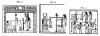
Kemetic · The Book of the Dead · 11 of 13
Translation: Plates I–X
Vignette: The scribe Ani, standing with hands raised in adoration before a table of offerings consisting of haunches of beef, loaves of bread and cake, vases of wine and oil, fruits, lotus, and other flowers. He wears a fringed white and saffron-coloured linen garment; and has a wig, necklace, and bracelets. Behind him stands his wife "Osiris, the lady of the house, the lady of the choir of Amen, Thuthu,"[1] similarly robed and holding a sistrum and a vine (?)-branch in her right hand, and a menat[2] in her left.
[1. See Plate XIX.
2. The menat, which is often called "the counterpoise of a collar," consists of a disk, with a handle attached, and a cord. It was an object which was usually offered to the gods, with the sistrum; it was presented to guests at a feast by their host; and it was held by priestesses at religious festivals. It was either worn on the neck or carried in the left hand; and it was an emblem which brought joy to the bearer. Interesting examples of the pendent menat in the British Museum are No. 17,166, inscribed, "Beautiful god, lord of the two lands, maker of things, King of the North and South, Khnem-ab-Ra, son of the Sun, Aahmes (Amasis), beloved of Hathor, lady of sycamore trees"; and No. 13,950 * in faïence; and Nos. 8172, 8173, and 20,607 in hard stone. No. 18,108 is the disk of a menat in faïence, inscribed, Hathor, lady of the town of Anitha." No. 20,760 is a disk and handle in bronze, the disk having, in hollow work, the figure of a cow, sacred to Hathor, and the handle, the upper part of which is in the form of the head of Hathor, having a sistrum. On the one side is the prenomen of Amenophis III. and on the other is Hathor, lady of the sycamore." The meaning and use of the menat is discussed by Lefébure in Le Menat et le Nom de l'eunuque (Proc. Soc. Bibl. Arch., 1891, pp. 333-349).
* A duplicate is in the Louvre; see Perrot and Chipiez, Histoire de l'Art, l'Égypte, p. 821, No. 550.]
{p. 246}
Text: [Chapter XV.] (1) [1] A HYMN OF PRAISE TO RA WHEN HE RISETH IN THE EASTERN PART OF HEAVEN. Behold Osiris Ani the scribe who recordeth the holy offerings of all the gods, (2) who saith: "Homage to thee, O thou who hast come as Khepera,[2] Khepera, the creator of the gods. Thou risest, thou shinest, (3) making bright thy mother [Nut], crowned king of the gods. [Thy] mother Nut doeth homage unto thee with both her hands. (4) The land of Manu[4] receiveth thee with content, and the goddess Maat[5] embraceth thee at the two seasons. May he give splendour, and power, and triumph, and (5) a coming-forth [i.e., resurrection] as a living soul to see Horus of the two horizons[6] to the
[1. The numbers in parentheses indicate the lines of the papyrus.
2. The god Khepera is usually represented with a beetle for a head; and the scarab, or beetle, was sacred to him. The name means "to become, to turn, to roll," and the abstract noun kheperu may be rendered by "becomings," or "evolutions." The god was self-created, and was the father of all the other gods; men and women sprang from the tears which fell from his eyes; and the animal and vegetable worlds owed their existence to him. Khepera is a phase of Tmu, the night-sun, at the twelfth hour of the night, when he "becomes" the rising sun or Harmachis (i.e., Horus in the horizon). He is also described as " Khepera in the morning, Ra at mid-day, and Tmu in the evening." See Lanzone, Dizionario, p. 927 ff.; Grébaut, Hymne à Ammon-Ra, p. 264, note 2; Pierret, Panthéon, pp. 74, 75; Lefébure, Traduction Comparée des Hymnes au Soleil, p. 39; De Rougé, Inscription d'Ahmés, p. 110; Archaeologia, vol. 52, p. 541 ff.; Wiedemann, Die Religion der Alten Aegypter, p. 17; Brugsch, Religion und Mythologie, p. 245, etc.
3. The goddess Nut represented the sky, and perhaps also the exact place where the sun rose. She was the wife of Seb, the Earth-god, and gave birth to Isis, Osiris, and other gods. One of her commonest titles is "mother of the gods." She is depicted as a woman bearing a vase upon her head, and sometimes wears the disk and horns usually characteristic of Isis and Hathor. She was the daughter and mother of Ra. See Lanzone, Dizionario, p. 392; Pierret, Panthéon, pp. 34, 36; Brugsch, Religion und Mythologie, pp. 603-610.
4. Manu is the name given to the mountains on the western bank of the Nile, opposite Thebes, wherein was situated tu Manu, "the mountain of Manu," the chief site of rock-hewn tombs. See Brugsch, Dict. Géog., p. 259.
5. Maat, "daughter of the Sun, and queen of the gods," is the personification of righteousness and truth and justice. In many papyri she is represented as leading the deceased into the Hall of Double Maat, where his heart is to be weighed against her emblem. She usually wears the feather, emblematic of Truth, and is called the "lady of heaven": see Lanzone, Dizionario, p. 276 (and tav. 109, where the twin-goddesses Maat are shown); Pierret, Panthéon, p. 2011. She is sometimes represented blind-fold: see Wiedemann, Religion der alten Aegypter, p. 78. For figures of the goddess in bronze and stone, see Nos. 380, 383, 386, II, 109, and II, 114 in the British Museum.
6 Heru-khuti, i.e., "Horus of the two horizons," the Harmachis of the Greeks, is the day-sun from his rising in the eastern horizon to his setting in the western horizon; for the various forms in which he is represented, see Lanzone, Dizionario, tav. 129. Strictly speaking, he is the rising sun, and is one of the most important forms of Horus. As god of mid-day and evening he is called Ra-Harmachis and Tmu-Harmachis respectively. The sphinx at Gizeh was dedicated to him.]
{p. 247}
ka[1] of Osiris,[2] the scribe Ani, triumphant[3] before Osiris, (6) who saith: Hail all ye gods of the Temple of the Soul,[4] who weigh heaven and earth in the balance, and who provide food and abundance of meat. Hail Tatunen,[5] One, (7) creator of mankind and of the substance of the gods of the south and of the north, of the west and of the east. Ascribe [ye] praise unto Ra, the lord of heaven, the (8) Prince, Life, Health, and Strength, the Creator of the gods, and adore ye him in his beautiful Presence as he riseth in the atet[6] boat. (9) They who dwell in the heights and they who dwell in the depths worship thee. Thoth[7] and Maat both are thy recorders. Thine enemy[8] is given to the (10) fire, the evil one hath fallen; his arms are bound, and his legs hath Ra taken from him. The children of (11) impotent revolt shall never rise up again.
[1. According to the Egyptian belief man consisted of a body xa, a soul ba, an intelligence xu, and ka, The word ka means "image," the Greek ei?'dolon (compare Coptic kau Peyron, Lexicon, p. 61). The ka seems to have been the "ghost," as we should say, of a man, and it has been defined as his abstract personality, to which, after death, the Egyptians gave a material form. It was a subordinate part of the human being during life, but after death it became active; and to it the offerings brought to the tomb by the relatives of the dead were dedicated. It was believed that it returned to the body and had a share in its re-vivification. See Birch, Mémoire sur une patère Égyptienne (in Trans. Soc. Imp. des Antiquaires de France, 1858; Chabas, Papyrus Magique, pp. 28, 29; Maspero, Étude sur quelques peintures, p. 191 ff.; Trans. Soc. Bibl. Arch., vol. vi., p. 494 ff.; Brugsch, Aegyptologie, p. 181; Wiedemann, Religion der alien Aegypter, p. 126 f.).
2 The deceased is always identified with Osiris, or the sun which has set, the judge and god of the dead. As the sun sets in the west and rises again in the cast, so the dead man is laid in his tomb on the western bank of the Nile, and after being acquitted in the Hall of judgment, proceeds to the east to begin a new existence.
3. maaxeru or maatxeru. On this word, see Naville, Litanie du Soleil, p. 74; Devéria, L'Expression Mââ-xerou (in Recueil de Travaux, tom. i., p. 10 ff.).
4. Compare ### and ### Brugsch, Dict. Géog., pp. 185, 186.
5. Tatunen, or Tenen was, like Seb with whom he was identified, the god of the earth; his name is often joined to that of Ptah, and he is then described as the creator of gods and men, and the maker of the egg of the sun and of the moon. See Lanzone, Dizionario, p. 1259; Wiedemann, Religion, p. 74; Pierret, Panthéon, p. 6; and Naville, La Litanie du Soleil, pp. 118, 119, and plate xxiv., 1. 3. This god was, in one aspect, a destroyer of created things; compare ###, Naville, op. cit., p. 89.
6. A name for the boat of the evening sun.
7. See infra, p. 257, note 2.
8 The enemy of Ra was darkness and night, or any cloud which obscured the light of the sun. The darkness personified was Apep, Nak, etc., and his attendant fiends were the mesu betesh, or 'children of unsuccessful revolt.']
{p. 248}
The House of the Prince[1] keepeth festival, and the sound of those who rejoice is in the (12) mighty dwelling. The gods are glad [when] they see Ra in his rising; his beams flood the world with light. (13) The majesty of the god, who is to be feared, setteth forth and cometh unto the land of Manu; he maketh bright the earth at his birth each day; he cometh unto the place where he was yesterday. (14) O mayest thou be at peace with me; may I behold thy beauties; may I advance upon the earth; may I smite the Ass; may I crush (15) the evil one; may I destroy Apep[2] in his hour[3]; may I see the abtu[4] fish at the time of his creation, and the ant fish in his creation, and the (16) ant[4] boat in its lake. May I see Horus in charge of the rudder, with Thoth
[1. ###, more fully ### "the great house of the old man," i.e., the great temple of Ra at Heliopolis: see Brugsch, Dict. Géog., p. 153.
2 Apep, the serpent, personifying darkness, which Horus. or the rising sun must conquer before he can re-appear in the East.
3 Compare the following scenes which represent Apep in the form of a serpent and crocodile and ass being pierced by the deceased.
4 The abtu and the ant fishes are sometimes depicted on coffins swimming at the bows of the boat of the sun.]
{p. 249}
and Maat beside him; may I grasp the bows of the (17) seket[1]boat, and the stern of the atet boat. May he grant unto the ka of Osiris Ani to behold the disk of the Sun and to see the Moon-god without ceasing, every day; and may my soul (18) come forth and walk hither and thither and whithersoever it pleaseth. May my name be proclaimed when it is found upon the board of the table of (22) offerings; may offerings be made unto me in my (24) presence, even as they are made unto the followers of Horus; may there be prepared for me a seat in the boat of the Sun on the day of the going forth of the (26) god; and may I be received into the presence of Osiris in the land (28) of triumph!
Appendix: The following versions of this chapter are taken from: I. Naville, Todtenbuch, Bd. I., Pl. xiv. II. Naville, Todtenbuch, Bd. I., Pl. xv.; III. British Museum Papyrus No. 9901 and IV. British Museum Papyrus No. 10,471.
I. (1) A HYMN OF PRAISE TO RA WHEN HE RISETH IN THE EASTERN PART OF HEAVEN. Behold Osiris, Qenna the merchant, (2) who saith: "Homage to thee, in thy rising thou Tmu in thy crowns of beauty. Thou risest, thou risest, thou Ra shinest, (3) thou shinest, at dawn of day. Thou art crowned like unto the king of the gods, and the goddess Shuti doeth homage unto thee. (4) The company of the gods praise thee from the double-dwelling. Thou goest forth over the upper air and thy heart is filled with gladness. (5) The sektet boat draweth onward as [Ra] cometh to the haven in the atet boat with fair winds. Ra rejoiceth, Ra rejoiceth. (6) Thy father is Nu, thy mother is Nut, and thou art crowned as Ra-Harmachis. Thy sacred boat advanceth in peace. Thy foe hath been cast down and his (7) head hath been cut off; the heart of the Lady of life rejoiceth in that the enemy of her lord hath been overthrown. The mariners of Ra have content of heart and Annu rejoiceth."
(8) The merchant Qenna saith: "I have come to thee, O Lord of the gods, Tmu-Harmachis, who passest over the earth . . . . . . . (9) I know that by which thou dost live. Grant that I may be like unto one of those who are thy favoured (10) ones [among the followers] of the great god. May my name be proclaimed, may it be found, may it be lastingly renewed with . . . . . . . (11) The oars are lifted into the sektet boat, and the sacred boat cometh in peace. (12) May I see Ra when he appeareth in the sky at dawn, and when his enemies have fallen at the block. (13) May I behold [Horus] guiding the rudder and steering with [his] two hands. (14) May I see the abtu fish at the moment of his creation; and may I see the ant fish when he maketh himself manifest at creation, and the ant boat upon its lake. O thou Only One, O thou Mighty One, thou Growing One, (15) who dost never wax faint, and
[1. A name of the boat of the rising sun.]
{p. 250}
from whom power cannot be taken. . . . . . . . . . . . . . the devoted (17) servant of "the lord of Abtu."
"The merchant Qenna saith: (18) "Homage to thee Heru-Khuti-Tmu, Heru-Khepera, mighty hawk, who dost cause the body [of man] to make merry, beautiful of face by reason of thy two great plumes. Thou (19) wakest up in beauty at the dawn, when the company of the gods and mortals sing songs of joy unto thee; hymns of praise are offered unto thee at eventide. The (20) starry deities also adore thee. O thou firstborn, who dost lie without movement, (21) arise; thy mother showeth loving kindness unto thee every day. Ra liveth and the fiend Nak is dead; thou dost endure for ever, and the (22) fiend hath fallen.
"Thou sailest over the sky with life and strength. The goddess Nehebka is in (23) the atet boat; the sacred boat rejoiceth. Thy heart is glad and thy brow is wreathed with the twin serpents."
II. (I) A HYMN OF PRAISE TO RA WHEN HE RISETH IN THE EASTERN PART OF HEAVEN. Behold Osiris, Qenna the merchant, triumphant, who saith: (2) "Homage to thee, O thou who risest in Nu, and who at thy birth dost make the world bright with light; all the company of the gods (3) sing hymns of praise unto thee. The beings who minister unto Osiris cherish him as King of the North and of the South, the beautiful and beloved man-child. When (4) he riseth, mortals live. The nations rejoice in him, and the Spirits of Annu sing unto him songs of joy. The Spirits of the towns of Pe and Nekhen (5) exalt him, the apes of dawn adore him, and all beasts and cattle praise (6) him with one accord. The goddess Seba overthroweth thine enemies, therefore rejoice (7) within thy boat; and thy mariners are content thereat. Thou hast arrived in the atet boat, and thy heart swelleth with joy. O Lord of the gods, when thou (8) dost create them, they ascribe praises unto thee. The azure goddess Nut doth compass thee on every side, and the god Nu floodeth thee with his rays of light. (9) O cast thou thy light upon me and let me see thy beauties, me, the (10) Osiris Qenna the merchant, triumphant! When thou goest forth over the earth I will sing praises unto thy fair (11) face. Thou risest in the horizon of heaven, and [thy] disk is adored [when] it resteth upon the mountain to give life unto the world."
Saith Qenna the merchant, triumphant: (12) "Thou risest, thou risest, coming forth from the god Nu. Thou dost become young again and art the same as thou wert yesterday, O mighty youth who hast created thyself. Not . . . . . . . my hand. (13) Thou hast come with thy splendours, and thou hast made heaven and earth bright with thy rays of pure emerald light. The land of Punt is (14) established for the perfumes which thou smellest with thy nostrils. (15) Thou risest, O thou marvellous Being, in heaven, the twin serpents are placed upon thy brow, and thou art lord of the world and the inhabitants (16) thereof; [the company] of the gods and Qenna the merchant, triumphant, adore thee."
III. (1, 2) A HYMN OF PRAISE TO RA WHEN HE RISETH IN THE EASTERN PART OF HEAVEN. (3) Behold Osiris Hunefer, triumphant, who saith: "Homage to thee, O thou who art Ra when thou (4) risest and Tmu when thou settest. Thou risest, thou risest; thou shinest, (5) thou shinest, thou who art crowned king of the {p. 251} gods. Thou art the lord of heaven, [thou art] the lord of earth, [thou art] the creator of those who dwell in the heights (6) and of those who dwell in the depths. [Thou art] the One god who came into (7) being in the beginning of time. Thou didst create the earth, (8) thou didst fashion man, thou didst make the watery abyss of the sky, thou didst form Hapi [the Nile], and thou art the maker of streams and of the (9) great deep, and thou givest life to all that is therein. Thou hast knit (10) together the mountains, thou has made mankind and the beasts of the field, thou hast created the heavens and the earth. Worshipped be thou whom the goddess Maat embraceth at morn and at eve. Thou dost travel across the (11) sky with heart swelling with joy; the Lake of Testes is at peace. The fiend Nak hath fallen and his two arms are cut off. The sektet boat receiveth fair winds, and the heart of him that is in his shrine rejoiceth. Thou (12) art crowned with a heavenly form, the Only one, provided [with all things]. Ra cometh forth from Nu in triumph. O thou mighty youth, thou everlasting son, self-begotten, who didst give thyself birth, (13) O thou mighty One, of myriad forms and aspects, king of the world, Prince of Annu, lord of eternity and ruler of the everlasting, the company of the gods rejoice when thou risest and when thou sailest (14) across the sky, O thou who art exalted in the sektet boat. Homage to thee, O Amen-Ra, thou who dost rest upon Maat, thou who passest over the heaven, and every face seeth thee. Thou dost wax great as thy (15) Majesty doth advance, and thy rays are upon all faces. Thou art unknown and canst not be searched out . . . . . . . . his fellow except thyself; thou art (16) the Only One . . . . . . [Men] praise thee in thy name [Ra], and they swear by thee, for thou art lord over them. Thou hast heard (17) with thine ears and thou hast seen with thine eyes. Millions of years have gone over the world; I cannot tell the number of them, through which thou hast passed. Thy heart hath decreed a day of happiness in thy name [of Ra]. Thou dost pass over (18) and travellest through untold spaces of millions and hundreds of thousands of years; thou settest out in peace, and thou steerest thy way across the watery abyss to the place which thou lovest; this thou doest in one (19) little moment of time, and thou dost sink down and makest an end of the hours."
Osiris, the governor of the palace of the lord of the two lands (i.e., Seti I.), Hunefer, triumphant, saith: (20) Hail my lord, thou that passest through eternity and whose being is everlasting. Hail thou Disk, lord of beams of light, thou risest and thou makest all mankind to live. Grant thou that I may behold thee at dawn each day."
IV. A HYMN OF PRAISE TO RA by Nekht, the royal scribe, captain of soldiers, who saith: "Homage to thee, O thou glorious Being, thou who art provided [with all things]. O Tmu-Heru-khuti, when thou risest in the horizon of heaven, a cry of joy cometh out of the mouth of all peoples. O thou beautiful Being, thou dost renew thyself in thy season in the form of the Disk within thy mother Hathor; therefore in every place every heart swelleth with joy at thy rising, for ever. The eastern and the western parts of heaven come to thee with homage, and give forth sounds of joy at thy rising. O Ra, thou who art Heru-khuti (Harmachis), the mighty man-child, the heir of eternity, self-begotten and self-born, king of earth, prince of the netherworld, governor of the mountains of Aukert (i.e., the netherworld), thou dost rise in the horizon of heaven and sheddest upon the world beams of emerald light; thou art born from the {p. 252} water, thou art sprung from Nu, who fostereth thee and ordereth thy members. O thou who art crowned king of the gods, god of life, lord of love, all the nations live when thou dost shine. The goddess Nut doeth homage unto thee, and the goddess Maat embraceth thee at all times. They who are in thy following sing unto thee with joy and bow down to the earth when they meet thee, the god of heaven, the lord of earth, the king of right and truth, the god of eternity, the everlasting ruler, the prince of all the gods, the god of life, the creator of eternity, the maker of heaven by whom is established all that therein is. The company of the gods rejoice at thy rising, the earth is glad when it beholdeth thy rays; the peoples that have been long dead come forth with cries of joy to see thy beauties. Thou goest forth over heaven and earth, made strong each day by thy mother Nut. Thou passest through the uppermost heaven, thy heart swelleth with joy; and the Lake of Testes is content thereat. The Enemy hath fallen, his arms are hewn off, the knife hath cut asunder his joints. Ra liveth in Maa[1] the beautiful. The sektet boat draweth on and cometh into port; the south, the north, the west and the east turn to praise thee, O thou unformed substance of the earth, who didst create thyself. Isis and Nephthys salute thee, they sing unto thee in thy boat hymns of joy, they shield thee with their hands. The souls of the East follow thee, the souls of the West praise thee. Thou art the ruler of all gods and thou hast joy of heart within thy shrine; for the Serpent Nak is condemned to the fire, and thy heart shall be joyful for ever. Thy mother Nut is adjudged to thy father Nu."
PLATE II.
Vignette I.: The disk of the Sun, supported by a pair of arms proceeding from the ankh, the sign of life, which in turn is supported by a tet the emblem of the East and of the god Osiris. The tet stands upon the horizon. On each side of the disk are three dog-headed apes, spirits of the Dawn, their arms raised in adoration of the disk. On the right hand side of the tet is the goddess Nephthys and on the left is Isis each goddess raising her hands in adoration of the tet, and kneeling upon the emblem aat, or hemisphere. Above is the sky. This vignette belongs properly to the hymn to the rising sun.[2]
[1. Maa, unvarying and unalterable Law. Compare the vignette from British Museum papyrus No. 9901. (Fig. 1.)
In some papyri the apes are four (Naville, Das Aeg. Todtenbuch, Bd. I., B1. 26), or seven (Naville, op. cit., Bd. I., Bl. 21) in number.
In the vignette which usually accompanies the hymn to the setting sun (Fig. 2), but which does not occur in the present papyrus, a hawk wearing on his head a disk encircled by a serpent, i.e., Ra-Harmachis, {footnote p. 253} takes the place of the disk and (e.g., British Museum papyri Nos. 9901 (Naville, op. cit., Bd. I., Bl. 22,), and 10,472); and the tet is represented by the stand ### (Naville, op. cit., Bd. 1., Bl. 22), on one side of which are three hawk-headed deities, and on the other three jackal-headed deities (see Lanzone, Dizionario, 10, pp. 56, 57.). Beneath are Isis and Nephthys kneeling in adoration before two lion-gods, which represent yesterday and to-morrow. An interesting variant of the latter vignette occurs in British Museum papyrus No. 10,472, which was made for the lady Anhai, a singer in the temple of Amen at Thebes, about B.C. 1000, where, in addition to the apes and figures of the goddesses (the titles of Isis being ### and those of Nephthys ###, there are represented, on each side (I) the winged utchat with pendent uræus and shen ### (emblematic of the sun's circuit) and feather (2) a man, prostrate, adoring the disk; (3) four men, upright, with both hands raised in adoration; and (4) a human-headed bird ###, emblematic of the soul of the deceased lady, standing upon a pylon.]
{p. 253}
Text: (1) [HYMN TO OSIRIS.] "Glory be to Osiris Un-nefer, the great god within Abydos, king of eternity, lord of the everlasting, who passeth through millions of years in his existence. Eldest son of the womb (2) of Nut, engendered by Seb the Erpat,[1] lord of the crowns of the North and South, lord of the lofty white crown. As Prince of gods and of men (3) he hath received the crook and the flail and the dignity of his divine fathers.[2] Let thy heart which is
[1. The word ### er-pat is composed of er "chief" and pat a clan, "tribe," or "family"; Seb, then, was the prince of the family of the gods. Erpat is a very ancient word, and was probably in use in Egypt before suten, the common word for "king." For a discussion on this point see Maspero, Un Manuel de Hiérarchie Égyptienne, p. 15 ff.; Brugsch, Aegyptologie, p. 210.
2 Osiris, the night sun, was the son of Ra, and the father and son of Horus. He is always represented as a mummy holding in his hands the sceptre ### crook ### and flail ###. See Lanzone, Dizionario, p. 690 ff.; Wiedemann, Religion, p. 123 ff.; Brugsch, Religion und Mythologie, p. 611 ff.]
{p. 254}
in the mountain of Amenta be content, for thy son Horus is stablished upon thy throne. (4) Thou art crowned lord of Tattu[1] and ruler in Abtu.[2] Through thee the world waxeth green (5) in triumph before the might of Neb-er-tcher.[3] He leadeth in his train that which is and that which is not yet, in his name (6) Ta-her-seta-nef;[4] he toweth along the earth in triumph in his name Seker.[6] He is (7) exceeding mighty and most terrible in his name Osiris. He endureth for ever and for ever in his name Un-nefer.[6] (8) Homage to thee, King of kings, Lord of lords, Prince of princes, who from the womb of Nut hast possessed the world (9) and hast ruled all lands and Akert.[7] Thy body is of gold, thy head is of azure, and emerald light encircleth thee. O An[8] of millions of years, (10) all-pervading with thy body and
[1. The name Tettet or Tattu was borne by two towns in Lower Egypt: Busiris, the metropolis of the 9th nome, and Mendes, the metropolis of the 16th nome. See Brugsch, Dict. Géog., p. 978, and De Rougé, Géographie Ancienne de la Basse Égypte, p. 58.
2. Both Busiris and Abydos claimed to be the resting place of the body of Osiris.
3. A name of Osiris when his scattered limbs had been brought together and built up again into a body by Isis and Nephthys: see Lanzone, Dizionario, p. 714. The name means "lord of entirety."
4. I.e., The one who draws the world.
5. Seker is, like Ptah, Osiris, and Tenen, a form of the night sun. At the festival of this god, the Hennu boat, a symbol of the god Seker of Memphis, was drawn round the sanctuary at dawn at the moment when the sun casts its golden rays upon the earth. For a list of Seker's shrines, see Lanzone, Dizionario, pp. 1117-1119. See also Wiedemann, Religion, p. 75; Pierret, Panthéon, p. 66.
6. A name of Osiris which, as an important name, is written at times in a cartouche, e.g., ###, ###. It is usually explained to mean "the Good Being," although it has been suggested ### (Proc. Soc. Bibl. Arch., 1886) that "beautiful hare" is its signification.
7. A general term for a necropolis. Akert is the country of which Osiris was the prince; and it is mentioned as connected with Stat and Neter-khert, each of which is a name of the great necropolis on the western bank of the Nile. See Brugsch, Dict. Géog., p. 75; Lepsius, Todtenbuch, chap. 165, 1. 6; Naville, La Litanie du Soleil, p. 98.
8. An or Ani, a name or form of Ra, the Sun-god (compare "Ani at the head of the cycle of the gods," Grébaut, Hymne, p. 22), and also of Osiris. Ani is also identified with the Moon-god; compare {footnote p. 255} [*] "Hail, Ani, thou shinest upon us from heaven every day. May we never cease to behold thy rays! Thoth protecteth thee and maketh thy soul to stand up in the maat boat in thy name of Moon." For the identification of Ani with Horus, see Naville, La Litanie du Soleil, p. 99, note 10. The god Ani is also addressed as "Eye of Horus " by the deceased in the 39th chapter of the Book of the Dead, which refers to the "uniting of a soul to its body in the underworld."
* For the hieratic text, see De Horrack, Lamentations d'Isis et de Nephthys, p. 4, II. 1-3.]
{p. 255}
beautiful in countenance in Ta-sert.[1] Grant thou to the ka of Osiris, the scribe Ani, splendour in heaven and might upon earth and triumph in Neter-khert;[1] and that I may sail down to (11) Tattu like a living soul and up to (13) Abtu like a bennu (phnix); and that I may go in and come out without repulse at (15) the pylons of the Tuat.[1] May there be given unto (16) me loaves of bread in the house of coolness, and (17) offerings of food in Annu, (18) and a homestead for ever in Sekhet-Aru[2] with wheat and barley (20) therefor."
PLATE III.
Vignette: Scene of the weighing of the Heart of the Dead. Ani and his wife enter the Hall of Double Law or Truth, wherein the heart, emblematical of the conscience, is to be weighed in the balance against the feather, emblematical of law. Above, twelve gods, each holding a sceptre are seated upon thrones before a table of offerings of fruit, flowers, etc. Their names are: Harmachis, "the great god within his boat"; Tmu; Shu; Tefnut, "lady of heaven"; Seb; Nut, "lady of Heaven" Isis; Nephthys; Horus, "the great god"; Hathor, "lady of Amenta"; and Sa. Upon the beam of the scales sits the dog-headed ape which was associated
[1. A name of the underworld.
2. Or Sexet-Anru, a division of the Sexet-hetepu (see Plate XXXV.), the Elysian fields wherein the souls of the blessed were supposed to reap and sow.
3. In British Museum papyrus No. 9901 the goddess Maat is seated on the centre of the beam of the balance. The double Maat goddesses are at times represented standing beside the balance to watch the result of the weighing, and at the same time Maat is also placed in the scale to be weighed against the heart of the deceased (Fig. x) (see Naville, Todtenbuch, Bd. I., Bl. 136, Pa.). {footnote page 256} In the papyrus of Qenna the head of Anubis is on the beam, and the ape, wearing disk and crescent, is seated upon a pylon-shaped pedestal beside the balance (Fig. 2). Another vignette shows Horus holding Maat in his band, weighing the heart in the presence of the Maat goddesses, and Anubis, holding the deceased by the hand, presents the heart to Osiris while Isis and Nephthys in the form of apes sit near (Fig. 3).
]
{p. 256}
with Thoth,[1] the scribe of the gods. The god Anubis, jackal-headed, tests the tongue of the balance, the suspending bracket of which is in the form of the feather The inscription above the head of Anubis reads:--"He who is in the tomb saith, pray thee, O weigher of righteousness, to guide (?) the balance that it may be stablished.'" On the left of the balance, facing Anubis, stands Ani's "Luck" or "Destiny," Shai and above is the object called mesxen which has been described[2] as "a cubit with human head," and which is supposed to be connected with the place of birth. Behind these stand the goddesses Meskhenet and Renenet: Meskhenet[3]
[1. In the papyrus of Sutimes (Naville, Todtenbuch, Bd. I., Bl. 43) the ape is called neb xemennu ut a maa, "Lord of Khemennu, just weigher"; and in British Museum papyrus No. 9900, "Thoth, lord of the scales."
2. Birch, in Bunsen's Egypt's Place, vol. v., p. 259. In the papyrus of Anhai (British Museum, No. 10,472) there is a meskhen on each side of the upright of the balance: one is called Shai and the other Renen.
3. Four goddesses bore the name of Meskhen, and they were supposed to assist the resurrection of Osiris; they were associated with Tefnut, Nut, Isis, and Nephthys (see Lepsius, Denkmäler, iv., Bl. 59a; and Mariette, Dendérah, iv., pl. 74 a). Each wore upon her head the object ###, which is said by some to represent the blossoms of palm trees (Lanzone, Dizionario, p. 329). Examples of this as an amulet, in hard stone, in the British Museum, are Nos. 8158, 8159, 8161, 20,618, and, in porcelain, No. 15,963.]
{p. 257}
presiding over the birth-chamber, and Renenet[1] probably superintending the rearing of children. Behind the meskhen is the soul of Ani in the form of a human-headed bird standing on a pylon. On the right of the balance, behind Anubis, stands Thoth,[2] the scribe of the gods, with his reed-pen and palette[3] containing black and red ink, with which to record the result of the trial. Behind Thoth stands the female monster Amam[4], the "Devourer," or Am-mit, the eater of the Dead."
[1. The name of this goddess is probably connected with the word renen, "to suckle." M. Pierret identifies her with the goddess of that name who presided over harvests, and is described as the "lady of the offerings of all the gods" (Panthéon, p. 61), having a snake's head, which in some instances is surmounted by the disk, horns and feathers of the goddess Hathor (see Lanzone, Dizionario, tav. 188, No. 2).
2 Thoth was the personification of intelligence. He was self-created and self-existent, and was the "heart of Ra." He invented writing, letters, the arts and sciences, and he was skilled in astronomy and mathematics. Among his many titles are "lord of Law," "maker of Law," and "begetter of Law." He justified Osiris against his enemies, and he wrote the story of the fight between Horus, the son of Osiris, and Set. As "lord of Law" he presides over the trial of the heart of the dead, and, as being the justifier of the god Osiris against his enemies, he is represented in funereal scenes as the justifier also of the dead before Osiris (see Lanzone, Dizionario, p. 1264 ff., and tav. cccciv., No. i; Pierret, Panthéon, pp. 10-14; and Brugsch, Religion und Mythologie, p. 439 ff.). Brugsch connects the name Tehuti (Thoth) with the old Egyptian word tehu, "ibis," and he believes that it means the "being who is like an ibis." The word tex also means "to measure," "to compute," "to weigh"; and as this god is called "the counter of the heavens and the stars, and of all that therein is," the connexion of the name Thoth with tex is evident. Bronze and faïence figures of the god represent him with the head of an ibis, and holding an utchat in his hands (see Nos. 481, 490a, and 11,385 in the British Museum). The utchat, or eye of the sun, has reference to the belief that Thoth brought back each morning the light of the sun which had been removed during the night.
3. The palettes of the Egyptian scribe were rectangular, and were made of wood, stone, basalt, ivory (see Nos. 5512a, 5513, 5525a, and 12,779, etc., in the British Museum). They measure from 10 to 17 inches in length, and from 2 to 3 inches in width. They usually contain two round cavities to hold red and black ink, and a groove to hold the reed-pens. The inscriptions on them, which usually have reference to Thoth, are cut, or written in ink, or inlaid in colour; the name of the owner of the palette is generally added. The colours with which the Egyptians wrote were made of vegetable substances, coloured earths, and preparations of copper.
4 She is also called "Devourer of Amenta" (i.e., the underworld), and Shai (see Lanzone, Dizionario, p. 129). In the British Museum papyrus No. 9901 she is described as hat en emsuh; pehu-s em tebt her-ab-set em ma "the fore-part of a crocodile; her hind-quarters are those of a hippopotamus; her middle part [is that] of a lion."
{footnote p. 258} The Devourer usually stands near the balance instead of behind Thoth; but there is one papyrus quoted by Naville, (Todtenbuch, Bd. I., Bl. 136) in which she is shown crouching beside the lake of fire in the infernal regions.
]
{p. 258}
Text: [Chapter XXXB.] Osiris, the scribe Ani, saith:[1] "My heart my mother, my heart my mother, my heart my coming into being! May there be nothing to resist me at [my] judgment; may there be no opposition to me from the Tchatcha;[2] may there be no parting of thee from me in the presence of him who keepeth the scales! Thou art my ka within my body [which] knitteth[3] and strengtheneth my limbs. Mayest thou come forth to the place of happiness to which[4] I am advancing. "May the Shenit[5] not cause my name to stink, and may no lies be spoken against me in the presence of the god![6] Good is it for thee to hear."[7] . . . . . . .
Thoth, the righteous judge of the great company of the gods who are in the presence of the god Osiris, saith: "Hear ye this judgment. The heart of Osiris hath in very truth been weighed, and his soul hath stood as a witness for him; it hath been found true by trial in the Great Balance. There hath not been found any wickedness in him; he hath not wasted the offerings in the temples; he hath not done harm by his deeds; and he uttered no evil reports while he was upon earth."
The great company of the gods reply to Thoth dwelling in Khemennu: "That which cometh forth from thy mouth hath been ordained. Osiris, the scribe
[1. Ani's speech forms the text of Chapter XXXB. as numbered by M. Naville (Todtenbuch, Bd. I., Bl. 43).
2. The four gods of the cardinal points, Mestha, Hapi, Tuamautef, and Qebhsennuf (see Naville, Todtenbuch Einleitung, p. 164).
Some copies read, "Thou art my ka within my body, the god Khnemu (i.e., "Moulder"), who uniteth (or formeth) and strengtheneth my limbs." Khnemu was called "builder of men, maker of the gods, the father from the beginning; creator of things which are," etc.
4 British Museum papyrus No. 9901 has "place of happiness to which thou goest with me."
5 A class of divine beings.
6 I.e., "the great god, lord of Amenta."
7. This sentence appears to be unfinished; see the Egyptian text, p. 12.]
{p. 259}
Ani, triumphant, is holy and righteous. He hath not sinned, neither hath he done evil against us. Let it not be given to the devourer Amemet to prevail over him. Meat-offerings and entrance into the presence of the god Osiris shall be granted unto him, together with a homestead for ever in Sekhet-hetepu, as unto the followers of Horus."
PLATE IV.
Vignette: Ani, found just, is led into the presence of Osiris. On the left the hawk-headed god Horus, the son of Isis, wearing the double crown of the North and the South, takes Ani by the hand and leads him forward towards "Osiris, the lord of eternity" Ausar neb t'etta, who is enthroned on the right within a shrine in the form of a funereal chest. The god wears the atef crown with plumes; a menat (see p. 245, note 2) hangs from the back of his neck; and he holds in his hands the crook, sceptre, and flail, emblems of sovereignty and dominion. He is wrapped in bandages ornamented with scale work. The side of his throne is painted to resemble the doors of the tomb. Behind him stand Nephthys on his right hand and Isis on his left. Facing him, and standing on a lotus flower, are the four "children of Horus (or Osiris)," or gods of the cardinal points. The first, Mestha, has the head of a man; the second, Hapi, the head of an ape; the third, Tuamautef, the head of a jackal; and the fourth, Qebhsennuf, the head of a hawk. Suspended near the lotus is an object which is usually called a panther's skin,[1] but is more probably a bullock's hide.
The roof of the shrine is supported on pillars with lotus capitals, and is surmounted by a figure of Horus-Sept or Horus-Seker and rows of uræi.
In the centre Ani kneels before the god upon a reed mat, raising his right hand in adoration, and holding in his left hand the kherp sceptre. He wears a whitened wig surmounted by a "cone," the signification of which is unknown. Round his neck is a deep collar of precious stones. Near him stands a table of offerings of meat, fruit, flowers, etc., and in the compartments above are a number of vessels for wine, beer, oil, wax, etc., together with bread, cakes, ducks, a wreath, and single flowers.
[1. On the bullock's hide, in which the deceased, or the person who represented him, was supposed to wrap himself, see Virey, Tombeau de Rekhmara, p. 50, and plate 26, lower register.]
{p. 260}
Appendix: The shrine is in some instances represented in the shape of a pylon, the cornice of which is ornamented either with uræi, or with the disk of the sun and feathers, emblematic of Maat. It usually rests upon a base made in the shape of a cubit, The throne upon which Osiris sits is placed upon reed mats (British Museum papyrus No. 10,471), or upon the cubit-shaped base, or in a pool of water, from which springs a lotus flower with buds and having the four gods of the cardinal points (see British Museum papyrus No. 9901) standing upon it. In some of the
oldest papyri the body of Osiris is painted white, and he stands upright. Isis is described as "great lady, divine mother," and Nephthys as "the mistress of the underworld." In British Museum papyrus No. 10471 the scene of the presentation of the deceased to Osiris is unusual and of interest. On the right the scribe Nekht and his wife Thuau stand with both hands raised in adoration of Osiris. Behind them, upon a cubit-shaped base, is a house with four windows in its upper half, and upon the roof two triangular projections similar to those which admit air into modern houses in the East. Before the door are a sycamore (?) tree and a palm tree, with clusters of fruit; on the left is the god Osiris on his throne, and behind him stands "Maat, mistress of the two countries, daughter of Ra," above whom are two outstretched female arms proceeding from a mountain and holding a disk between the hands. In the centre, between Osiris and the deceased, is a pool of water with three sycamore (?) trees on each side, and at each corner a palm tree bearing clusters of dates; and from it there springs a vine laden with bunches of grapes.
In British Museum papyrus No. 10,472 the god seated in the shrine wears the crown of the god Tanen, and is called "Ptah-Seker-Ausar, within the hidden place, great god, lord of Ta-sert, king of eternity, prince of the everlasting."
Text: Saith Horus, the son of Isis: "I have come unto thee, O Unnefer, and I have brought the Osiris Ani unto thee. His heart is [found] righteous coming forth from the balance, and it hath not sinned against god or goddess. Thoth hath weighed it according to the decree uttered unto him by the company {p. 261} of the gods; and it is very true and righteous. Grant him cakes and ale; and let him enter into the presence of Osiris; and may he be like unto the followers of Horus for ever."
Behold, Osiris Ani saith: "O Lord of Amentet (the underworld), I am in thy presence. There is no sin in me, I have not lied wittingly, nor have I done aught with a false heart. Grant that I may be like unto those favoured ones who are round about thee, and that I may be an Osiris, greatly favoured of the beautiful god and beloved of the lord of the world, [I] the royal scribe indeed, who loveth him Ani, triumphant before the god Osiris."
Appendix: The usual title of this chapter [XXXB.] is, "Chapter of not allowing the heart of [the deceased] to be driven away from him in the underworld."[1] it is an address by the deceased to his own heart, which he calls his ka or "double" within his body. It should be accompanied by a vignette of the trial of the heart in which the heart is weighed against the dead man himself, as in the ancient Nebseni papyrus.
In the Ani papyrus, however, it will be observed that the heart is being weighed against the feather of the Law, Maat, a scene which often accompanies Chapter CXXV.
Interesting variants of the vignettes of Chapter XXXB. are given by Naville (Todtenbuch, Bd. I., Bl. 43), where we find the deceased addressing either his heart placed on a stand, or a beetle, or a heart to which are attached the antennæ of a beetle. In certain papyri this chapter is followed by a rubric:--"[This chapter is] to be said over a scarab[2] of green stone encircled with smu metal, and [having] a ring of silver, which is to be placed upon the neck of the dead. This chapter was found in Khemennu.[3]
[1. ###
2. Chapter XXXA. is never found inscribed upon scarabs.
3. I.e., Hermopolis Magna, the metropolis of Un, the 15th nome of Upper Egypt, the city
called ### by the Copts, and Eshmûnên, ### by the Arabs. It was the abode of the "eight" (xemennu) great primeval gods, and of Thoth, the scribe of the gods. (See Meyer and Dümichen, Geschichte des alten Agyptens, p. 185.)]
{p. 262}
written upon a slab of steel of the South, in the writing of the god himself, under the feet of the majesty of the god, in the time of the majesty of Men-kau-Ra,[1] the king of the North and of the South, triumphant, by the royal son Heru-tata-f[2] who found it while he was journeying to inspect the temples."[3]
The scarabs which are found in the mummies, or lying upon the breast just above the position of the heart, form an interesting section of every large Egyptian collection. In the British Museum series every important type of the funereal scarab is represented. They are made of green basalt, green granite (Nos. 7894 and 15,497), white limestone (Nos. 7917, 7927, 15,508), light green marble (No. 7905), black stone (Nos. 7907, 7909, 7913), blue paste (Nos. 7904, 14,549), blue glass (No. 22,872), and purple, blue, or green glazed faïence (Nos. 7868, 7869). They vary in size from 5 inches to 2 inches in length. On the hard stone examples the text of the Chapter of the Heart, more or less complete, is usually cut on the base in outline; but it is sometimes traced in red ink (No. 7915), or in gold (No. 15,518). Incuse hieroglyphics are sometimes filled with gold (No. 7881). The name of the person with whom the scarab was buried usually precedes the text of the Chapter of the Heart; but in many instances blank spaces are found left without insertion of the name--a proof that i, these amulets were bought ready-made. The base however is often quite plan (Nos. 7965, 7966), or figures of Osiris, Isis, and Nephthys occupy the place of the usual inscription (Nos. 15,500, 15,507). The backs of scarabs are generally quite plain, but we find examples inscribed with figures of the boat of the Sun Osiris, with flail and crook the bennu bird, and the u'tat (No. 7883), Ra and Osiris (No. 15,507), and the bennu bird with the inscription neteri ab en Ra, "the mighty heart of Ra" (No. 7878). A finehard, green stone scarab of the Greek or Roman period has upon the back the figures of four Greek deities (No. 7966). In rare instances, the beetles have a human face (Nos. 7876, 15,516) or head (No. 7999). Carefully made scarabs have usually a band of gold across and down the back where the wings join: an example of the late period (No. 7977) has the whole of the back gilded. The scarab was set in a gold oval ring, at one end of which was a smaller ring for suspension from the neck or for attachment to the bandages of the mummy (No. 15,504). The green glazed faïence scarab of Thothmes III. (No. 18,190) was suspended by a gold chain from a bronze torque. A thick gold wire to fit the neck is attached to No. 24,401. The base of the scarab is sometimes in the form of a heart (Nos. 7917, 7925). A remarkable example of this variety is No. 7925, in which are
[1. The fifth king of the IVth dynasty.
2. This prince is said to have been a very learned man, whose speech was difficult to be understood (see Wiedemann, Aeg. Geschichte., p. 191).
3. For the hieroglyphic text, see pp. 13-15. This rubric was published by Birch, Aeg. Zeitschrift, p. 54; and by Rosellini, Breve Notizia interno un frammento di Papiro funebre Egizio essistente nel ducale museo di Parma; Parma, 1839, 8vo.]
{p. 263}
the emblems of "life," "stability," and "protection," engraved on the upper part of the base. Across the back of this scarab is -- ###;[1] On the right wing:-- ### and on the left ###[2]. A highly polished, fine green basalt scarab with human face (No. 7876) is set in a gold base, upon the face and edges of which are cut part of the Chapter of the Heart. At a period subsequent to the XXIInd dynasty inscribed funereal scarabs in marble, paste, etc., were set in pylon-shaped pectorals made of Egyptian porcelain, glazed blue, green, or yellow, which were sewed to the mummy bandages over the heart. On such pectorals the boat of the Sun is either traced in colours or worked in relief, and the scarab is placed so as to appear to be carried in the boat; on the left stands Isis, and on the right Nephthys (Nos. 7857, 7864, 7866).
PLATES V. AND VI.
Vignettes: The funereal procession to the tomb; running the length of the two plates. In the centre of Plate V. the mummy of the dead man is seen lying in a chest or shrine mounted on a boat with runners, which is drawn by oxen. In the boat, at the head and foot of the mummy, are two small models of Nephthys and Isis. By the side kneels Ani's wife Thuthu, lamenting. In front of the boat is the Sem priest burning incense in a censer,[3] and pouring out a libation from a vase; he wears his characteristic dress, a panther's skin. Eight mourners follow. one of whom has his hair whitened. In the rear a sepulchral ark or chest[4] surmounted. by a figure of Anubis and ornamented with emblems of "protection" and "stability," is drawn on a sledge by four attendants, and is followed by two others. By their side walk other attendants carrying Ani's palette, boxes, chair, couch, staff, etc.
In Plate VI. the procession is continued up to the tomb. In the centre is a
[1. "Thou goest forth over heaven in three-fold peace [in] thy sektet boat; when thou showest thy face . . . . . . . thee."
2. "He giveth to thee thine eyes to see therewith, and thine cars [to hear therewith]."
3. For a bronze censer similar in shape, see No. 5296 a, Fourth Egyptian Room.
4. It is similar in shape to the chests which held the four jars containing the mummied intestines of the deceased. For examples of them see Nos. 8543a, 8543b in the Third Egyptian Room.]
{p. 264}
group of wailing women, followed by attendants carrying on yokes boxes of flowers, vases of unguents, etc. In the right centre are a cow with her calf, chairs of painted wood with flowers upon them, and an attendant with shaven head, carrying a haunch, newly cut, for the funereal feast. The group on the right is performing the last rites. Before the door of the tomb stands the mummy of Ani to receive the final honours; behind him, embracing him, stands Anubis, the god of the tomb; and at his feet, in front, kneels Thuthu to take a last farewell of her husband's body. Before a table of offerings stand two priests: the Sem priest, who wears a panther's skin, holding in his right hand a libation vase, and in his left a censer; and a priest holding in his right hand an instrument[1] with which he is about to touch the mouth and eyes of the mummy, and in his left the instrument for "opening the mouth."[2] Behind or beside them on the ground, in a row, lie the instruments employed in the ceremony of "opening the mouth,"[2] etc., the mesxet instrument, the sepulchral box, the boxes of purification, the bandlet, the libation vases, the ostrich feather and the instruments called Seb-ur, Temanu or Tun-tet, and the Pesh-en-kef. The Kher-heb priest stands behind reading the service of the dead from a papyrus.
Appendix: In the papyrus of Hunefer a slab or stele with rounded top is placed by the door of the tomb (Fig. 1, p. 265). In the upper part of it the deceased is shown adoring Osiris, and below is the legend,[3] "Hail, Osiris, the chief of Amenta, the lord of eternity,
[1. This instrument is called ### ur hekau, and is made of a sinuous piece of wood, one end of which is in the form of a ram's head surmounted by a uræus (Fig. 1).
2. In the Neb-seni papyrus the "Guardian of the Scale" opens the mouth of the deceased (Fig. 2).
3. ###.]
{p. 265}
spreading out in everlastingness, lord of adorations, chief of the company of his gods; and hail, Anubis [dweller] in the tomb, great god, chief of the holy dwelling. May they grant that I may go into and come out from the underworld, that I may follow Osiris in all his festivals at the beginning of the year, that I may receive cakes, and that I may go forth into the presence of [Osiris]; I, the double (ka) of Osiris, the greatly favoured of his god, Hu-nefer." In the upper register of this section of the papyrus is the text of the "Chapter of opening the mouth of the statue of Osiris." The complete scene, including this stele and vignette, appears in the tomb of Pe-ta-Amen-Apt. In the vignette of the first chapter of the Book of the Dead in the papyrus of Neb-qet[1] the soul of the deceased is represented descending the steps of the tomb to carry food to its mummy in the underground chamber (Fig. 2).
The ceremonies[2] which took place at the door of the tomb in an Egyptian funeral are of considerable interest. The priest called Kher-heb, holding the Sem priest by the arm, gives directions for the slaughter of "a bull of the South." The slaughterer, standing on the bull, cuts off a fore-leg (Fig. 3) and takes out the heart. A woman, called the Tcherauur, who personifies Isis, then whispers in the deceased's ear, "Behold, thy lips are set in order for thee, so that thy mouth may be opened." Next, an antelope[3] and a duck[4]
[1. Devéria and Pierret, Papyrus Funéraire de Neb-set, plate 3.
2. The following description of them is based upon the chapters on this subject in Dümichen, Der Grabpalast des Patuamenap, Abth. ii I, plates x ff., pp. 3 ff.
3. ### ari.
4. ### smennu.]
{p. 266}
are brought by order of the Kher-heb, and their heads are cut off.[1] The Kher-heb then addresses the Sem priest: "I have seized them for thee, I have brought unto thee thine enemies. His hands bring his head [as] his gift. I have slain them for thee, O Tmu; let not his enemies rise up against this god." The slaughterer then presents the thigh to the Kher-heb, and the heart to an official whose title was Smer, and all three then "place the thigh and the heart upon the ground before this god" (i.e., Osiris). The Kher-heb then says to the deceased, represented by his mummy or statue: I have brought unto thee the thigh (Fig. 4) as the Eye of Horus. I have brought unto thee the heart; let there be no rising up against this god. I have
brought unto thee the antelope, his head is cut off; I have brought unto thee the duck, his head is cut off." Here the sacrifice ends.
The next part of the ceremony, i.e., "the opening of the mouth and eyes," is performed by the Sem priest, who addresses the deceased: "I have come to embrace thee, I am thy son Horus, I have pressed thy mouth; I am thy son, I love thee. His mother beats her breast and weeps for him, and those who are in chains with him (i.e., Isis and Nephthys) beat their breasts. Thy mouth was closed, but I have set in order for
[1. The slaughter of the antelope and duck typified the destruction of the enemies of the deceased; for, when Horus destroyed the enemies of his father Osiris, "he cut off their heads [which took] the form of ducks in the sky, making them to fall headlong to the ground in the form of antelopes, and into the water in the form of fishes," For the text, see Schiaparelli,. Il Libro dei Funerali degli Antichi Egiziani (in Atti della R. Accademia dei Lincei; Rome, 1883 and 1890), p. 94; Naville, Todtenbuch, chap. 134.]
{p. 267}
"thee thy mouth[1] and thy teeth." The Kher-heb next calls on the Sem priest four times: "O Sem, take the Seb-ur[2] (Fig. 5) and open the mouth and the eyes"; and while the Sem priest is performing the ceremony the Kher-heb continues: "Thy mouth was closed, but I have set in order for thee thy mouth and thy teeth. I open for thee thy mouth, I open for thee thy two eyes. I have opened for thee thy mouth with the instrument of Anubis. I have opened thy mouth with the instrument of Anubis, with the iron tool with which the mouths of the gods were opened. Horus, open the mouth, Horus, open the mouth. Horus hath opened the mouth of the dead, as he whilom opened the mouth of Osiris, with the iron which came forth from Set, with the iron tool (Fig. 6) with which he opened the mouths of the gods. He hath opened thy mouth with it. The dead shall walk and shall speak, and his body shall [be] with the great company of the gods in the Great House of the Aged one in Annu, and he shall receive there the ureret crown from Horus, the lord of mankind." The Kher-heb next says: "Let the Ami-Khent priest (Fig. 7) stand behind him (i.e., the deceased), and say, 'My father, my father,' four times." The eldest son of the deceased then stands behind the deceased, and in his
name the Kher-heb says: "His mother beateth her breast and weepeth for him, and those who are in chains with him also beat their breasts." Another priest, called Am-Khent-Heru, takes up the same position and says: "Isis goeth unto Horus, who embraceth his father." A priestly official belonging to the mesenti class then goes behind the deceased, and the Sem, Smer and Kher-heb priests stand in front, and the Sem priest and the Kher-heb, personifying Horus and Sut, respectively cry: "I am Horus, I am Sut; I will not let thee illumine the head of my father." The Sem priest then leaves the Ka-chapel and returns, leading in the Se-mer-f, i.e., "the son who loveth him"; whereupon the Kher-heb says: "O Sem, let the Se-mer-f come into the tomb in order that he may see the god." The Sem priest holding him by the arm then leads forward the Se-mer-f, who addresses the deceased: "I have come, I have brought
[1. See Schiaparelli, Il Libro dei Funerali degli Antichi Egiziani; Maspero, Le Rituel du Sacrifice Funéraire (in Revue de L'Histoire des Religions, 1887, p. 159 ff.).
2. ###. For a complete list of these instruments, see Schiaparelli, Il Libro dei Funerali degli Antichi Egiziani, p.109.]
{p. 268}
unto thee thy son who loveth thee; he shall open for thee thy mouth and thine eyes." (Fig. 8). A tomb-official, Am-as, then takes up his position behind the deceased, and the Se-mer-f and the Kher-heb stand in front; the Kher-heb repeating four times: "The Se-mer-f openeth the mouth and the two eyes of the deceased, first with a needle of iron, then with a rod of smu metal"; the Am-as addressing the deceased: "Behold the Se-mer-f"; and the Kher-heb saying, in the name of the Se-mer-f: "I have pressed for thee thy mouth, even as thy father pressed it in the name of Seker. Hail, Horus hath pressed thy mouth for thee, he hath opened thine eyes for thee; Horus hath opened thy mouth for thee, he hath opened for thee thine eyes; they are firmly stablished. Thy mouth was closed; I have ordered thy mouth and thy teeth for thee in their true order. Thou hast [again] opened thy mouth; Horus hath opened thy mouth. I have stablished thy mouth firmly. Horus hath opened for thee thy mouth, Horus hath opened for thee thy two eyes." The Kher-heb then speaks on behalf of the Sem priest: "Thy mouth was closed up. I have ordered aright for thee thy mouth and thy teeth. Thy mouth is firmly stablished. Thy mouth was tightly closed. His mouth is firmly stablished, and [his] two eyes are firmly stablished." The Sem priest next presents to the deceased (Fig. 9) a cone-shaped offering,[2] and at the same time the Kher-heb says: "Open the mouth and the two eyes, open the mouth and the two eyes. Thou hadst tightly closed thy mouth, thou hast [again] opened thy two eyes." Then the Kher-heb says, on behalf of the Smer (Fig. 10) priest who stands behind the deceased:
"One cometh unto thee for thy purification." Next the Se-mer-f comes forward with four boxes (Fig. 11) in his hands, and the Kher-heb says: "O se-mer-f, take the four boxes of purification, press the mouth and the two eyes, and open the mouth and the two eyes with each of them four times, and say, 'Thy mouth and thy two eyes are firmly stablished, and they are restored aright,' and say also, 'I have firmly pressed thy mouth, I have opened thy mouth, I have opened thy two eyes by means of the four boxes of purification."' The Sem priest then approaches
[1. ### t'ettef.
2. A large collection of such offerings is exhibited in the Third Egyptian Room.]
{p. 269}
the deceased (Fig. 12) with the instrument ###[1], and the Kher-heb at the same time says: "O Sem priest, lay the pesh-en-kef upon his mouth, and say, 'I have stablished for thee thy two jaw-bones in thy face which was divided into two parts.'" The Sem priest next makes an offering of grapes (Fig. 13), the Kher-heb saying: "O Sem priest, place the grapes upon his mouth and say, 'He bringeth to thee the eye of Horus, he graspeth it; do thou also grasp it.'" After an ostrich feather has been offered (Fig. 14) by the Sem priest, and a number of the ceremonies described above have been repeated, and other animals slaughtered, the Kher-heb addresses the Sem priest, and says: "Take the instrument Tun-tet[2] (thrice) and open the mouth and the eyes" (four times). He then continues: "O Sem priest, take the iron instrument of Anubis, Tun-tet (thrice). Open the mouth and the two eyes (four times), and say, 'I open for thee thy mouth with the iron instrument of Anubis with which he opened the mouths of the gods. Horus openeth the mouth, Horus openeth the mouth,
Horus openeth the mouth with the iron which cometh forth from Set, wherewith he hath opened the mouth of Osiris. With the iron tool (meskhet) wherewith he opened the mouths of the gods doth he open the mouth. He [the deceased] shall go in and he shall speak [again], and his body shall dwell with the company of the great gods in Annu, wherein he hath received the ureret crown from Horus, lord of men. Hail, Horus openeth thy mouth and thy two eyes with the instrument Seb-ur or Teman,[3] with the instrument Tun-tet of the Opener of the Roads (i.e., Anubis) wherewith he opened the mouth of all the gods of the North. Horus the Great[4] cometh to embrace thee. I, thy son who loveth thee, have opened thy mouth and thy two eyes. His mother beateth her breast in grief while she embraceth him, and the two sisters (i.e., Isis and Nephthys), who are one, strike themselves in grief. All the gods open thy mouth according to the book of the service."' The Kher-heb next instructs the Sem priest to clothe the mummy or statue of the deceased with the nemes
[1. It is called Pesh-en-kef. See Dümichen, Der Grabpalast des Patuamenap, Abth. I, pp. 18, 19.
2. ###.
3.###.
4 Heru-ur, the Heroeris of the Greeks.]
{p. 270}
band or fillet (Fig. 15), and to say: "Lo! the nemes fillet, the nemes fillet, which cometh as the light, which cometh as the light; it cometh as the eye of Horus, the brilliant; it cometh forth from Nekheb. The gods were bound therewith; bound round is thy face with it in its name of Hetch (i.e., light, or brilliance), coming forth from Nekheb. "All that could do harm to thee upon earth is destroyed." The Sem priest, holding a vase of ointment in his left hand, and smearing the mouth with his fore-finger (Fig. 16), says: "I have anointed thy face with ointment, I have anointed thine eyes. I have painted thine eye with uatch and with mestchem. May no ill-luck happen through the dethronement of his two eyes in his body, even as no evil fortune came to Horus through the overthrow of his eye in his body. Thy two eyes are decked therewith in its name of Uatch, which maketh thee to give forth fragrance, in its name of "Sweet-smelling." A number of scented unguents and perfumes are brought forward, and at the presentation of each a short sentence is recited by the Kher-heb having reference to the final triumph of the deceased in the underworld and to the help which the great gods will render to him.
Text: [Chapter I.][2] (1) HERE BEGIN THE CHAPTERS OF COMING FORTH BY DAY,[3] AND OF THE SONGS OF PRAISE[4] AND (2) GLORIFYING,[4] AND OF COMING FORTH FROM AND GOING INTO THE GLORIOUS NETER-KHERT IN THE BEAUTIFUL
[1. ###.
2 The text accompanying Plates 5 and 6 represents Chapter I., Chapter XXII., and the Rubric of Chapter LXXII., of Lepsius's numeration.
3. In Egyptian Per em hru. This title has been translated and explained in various ways, as e.g., "Coming forth from [or as] the Day" (Birch, in Bunsen's Egypt's Place, vol. v., p. 161) The departure from the-day" (Birch, Papyrus of Nas-khem, p. 3); "Sortir du jour" (Devéria, Catalogue; 1874, p. 49); "Sortir du jour" (Naville, Einleitung, p. 23); "Sortie de la journée" (Pierret, Le Papyrus de Neb-Qed; 1872, p. 2); "Ausgang bei Tage" (Brugsch, Aegyptologie, p. 155). Another fairly common title for the Book of the Dead is "Chapter of making perfect the blessed dead" (see Naville, Einleitung, pp. 24, 25).
4. For other examples of the use of the words settes and sexu, see Brugsch, Wörterbuch, pp. 133, 1165.]
{p. 271}
AMENTA; TO BE SAID ON (3) THE DAY OF THE BURIAL: GOING IN AFTER COMING FORTH. Osiris Ani, (4) Osiris, the scribe Ani, saith: "Homage to thee, O bull of Amenta, Thoth the (5) king of eternity is with me. I am the great god in[1] the boat of the Sun; I have (6) fought for thee. I am one of the gods, those holy princes[2] who make Osiris (7) to be victorious over his enemies on the day of weighing of words.[3] (8) I am thy mediator, O Osiris. I am [one] of the gods (9) born of Nut, those who slay the foes of Osiris (10) and hold for him in bondage the fiend Sebau. I am thy mediator, O Horus. (11) I have fought for thee, I have put to flight the enemy for thy name's sake. I am Thoth, who have made (12) Osiris victorious over his enemies on the day of weighing of words in the (13) great House of the mighty Ancient One in Annu.[4] I am Tetteti,[5] the son of Tetteti; I was (14) conceived in Tattu, I was born in (15) Tattu.[6] I am with those who weep and with the women who bewail (16) Osiris in the double land (?) of Rechtet;[7] and I make Osiris to be victorious over his enemies. (17) Ra commanded Thoth to make Osiris victorious over his enemies; and that which was (18) bidden for me Thoth did. I am with Horus on the day of the clothing of (19) Teshtesh[9] and of the opening of the storehouses of water for the purification of the god whose heart moveth not, and (20) of the unbolting of the door of concealed things in Re-stau.[10] I am with Horus who (21) guardeth the left shoulder of Osiris in
[1. The papyrus of Ani reads ### as do Pf, Pj, Pk, and Pl. See Naville, Todtenbuch, Bd., I., Bl, p. 2.
2. I.e., Mestha, Hapi, Tuamautef, Qebhsennuf, the gods of the cardinal points.
3. Compare the use of ### in 2 Samuel, iii. 13.
4. A name of the temple of Ra in Heliopolis. See Brugsch, Dict. Géog., p. 153.
5. I.e., the god of Tettetu, or Busiris, a town which was believed to contain the body of Osiris.
6 See Brugsch, Dict. Géog., p. 978.
7. The reading ### . . . . Rextet is given by British Museum papyrus No. 9964. See also Brugsch, Dict. Géog., p. 392.
8. The translation here follows the variant reading given by Pierret ### utu en Ra er semaaxeru Ausar. See Aeg. Zeitschrift, 1869, p. 139; and Le Livre des Morts, p. 10.
9. A name of Osiris. See Lanzone, Dizionario, p. 1262.
10. I.e., "the door of the passages of the tomb." A picture of Re-stau ### is given on Plate VIII.]
{p. 272}
Sekhem,[1] and I (22) go into and come out from the divine flames[2] on the day of the destruction (23) of the fiends in Sekhem. I am with Horus on the day of the (24) festivals of Osiris, making the offerings on the sixth day of the festival,[3] [and on] the Tenat[4] festival in (25) Annu. I am a priest in Tattu, I Rere (?) in "the temple of Osiris,[6] [on the day of] casting Up (26) the earth.[7] I see the things which are concealed in Re-stau. (27) I read from the book of the festival of the Soul [which is] in Tattu.[8] I am the Sem[9] priest (28), and I perform his course. I am the great chief of the work [10] on the day of the placing of the hennu
[1. Sekhem is the metropolis of ### or ### Khens, the Greek Letopolites, the 2nd nome of Lower Egypt; it is the ###, or ### of the Coptic writers, and was situated about twenty-five miles north of Memphis. According to a text at Edfu, the neck of Osiris, ### maxaq, was preserved there. The god Horus, under the form of a lion, was worshipped at Sekhem. See Brugsch, Aeg. Zeitschrift, 1879, pp. 33-36; Brugsch, Dict. Géog., p. 738; and De Rougé, Géographie Ancienne, p. 8.
2. The chief variants are ###, (see Naville, Todtenbuch, Bd. II, Bl. 8.) On this passage see Devéria, Aeg. Zeitschriff, 1870, p. 60.
3. I.e., the day of the festival of Osiris who is called "Lord of the Festival of the Sixth Day." A list of the festivals of the month is given by Brugsch, Matériaux pour servir à la reconstruction du Calendrier; Leipzig, 1864, plate iv.
4. I.e., the festival on the 7th day of the month. See Brugsch, op. cit., plate iv.
5. Var. ### Tatau.
6. The reading of the text is not usual. British Museum papyrus No. 9901 has, after Tattu, ### and according to this text we should read, "I am a priest in Tattu, exalting him that is upon the steps (Pierret, "degrés de l'initiation"); I am a prophet in Abtu on the day of casting up the earth."
7. According to Devéria (Aeg. Zeitschrift, 1870, p. 61), "casting up the earth" means the day of digging the grave.
8 Var. ### "The Ram, lord of Tattu," i.e., Osiris.
9 Or setem ###, a priest of Ptah at Memphis.
10 ### ur xerp ab (or hem), the name of the chief priest of Ptah at Memphis (see Brugsch, Wörterbuch, Supp., p. 392; and Brugsch, Aegytologie, p. 218). The position of this official is described by Maspero, Un Manuel de Hiérarchie Étgyptienne, p. 53. The title was in use in the earliest times (see De Rougé, Six Premières Dynasties, pp. 110, 111).]
{p. 273}
boat of Seker (29) upon its sledge.[1] I have grasped the spade[2] (30) on the day of digging the ground in Suten-henen.[3] O ye who make (31) perfected souls to enter into the Hall of Osiris, may ye cause the perfected soul of Osiris, the scribe (32) Ani, victorious [in the Hall of Double Truth], to enter with you into the house of Osiris. May he hear as ye hear; may he (33) see as ye see; may he stand as ye stand; may he sit as (34) ye sit![4]
"O ye who give bread and ale to perfected souls in the Hall of (35) Osiris, give ye bread and ale at the two seasons to the soul of Osiris Ani, who is (36) victorious before all the gods of Abtu, and who is victorious with you.
"(37) O ye who open the way and lay open the paths to perfected souls in the Hall of (38) Osiris, open ye the way and lay open the paths (39) to the soul of Osiris, the scribe and steward of all the divine offerings, Ani (40) [who is triumphant] with you. May he enter in with a bold heart and may he come forth in peace from the house of Osiris. May he not (41) be rejected, may he not be turned back, may he enter in [as he] pleaseth, may he come forth [as he] (42) desireth, and may he be victorious. May his bidding be done in the house of Osiris; may he (43) walk, and may he speak with you, and may he be a glorified soul along with you.[5] He hath not been found wanting (44) there,[6] and the Balance is rid of [his] trial."[6]
Appendix: After the First Chapter M. Naville has printed in his Todtenbuch the text of a composition which also refers to the funeral, and which he has designated Chapter 1B. It is entitled "Chapter of making the
[1. The day of the festival of Seker was celebrated in the various sanctuaries of Egypt at dawn, "at the moment when the sun casts its golden rays upon the earth." The hennu boat was drawn round the sanctuary (see Lanzone, Dizionario, pp. 1117-1119.). The Serapeum was called Pa-hennu.
2. M. Pierret renders, "Je reçois l'office de laboureur," but the variants given by M. Naville show that some digging instrument is intended.
3 I.e., Het-suten-henen, the Heracleopolis Magna of the Greeks, the ### of the Copts, and ### of the Arabs. See Brugsch, Dict. Géog., p. 601.
4. British Museum papyrus No. 9901 adds, "in the Temple of Osiris."
5. I.e., in the Hall of Double Truth.
6. For a translation of the remainder of the chapter according to the Saïtic recension, see Pierret, Le Livre des Morts, pp. 7, 8.]
{p. 274}
mummy to go into the underworld on the day of the funeral." The text is, however, mutilated in places; and the following version has been made by the help of the two copies of the text published by Pleyte, Chapitres Supplémentaires au Livre des Morts, p. 182 ff.; and by Birch, Proc. Soc. Bibl. Arch., 1885, p. 84 f.
[Chapter IB.] " Homage to thee,[1] O thou who livest in Set-Sert of Amenta. Osiris the scribe Nekht-Amen, triumphant, knoweth thy name. Deliver thou him from the worms which are in Re-stau, and which feed upon the bodies of men and drink their blood. Osiris, the favoured one of his divine city, the royal scribe Nekht-Amen, triumphant, is known unto you [ye worms] and he knoweth your names. This is the first bidding of Osiris, the Lord of All, who hath completed all his hidden works: 'Give thou breath [unto them] who fear those who are in the Bight of the Stream of Amenta.' He hath ordered the plans of . . . . . . . . . . . His throne is placed within the darkness, and there is given unto him glory in Re-stau. O god of light, come thou down unto me and swallow up the worms which are in Amenta, The great god who dwelleth within Tattu, whom he seeth not, heareth his prayers. They who are in affliction fear him [the god] who cometh forth with the sentence at the sacred block. Osiris, the royal scribe Nekht-Amen, cometh with the decree of the Lord of All, and Horus hath taken possession of his throne for him. He cometh with tidings; [may he enter in] according to his word and may he see Annu. The nobles have stood up on the ground before him, and the scribes magnify him. The princes bind his swathings, and make festivals for him in Annu. For him hath heaven been led captive; he hath seized the inheritance of the earth in his grasp. Neither heaven nor earth can be taken away from him, for, behold, he is Ra, the first-born of the gods. His mother suckleth him, she giveth her breast from the sky."
[Rubric.] The words of this chapter are to be said after [the deceased] is laid to rest in Amenta, etc.
Text: [Chapter XXII.][2] (1) CHAPTER OF GIVING A MOUTH (2) TO OSIRIS ANI, THE SCRIBE AND TELLER OF THE HOLY OFFERINGS OF ALL THE GODS. MAY HE BE VICTORIOUS IN NETER-KHERT! (3) "I rise out of the egg in the hidden land. May my mouth be given (4) unto me that I may speak with it before the great god, the lord of the underworld. (5) May my hand and my arm not be forced back by the holy (6) ministers of any god. I am Osiris, the lord of the mouth of the tomb; and Osiris, the victorious scribe Ani, hath a portion 3 with him (7) who is upon the
[1. The god addressed is Anubis, who in the vignette is shown standing by the bier.
2 The Nebseni papyrus here has a vignette in which the "Guardian of the Balance" is shown touching the mouth of the deceased. In other instances the deceased touches his own mouth.
3 The Nebseni papyrus has: "Osiris, lord of Re-stau, is the being who is on the top of the steps," The Ani papyrus incorrectly reads "his top."]
{p. 275}
top of the steps. According to the desire of my heart, I have come from the Pool of Fire,[1] and I have quenched it. (8) Homage to thee,[2] O thou lord of brightness, thou who art at the head[3] of the Great House, and who dwellest in night (9) and in thick darkness; I have come unto thee. I am glorious, I am pure; my arms (10) support thee. Thy portion shall be with those who have gone before. O grant unto me my mouth that I may speak (11) therewith; and that I may follow my heart when it passeth through the fire and darkness."[4]
[Rubric of Chapter LXXII.] (I). If this writing be (2) known [by the deceased] upon earth, and this chapter be done into writing upon [his] coffin, he shall come forth by (3) day in all the forms of existence which he desireth, and he shall enter into [his] place and shall not be rejected. (4) Bread and ale and meat shall be given unto Osiris, the scribe Ani, upon the altar of Osiris. He shall (5) enter into the Fields of Aaru in peace, to learn the bidding of him who dwelleth in Tattu; (6) there shall wheat and barley be given unto him; there shall he flourish as he did upon (7) earth; and he shall do whatsoever pleaseth him, even as [do] the gods who are in the underworld, (8) for everlasting millions of ages, world without end.
Appendix: The text of Chapter LXXII. does not occur in the Papyrus of Ani. It is given by M. Naville (see Todtenbuch, I., Bl. 84) from, a papyrus in the Louvre. In the vignettes which accompany it, the deceased is represented as adoring three gods, who are either standing in a shrine or are seated upon it. In other instances, the deceased stands by a sepulchral chest or outside a pylon with hands raised in adoration. The following is a translation of the Louvre text:--
(1) CHAPTER OF COMING FORTH BY DAY AND OF PASSING THROUGH THE AMMAHET. (2) "Homage to you, O ye lords of kas, ye lords of right and truth, infallible, who shall endure for ever and shall exist through countless ages, grant that (3) 1 may enter into your [presence]. I, even I, am pure and holy, and I have gotten power over the spells which are mine. judgment (4) hath been passed
[1. A variant gives the reading ### (Naville, Todtenbuch, Bd. IL, Bl. 84). For the situation of the pool, see Brugsch, Dict. Géog, p. 359.
2 The following lines of text form the XXIst chapter of the Saïte recension of the Book of the Dead. See Lepsius, Todtenbuch, plate xiv.; and Pierret, Le Livre des Morts, p. 91.
3 Compare ###.
4 The chapter which Lepsius has numbered XXIII., as being most closely connected with the XXIInd chapter, and which refers to the opening of the mouth of the deceased, follows on Plate XV.]
{p. 276}
upon me in my glorified form. Deliver ye me from the crocodile which is in the place of the lords of right and truth. Grant ye unto me (5) my mouth that I may speak therewith. May offerings be made unto me in your presence, for I know you and I know your names, and I know (6) the name of the great god. Grant ye abundance of food for his nostrils. The god Rekem passeth through the western horizon of heaven. He (7) travelleth on, and I travel on he goeth forth, and I go forth. Let me not be destroyed in the place Mesqet let not the Fiend get the mastery over me; let me not be driven back from your gates; (8) let not your doors be shut against me; for I have [eaten] bread in Pe and I have drunken ale in Tepu. If my arms be fettered in the (9) holy habitation, may my father Tmu stablish for me my mansion in the place above [this] earth where there are wheat and barley in abundance which cannot be told. May feasts be made for me there, for my soul and for my (10) body. Grant me even offerings of the dead, bread, and ale, and wine, oxen, and ducks, linen bandages and incense, wax, and all the good and fair and pure things whereby the gods do live. May I rise again in all the forms which (11) I desire without fail and for ever. May I sail up and down through the fields of Aaru; may I come thither in peace; for I am the double Lion-god."
PLATES VII.-X.
Vignette: The vignette of these plates, forming one composition, runs along the top of the text. The subjects are:-
Plate VII. i. Ani and his wife in the seh hall;[1] he is moving a piece on a draught-board [2] (to illustrate lines 3 and 4 of the text).
2. The souls of Ani and his wife standing upon a pylon-shaped building. The hieroglyphics by the side of Ani's soul read ba en Ausar, "the soul of Osiris."
[1. In the papyrus of Hunefer the first scene in this vignette is composed of Amenta, and the signs ### and ###, emblematic of food and drink. On each side is a figure of the deceased, but that on the left faces to the left and that on the right faces to the right. (1) Compare also the variant from the papyrus of Mut-em-uaa. (2)
2. See page 281, note i.]
{p. 277}
3. A table of offerings, upon which are laid a libation vase, plants, and lotus flowers[1].
4. Two lions seated back to back and supporting the horizon, over which extends the sky. The lion on the right is called Sef, i.e., "Yesterday," and that on the left Tuau, i.e., "Tomorrow" (to illustrate lines 13-16).
5. The bennu bird,[2] and a table of offerings (to illustrate lines 26-30).
6. The mummy of Ani lying on a bier within a funereal shrine; the head and foot are Nephthys and Isis in the form of hawks. Beneath the bier are vases painted to imitate variegated marble or glass,[3] a funereal box, Ani's palette, etc.[4]
Plate VIII. I.[5] The god Heh "Millions of years," wearing the emblem of "years" ( upon his head, and holding a similar object in his right hand; he is
[1. In many papyri a figure of the deceased, kneeling in adoration before the lions supporting the horizon, takes the place of the table of offerings. Here the artist probably intended to represent the souls of Ani and his wife making these offerings to the lion-gods.
2 The name of the sanctuary in which the bennu bird was worshipped was Het-bennu. Greek writers called this bird the phoenix, and the Egyptians considered it as a symbol of Osiris. In a text quoted by Brugsch (Wörterbuch, p. 397), it is said to have created itself. The bennu was also worshipped at Diospolis Parva in Upper Egypt; and it was asserted that the thigh of Osiris was preserved in one of its sanctuaries, and his phallus in another.
3 For examples of such vases see Nos. 4875, 4879, 4887, 9529, in the Fourth Egyptian Room.
4 In many papyri the soul of the deceased in the form of a human-headed bird is seen hovering over the dead body. (Fig. 1.)
6 The papyrus of Ani omits the two uræi which are referred to in lines 33-36. According to the papyrus of Hunefer (British Museum papyrus No. 9901) they represent the North and the South. (Fig. 2.)
]
{p. 278}
kneeling and extends his left hand over a pool (?) in which is an eye (to illustrate line 46).
2. The god Uatch-ura, "Great Green Water," with each hand extended over a pool; that under his right hand is called She en hesmen, "Pool of Natron," and that under his left hand She en Maaat, "Pool of Nitre or Salt" (to illustrate lines 47-50).
3. A pylon with doors, called Re-stau, "Gate of the funereal passages" (to illustrate lines 56-58).
4. The utchat facing to the left above a pylon (to illustrate line 73).
5. The cow (Fig. 1) Mehurt maat Ra, "Mehurt, the eye of Ra," with a flail and having on her head a disk and horns and round her neck the collar and menat (to illustrate lines 75-79).[1]
6. A funereal chest from which emerge the head of Ra, and his two arms and hands, each holding the emblem of life. The chest, which is called aat Abtu, "the district of Abydos," or the "burial place of the East," has upon its side figures of the four children of
[1. In the papyrus of Hunefer (British Museum papyrus No. 9902) the god Thoth is represented offering the utchat to the Mehurt cow. (Fig. 2.)
]
{p. 279]
Horus who protect the intestines of Osiris or the deceased. On the right stand Tuamautef and Qebhsennuf, and on the left Mestha and Hapi (to illustrate lines 82, 83).
Plate IX. 1. Figures of three gods who, together with Mestha, Hapi, Tuamautef, and Qebhsennuf, are the "seven shining ones" referred to, in line 99. Their names are: Maa-atef-f, Kheri-beq-f, and Heru-khent-maati.
2. The god Anpu (Anubis), jackal-headed.
3. Figures of seven gods, whose names are Netchehnetcheh, Aaqetqet, Khenti-heh-f[1], Ami-unnut-f[2], Tesher-maa,[3], Bes-maa-em-kerh,[4] and An-em-hru[5] (to illustrate lines 99-106).
4. The soul of Ra, and the soul of Osiris in the form of a human-headed bird wearing the crown conversing in Tattu a scene of very rare occurrence, and illustrating lines 111, 112.
[1. I.e., "He dwelleth in his flame."
2. I.e., " He who is in his hour."
3. I.e., " Red of both eyes."
4. I.e., "Flame seeing in the night."
5. I.e., " Bringing by day."]
{p. 280}
Plate X. I. The Cat, i.e., the Sun, which dwelleth by the persea tree in Heliopolis, cutting off the head of the serpent Apepi, emblematic of his enemies.[1]
2. Three seated deities holding knives. They are probably Sau, Horus of Sekhem, and Nefer-Tmu.
3. Ani and his wife Thuthu, who holds a sistrum, kneeling in adoration before the god Khepera, beetle-headed, who is seated in the boat of the rising sun (to illustrate lines 116 ff.).
4. Two apes, emblematic of Isis and Nephthys (to illustrate lines 124, 125).
5. The god Tmu, seated within the Sun-disk in the boat of the setting sun, facing a table of offerings.
6. The god Rehu, in the form of a lion (to illustrate line 133).
7. The serpent Uatchit, the lady of flame, a symbol of the eye of Ra, coiled round a lotus flower. Above is the emblem of fire.
Text: [Chapter XVII.] (1.) HERE BEGIN THE PRAISES AND GLORIFYINGS[2] OF COMING OUT FROM AND GOING INTO (2) THE GLORIOUS NETER-KHERT IN THE BEAUTIFUL AMENTA, OF COMING OUT BY DAY[3] IN ALL THE FORMS OF EXISTENCE WHICH
[1. Compare the following variant from a papyrus in Dublin. In the papyrus of Hunefer, before the scene of the Cat cutting off Apepi's head, is one in which the deceased is represented kneeling in adoration before five ram-headed gods, whose names are Ra, Shu, Tefnut, Seb and Ba-[neb]-Tattu.
2. Pierret renders, résurrection des mânes." See Le Livre des Morts, p. 53.
3. Some copies read, "to be with the followers of Osiris, and to feed upon the food of Un-nefer, to come forth by day"; and others, "may I drink water at the sources of the streams, and be among the followers of Un-nefer; may I see the disk every morning." For the texts, see Naville, Todtenbuch, Bd. II., Bl. 29.]
{p. 281}
PLEASE HIM (i.e., THE DECEASED), OF PLAYING AT DRAUGHTS' AND SITTING IN THE (3) SEH HALL, AND OF COMING FORTH AS A LIVING SOUL. Behold Osiris, the scribe Ani, after (4) he hath come to his haven [of rest]. That which hath been done upon earth [by Ani] being blessed, all (5) the words of the god Tmu come to pass. "I am the god Tmu in [my] rising;[2] I am the only One. I came into existence in Nu. (6) I am Ra who rose in the beginning. [He hath ruled that which he made.][3]"
(7) Who then is this? It is Ra who rose for the first time in the city of (8) Suten-henen[4] [crowned][5] as a king in [his] rising.[6] The pillars of Shu[7] were not as yet created, when he was upon the (9) high place of him who is in Khemennu.[8]
"I am the great god who gave birth to himself, even Nu, (10) [who] created his name Paut Neteru[9] as god."
Who then (11) is this? It is Ra, the creator of the name[s] of his limbs, which came into being (12) in the form of the gods in the train of Ra.
"I am he who is not driven back among the gods."
[1. For accounts of the way in which draughts were played by the Egyptians, see Birch, in Revue Archéologique, 1864, p. 56 ff.; Birch, in Aeg. Zeitschrift, 1866, p. 97; Birch, in Trans. Boy. Son Literature, New Series, vol. ix., p. 256; and Falkner, Oriental Games, London, 1892. The draught-board of the ancient Egyptians is often a rectangular wooden box, the top divided into squares, containing a drawer in which the men are kept (British Museum, No. 21,576). Draught-boards were also made of blue glazed faïence, and bone or ivory (British Museum, No. 21,577). The draughtsmen n are of wood, bone, ivory, glazed faïence, or stone, and have at times the heads of lions 1) (British Museum, Nos. 13,417, 21,580, 21,581); jackals (British Museum, Nos. 604b, 24,660-66); and of the god Bes (British Museum, Nos. 6413c, 24,667-75). No. 6414a is inscribed with the prenomen of Necho II.
2, I.e., the Sun-god when he sets and rises.
3. Supplied from the Papyrus of Nebseni. See British Museum papyrus No. 9900; Naville, Todtenbuch, Bd. II., Pl. xxxi.
4 See supra, p. 273, note 3.
5. Adding ### or ### from the variant readings given by Naville.
6. Some papyri read Unnu; on this town, see Brugsch, Dict. Géog., p. 146.
7. Shu was the son of Ra and Hathor and the twin-brother of Tefnut. He typified the sunlight, and separated the earth from the sky, which he established and supported. For a drawing of Shu and his four supports, see Lanzone, Dizionario, tav. 385.
8. See Brugsch, Dict. Géog., p. 749.
9. I.e., " substance of the gods."]
{p. 282}
(13) Who then is this? It is Tmu in his disk, or (as others say), It is Ra in (14) his rising in the eastern horizon of heaven.
"I am Yesterday; I know (15) Tomorrow."
Who then is this? Yesterday is Osiris, and (16) Tomorrow is Ra, on the day when he shall destroy the (17) enemies of Neb-er-tcher, and when he shall stablish as prince and ruler (18) his son Horus, or (as others say), on the day when we commemorate the festival (19) of the meeting of the dead Osiris with his father Ra, and when the battle of the (20) gods was fought in which Osiris, lord of Amentet, was the leader.
What then is this? (21) It is Amentet, [that is to say] the creation of the souls of the gods when Osiris was leader in Set-Amentet; or (22) (as others say), Amentet is that which Ra hath given unto me; when any god cometh, he doth arise and (23) doeth battle for it.
"I know the god who dwelleth therein."
(24) Who then is this? It is Osiris," or (as others say), Ra is his name, even Ra (25) the self-created.
"I am the bennu[1] bird (26) which is in Annu, and I am the keeper of the volume of the book of things[2] which are and of things which shall be."
Who (27) then is this? It is Osiris, or (as others say), It is his dead body, or (as others say), (28) It is his filth. The things which are are and the things which shall be are his dead body; or (as others say), (29) They are eternity and everlastingness. Eternity is the day, and everlastingness (30) is the night.
"I am the god Amsu[3] in his coming-forth; may his (31) two plumes be set upon my head."
[1. See above, p. 277, note 2.
2. Or, "I am he that presideth over the arrangement (or ordering) of things," etc. Birch renders it, "The Creator of beings and existences," and Pierret, "La loi de 1'existence et des êtres." In a hymn Ra is called neb enti, "lord of things which are," and ari enti, "maker of things which are," and ari unenet, "maker of things which shall be." See Grébaut, Hymne à Ammon-Ra, pp. 5, 16, 27, who, however, believes to mean inanimate objects; see p. 130.
3. The name of this god was first read Khem, and then Min, but it has been proved (Aeg. Zeitschriff, 1877, p. 98, and Trans. Soc. Bibl. Arch., Vol. VIII., p. 204, note 2) that the correct {footnote page 283} reading is Amsu (compare the variants in Naville, Todtenbuch, Bd. II., Bl. 41). This god was associated with Amen-Ra, and represented the power of reproduction (see Pierret, Panthéon, p. 39; and Lanzone, Dizionario, p. 935). The seat of his worship was Apu, the Panopolis of the Greeks, and the Akhmîm of Arabic writers. For the forms of the name of the town, see Brugsch, Dict. Géog., p. 19. Figures of Amsu, in bronze and faïence, are common, and good examples are Nos. 43, 44, 45, 46, 47a, and 13,520 in the Third Egyptian Room.]
{p. 283}
Who then is this? Amsu is Horus, the (32) avenger of his father, and his coming-forth is his birth. The (33) plumes upon his head are Isis and Nephthys when they go forth to set themselves (34) there, even as his protectors,[1] and they provide that which (35) his head lacketh,[2] or (as others say), They are the two exceeding great uræi which are upon the head of their (36) father Tmu, or (as others say), His two eyes are the two plumes.
(37) "Osiris Ani, the scribe of all the holy offerings, riseth up in his place in triumph; he cometh into (38) his city."[3]
What then is this? It is the horizon of his father Tmu.
(39) "1 have made an end of my shortcomings, and I have put away my faults."
What then (40) is this? It is the cutting off of the corruptible[4] in the body of Osiris, the scribe Ani, (41) triumphant before all the gods; and all his faults are driven out.
(42) What then is this? It is the purification [of Osiris] on the day of his birth.
(43) "I am purified in my exceeding great double nest[5] which is in Suten henen, (44) on the day of the offerings of the followers of the great god who is therein."
(45) What then is this? "Millions of years" is the name of the one
[1. Or "grandmothers." Isis was the " greater tcherti," and Nephthys the "lesser tcherti." On the word, see Brugsch, Wörterbuch, Supp., p. 11335.
2. The chief variant readings are ###.
3. British Museum papyrus No. 9900 has, "I rise up in my land, I come into (or from) mine eye." The papyrus of Kenna at Leyden has the same reading as that of Ani.
4. The papyrus of Kenna has "the hind-parts."
5. The chief variants are ### and ###. See Naville, Todtenbuch, Bd. II., Pl. xvii.]
{p. 284}
[nest], (46) "Green Lake"[1] is the name of the other; a pool of natron, and a pool of nitre (47); or (as others say), "The Traverser of Millions of Years" is the name of the one, "Great Green Lake" (48) is the name of the other; or (as others say), " The Begetter of Millions of Years" is the name of the one, "Green Lake" is (49) the name of the other. Now as concerning the great god who is in it, it is Ra himself. (50)
"I pass over the way, I know the head[2] of the Pool of Maata."[3]
(51) What then is this? It is Re-stau;[4] that is to say, it is the underworld on the (52) south of Naarut-f,[5] and it is the northern door[6] of the tomb.
Now as concerning (53) She-Maaat,[7] it is Abtu; or (as others say), It is the road by which his (54) father Tmu travelleth when he goeth to Sekhet-Aaru,[8] (55) which bringeth forth the food and nourishment of the gods behind the shrine. (56) Now the Gate of Sert[9] is the gate of the pillars of Shu, (57) the northern gate of the underworld; or (as others say), It is the two leaves of the door through (58) which the god Tmu passeth when he goeth forth in the eastern horizon of heaven.
(59) "O ye gods who are in the presence[10] (of Osiris), grant me your arms, for I am the god (60) who shall come into being among you."
[1. According to Brugsch (Dict. Géog., p. 179), "Green Lake" is the name of one of the two sacred lakes of Heracleopolis Magna.
2. Literally "heads."
3. For the locality of this name in Egypt, see Brugsch, Dict. Géog., p. 248.
4. I.e., " the door of the passages of the tomb."
5. The chief variants in Naville are ###.
6. Variants ###.
7. I.e., the "Pool of Double Truth."
8. After the name Sekhet-Aaru, British Museum papyrus No. 9900 has "I come forth to the land of the . . . . . . . I come forth from the gate Ser." "What then is this?" The papyrus of Ani omits this passage.
9 According to Brugsch (Die biblischen sieben jahre der Hungersnoth, p. 13) should be read T'eser. In 1867 Dr. Birch translated, "I go from the Gate of the Taser" (Bunsen, Egypt's Place, Vol. V., p. 174).
10. A variant has "who are in his following." See Naville, Todtenbuch, Bd. II., Pl. xlix.]
{p. 285}
What then is this? It is the drops of blood (61) which fell from Ra when he went forth (62) to cut himself. They sprang into being as the gods Hu and Sa, who are in the (63) following of Ra and who accompany Tmu (64) daily and every day.
"I, Osiris, Ani (65) the scribe, triumphant, have filled up for thee the utchat[1] after it was darkened (66)[2] on the day of the combat of the Two Fighters."[3]
What then (67) is this? It is the day on which Horus fought with (68) Set, who cast filth in the face of Horus, and when Horus destroyed the (69) powers of Set. Thoth did this with his own hand.
(70) "I lift the hair[-cloud][4] when there are storms in the sky."
What then is this? (71) It is the right eye of Ra, which raged against [Set] when (72) he sent it forth. Thoth raiseth up the hair[-cloud], and bringeth the eye (73) alive, and whole, and sound, and without defect to [its] lord; or (as others say), It is the eye of Ra when it is sick and when it (74) weepeth for its fellow eye; then Thoth standeth up to cleanse it.
(75) "I behold Ra who was born yesterday from the (76) buttocks[5] of the cow Meh-urt;[6] his strength is my strength, and my strength is his strength."
What then (77) is this? It is the water of heaven, or (as others say), (78) It is the image of the eye of Ra in the morning at his daily birth. (79) Meh-urt is the eye of Ra. Therefore Osiris, the (80) scribe Ani, triumphant, [is] a great one among the gods (81) who are in the train of Horus. The words are] spoken for him that loveth his lord.[7]
[1. I.e., the eye of the Sun.
2. Some variants give "pierced."
3. Rehui was a name given in the first instance to Horus and Set, but subsequently it was applied to any two combatants (see the passages quoted by Brugsch, Wörterbuch, Suppl., p. 734). British Museum papyrus No. 10,184 (Sallier IV.), states that the battle between Horus and Set took place on the 26th day of the month of Thoth, i.e., October (see Chabas, Le Calendrier, p. 28).
4. The scribe has omitted the words em utchat, "from the eye of the sun." The word shen is a name for the clouds which cover the eye of the sun, and which are in appearance like hair. Brugsch in his Wörterbuch (Suppl.), p. 1193, gives the word as meaning "tempest."
5. The papyrus has ###.
6. For figures of this goddess, see Lanzone, Dizionario, plate 131.
7. The meaning of this passage is doubtful. Birch renders, "one of the gods who belong to Horus, whose words exceed the wish of his Lord"; and Pierret, "un de ces dieux qui suivent Horus, et parlent selon la volonté de leur seigneur."]
{p. 286}
(82) What then is this? [i.e., who are these gods?] Mestha, Hapi[1] Tuamautef, and Qebhsennuf.
(83) "Homage to you, O ye lords of right and truth, and ye holy ones who [stand] behind Osiris, who utterly do away with (84) sins and crime, and [ye] who are in the following of the goddess Hetep-se(85)-khus, grant that I may come unto you. Destroy ye all the faults which (86) are within me, even as ye did for the seven Shining Ones (87) who are among the followers of their lord Sepa.[1] (88) Anubis appointed their place on the day [when was said], 'Come therefore thither.'"
What then (89) is this? These lords of right and truth are Thoth and (90) Astes, lord of Amenta. The holy ones who stand behind Osiris, even Mestha, (91) Hapi, Tuamautef, and Qebhsennuf, are they who are (92) behind the Thigh[2] in the northern sky. They who do away with (93) sins and crime and who are in the following of the goddess Hetep-se-khus (94) are the god Sebek in the waters. The goddess Hetep-se-khus is the eye of (95) Ra, or (as others say), It is the flame which followeth after Osiris to burn up (96) the souls of his foes. As concerning all the faults which are (97) in Osiris, the scribe of the holy offerings of all the gods, Ani, triumphant, [they are all that he hath done against the lords of eternity][3] since he came forth (98) from his mother's womb. As concerning (99) the seven Shining Ones, even Mestha, Hapi, Tuamautef, Qebhsennuf, (100) Maa-atef-f, Kheri-beq-f, and Horus-Khenti-maa, Anubis appointed (101) them protectors of the body of Osiris, or (as others say), (102) [set them] behind the place of purification of Osiris; or (as others say), Those seven glorious ones are (103) Netcheh-netcheh, Aqet-qet, An-erta-nef-bes-f-khenti-heh-f,[4] (104) Aq-her-unnut-f,[5] Tesher-maa-ammi (105) -het-Anes,[6]
[1. British Museum papyrus No. 10,477 reads ### which agrees with many of the variants given in Naville, Todtenbuch, Bd. II., P1. liii. The papyrus of Nebseni agrees with that of Ani; No. 19,471 has the curious reading, ###.
2. The Egyptian name for the constellation of the Great Bear. See Brugsch, Astronomische und Astrologische Inschriften, p. 123.
3. Some such words as have been omitted. See Naville, Todtenbuch, Bd. IL, Pl. lv.
4. I.e., "He doth not give his flame, he dwelleth in the fire."
5. I.e., "He goeth in at his hour."
6. I.e., "He that hath two red eyes, the dweller in Het-Anes." According to Brugsch (Dict. Géog., p. 64), Het-Anes, i.e., the "house of cloth," was a district belonging to the temple of Suten-henen or Heracleopolis in Upper Egypt.]
{p. 287}
Ubes-hra-per-em-khet khet,[l] and Maa (106) -em-qerh-an-nef-em-hru.[2] The chief of the holy ones (107) who minister in his chamber is Horus, the avenger of his father. As to the day (108) [upon which was said] " Come therefore thither," it concerneth the words, "Come (109) then thither," which Ra spake unto Osiris. Lo, may this be decreed for me in Amentet.
"I am the soul which dwelleth in the two (110) tchafi."
What then is this? It is Osiris [when] he goeth into Tattu (111) and findeth there the soul of Ra; there the one god (112) embraceth the other, and souls spring into being within the two tchafi.[3]
["I am the Cat which fought (?) by the Persea tree hard by in Annu, on the night when the foes of Neb-er-tcher were destroyed."]
What then is this? The male cat is Ra himself, and he is called Maau[4] by reason of the speech of the god Sa [who said] concerning him: "He is like (maau) unto that which he hath made, and his name became Maau"; or (as others say), It is Shu who maketh over the possessions of Seb to Osiris. As to the fight (?) by the Persea tree hard by, in Annu, it concerneth the children of impotent revolt when justice is wrought on them for what they have done. As to [the words] "that night of the battle," they concern the inroad [of the children of impotent revolt] into the eastern part of heaven, whereupon there arose a battle in heaven and in all the earth.
"O thou who art in the egg (i.e., Ra), who shinest from thy disk and risest in thy horizon, and dost shine like gold above the sky, like unto whom there is none among the gods, who sailest over the pillars of Shu (i.e., the ether), who givest blasts of fire from thy mouth, [who makest the two lands bright with thy radiance, deliver] the faithful worshippers from the god whose forms are hidden, whose eyebrows are like unto the two arms of the balance on the night of the reckoning of destruction."
[1. I.e., "Blazing-face coming forth, going back."
2 I.e., "The one who seeth by night, and leadeth by day."
3 This reading differs from that of any other papyrus of this period. After the words, "spring into being within the two tchafi," the papyrus of Nebseni has, "It is Horus, the avenger of his father, and Horus-khenti-en-maa," or (as others say), "'the two souls within the tchafi' are the soul of Ra [and] the soul of Osiris, [or] the soul which is in Shu and the soul which is in Tefnut, that is, the two souls which are in Tattu." It appears that the scribe of the Ani papyrus has here accidentally omitted a long section; the text is therefore supplied within brackets from the Nebseni papyrus, plate xiv., 1. 16 ff.
4. Note the play upon the words maau, "cat," and maau, "like."]
{p. 288}
Who then is this? It is An-a-f, the god who bringeth his arm. As concerning [the words] "that night of the reckoning of destruction," it is the night of the burning of the damned, and of the overthrow of the wicked at [the sacred] block, and of the slaughter of souls.
Who then is this? It is Nemu, the headsman of Osiris; or (as others say), It is Apep when he riseth up with one head bearing maat (i.e., right and truth) [upon it]; or (as others say), It is Horus when he riseth up with two heads, whereof the one beareth maat and the other wickedness. He bestoweth wickedness on him that worketh wickedness, and maat on him that followeth after righteousness and truth; or (as others say), It is the great Horus who dwelleth in [Se] khem; or (as others say), It is Thoth; or (as others say), It is Nefer-Tmu, [or] Sept,[1] who doth thwart the course of the foes of Neb-er-tcher.
"Deliver me from the Watchers who bear slaughtering knives, and who have cruel fingers,[2] and who slay those who are in the following of Osiris. May they never overcome me, may I never fall under their knives."
"What then is this? It is Anubis, and it is Horus in the form of Khent-en-maa; or (as others say), It is the Divine Rulers who thwart the works of their [weapons]; it is the chiefs of the sheniu chamber.
"May their knives never get the mastery over me, may I never fall under their instruments of cruelty, for I know their names, and I know the being Matchet[3] Who is among them in the house of Osiris, shooting rays of light from [his] eye, but he himself is unseen. He goeth round about heaven robed in the flame of his mouth, commanding Hapi, but remaining himself unseen. May I be strong upon earth before Ra, may I come happily into haven in the presence of Osiris. Let not your offerings be hurtful to me, O ye who preside over your altars, for I am among those who follow after Neb-er-tcher according to the writings of Khepera. I fly as a hawk, I cackle as a goose; I ever slay, even as the serpent goddess Nehebka."
What then is this? They who preside at the altars are the similitude of the eye of Ra and the similitude of the eye of Horus.
"O Ra-Tmu, lord of the Great House, prince, life, strength and health of all the gods, deliver thou [me] from the god whose face is like unto that of a dog, whose brows are as those of a man, and who feedeth upon the dead, who watcheth
[1. Many papyri read, "Nefer-Tmu, son of Bast, and the tchatcha."
2. Or instruments of death.
3. I.e., the "Oppressor."]
{p. 289}
at the Bight of the Fiery Lake, and who devoureth the bodies of the dead and swalloweth hearts, and who shooteth forth filth, but he himself remaineth unseen."
Who then is this? "Devourer for millions of years" is his name, and he dwelleth in the Lake of Unt.[1] As concerning the Fiery Lake, it is that which is in Anrutf, hard by the Shenit chamber. The unclean man who would walk thereover doth fall down among the knives; or (as others say), His name is "Mathes,"[2] and he is the watcher of the door of Amenta; or (as others say), His name is "Heri-sep-f."
"Hail, Lord of terror, chief of the lands of the North and South, lord of the red glow, who preparest the slaughter-block, and who dost feed upon the inward parts!"
Who then is this? The guardian of the Bight of Amenta.
What then is this? It is the heart of Osiris, which is the devourer of all slaughtered things. The urerit crown hath been given unto him with swellings of the heart as lord of Suten-henen.
What then is this? He to whom hath been given the urerit crown with swellings of-the heart as lord of Suten-henen is Osiris. He was bidden to rule among the gods on the day of the union of earth with earth in the presence of Neb-er-tcher.
What then is this? He that was bidden to rule among the gods is [Horus] the son of Isis, who was appointed to rule in the place of his father Osiris. As to the day of the union of earth with earth, it is the mingling of earth with earth in the coffin of Osiris, the Soul that liveth in Suten-henen, the giver of meat and drink, the destroyer of wrong, and the guide of the everlasting paths.
Who then is this? It is Ra himself.
"Deliver thou [me] from the great god who carrieth away souls, and who devoureth filth and eateth dirt, the guardian of the darkness [who himself " liveth] in the light. They who are in misery fear him."
As concerning the souls within the (113) tchafi [they are those which are] with the god who carrieth away the soul, who eateth hearts, and who feedeth (114) upon offal, the guardian of the darkness who is within the seker boat; they who live in (115) crime fear him.
Who then is this? It is Suti, or (as others say), It is Smam-ur,[3] (116) the soul of Seb.
"Hail, Khepera in thy boat, the twofold company of the gods is thy body. Deliver thou Osiris (117) Ani, triumphant, from the watchers who give judgment,
[1. Reading se en Unt.
2 The one with a knife.
3 I.e., Great Slayer.]
{p. 290}
who have been appointed by Neb-er(118)-tcher to protect him and to fasten the fetters on his foes, and who slaughter in the shambles (119); there is no escape from their grasp. May they never stab me with their knives, (120) may I never fall helpless in their chambers of torture. (121) Never have the things which the gods hate been done by me, for I am pure within the Mesqet. (122) Cakes of saffron have been brought unto him in Tanenet."
Who then is this? (123) It is Khepera in his boat. It is Ra himself. The watchers (124) who give judgment are the apes Isis and Nephthys. The things which the gods hate (125) are wickedness and falsehood; and he who passeth through the place of purification within the Mesqet is Anubis, who is (126) behind the chest which holdeth the inward parts of Osiris.
He to whom saffron cakes have been brought in (127) Tanenet is Osiris; or (as others say), The saffron cakes (128) in Tanenet are heaven and earth, or (as others say), They are Shu, strengthener of the two lands in (129) Suten-henen. The saffron cakes are the eye of Horus; and Tanenet is the grave (110) of Osiris.
Tmu hath built thy house, and the two-fold Lion-god hath founded thy habitation; (131) lo! drugs are brought, and Horus purifieth and Set strengtheneth, and Set purifieth and Horus strengtheneth.
(132) "The Osiris, the scribe Ani, triumphant before Osiris, hath come into the land, and hath possessed it with his feet. He is Tmu, and he is in the city."
(133) "Turn thou back, O Rehu, whose mouth shineth, whose head moveth, turn thou back from before his strength"; or (as others say), Turn thou back from him who keepeth watch (134) and is unseen. "The Osiris Ani is safely guarded. He is Isis, and he is found (135) with [her] hair spread over him. I shake it out over his brow. He was conceived in Isis and begotten in (136) Nephthys; and they cut off from him the things which should be cut off."
Fear followeth after thee, terror is upon thine (137) arms. Thou art embraced for millions of years in the arms [of the nations]; mortals go round about thee. Thou smitest down the mediators of thy (138) foes, and thou seizest the arms of the powers of darkness. The two sisters (i.e., Isis and Nephthys) are given to thee for thy delight. (139) Thou hast created that which is in Kheraba, and that which is in Annu. Every god feareth thee, for thou art exceeding great and terrible; thou [avengest] every (140) god on the man that curseth him, and thou shootest out arrows . . . . . . . . Thou livest according to thy will; thou art Uatchit, the Lady of Flame. Evil cometh (141) among those who set themselves up against thee.
{p. 291}
What then is this? The hidden in form, granted of Menhu, (142) is the name of the tomb. He seeth [what is] in [his] hand, is the name of the shrine, or (143) (as others say), the name of the block. Now he whose mouth shineth and whose head moveth is (144) a limb of Osiris, or (as others say), of Ra. Thou spreadest thy hair and I shake it out over his brow (145) is spoken concerning Isis, who hideth in her hair and draweth her hair over her. Uatchi, the Lady of Flames, is the eye of Ra.[1]
PLATES XI. AND XII.
Vignette I.: Ani and his wife Thuthu approaching the first Arit,[3] the cornice of which is ornamented with ### i.e., emblems of power, life, and stability. At the entrance sit three gods, the first having the head of a hare, the second the head of a serpent, and the third the head of a crocodile. The first holds an ear of corn (?), and each of the others a knife.
Text [CHAPTER CXLVII.]: (I) THE FIRST ARIT. The name of the doorkeeper is Sekhet-hra-asht-aru[3]; the name of the (2) watcher is Meti-heh (?)[4]; the name of the herald is Ha-kheru.[5]
[WORDS TO BE SPOKEN WHEN OSIRIS COMETH TO THE FIRST ARIT IN AMENTA.[6]] Saith (3) Ani, triumphant, when he cometh to the first Arit: "I am the mighty one who createth his own light. (4) I have come unto thee, O Osiris, and, purified from that which defileth thee, I adore thee. Lead on; (5) name not the name
[1. Lepsius (Todtenbuch, Bl. XI.) adds, after this: "Now those who rise up against me and among whom is evil [see above, l. 141] are the powers of darkness of the god Sut, when there is strife among them, for strife is flame."
2. "May it be granted to [the dead] by the decree of [the gods] who are in Tattu to destroy the souls of his foes!"
2 House or mansion. in the upper line of Plates XI. and XII. there is a series of seven Arits, or mansions, through which the deceased is supposed to pass. In the lower line are the ten Sebkhets, or pylon-shaped gateways.
3 "Reversed of face: of many forms." Var. ###.
4 Var. ###.
5 "The voice that travelleth." Var. ###. "The high-voiced."
6 Supplied from Naville, Todtenbuch, 1. 165.]
{p. 292}
of Re-stau unto me. Homage to thee, O Osiris, in thy might and in thy strength (6) in Re-stau. Rise up and conquer, O Osiris, in Abtu. Thou goest round about heaven, thou sailest in the presence of Ra, (7) thou seest all the beings who have knowledge.[1] Hail Ra, who circlest in [the sky]. Verily I say [unto thee], O Osiris, I am a (8) godlike ruler. (9) Let me not be driven hence[2] (10) nor from the wall of burning coals. [I have] opened the way in Re-stau; (11) I have eased the pain of Osiris; [I have] embraced that which the balance I hath weighed; [I have] made a path for him in the great valley, it and [he] maketh a path. Osiris shineth(?)."
Vignette II.: The second Arit, guarded by three gods; the first of whom has the head of a lion, the second the head of a man, and the third the head of a dog. Each one holds a knife.
Text: (1) THE SECOND ARIT. The name of (2) the doorkeeper is Un-hat[4]; (3) the name of the watcher is (4) Seqet-hra; the name of the herald is Uset.[5]
(6) Saith Osiris Ani, when he cometh unto this Arit; "He sitteth to do his heart's desire, and he weigheth (7) words as the second of Thoth. The strength of Thoth[6] humbleth the (8) hidden Maata gods[7] who feed upon Maat throughout the years [of their lives].[8] I make offerings at the (9) moment when [he] passeth on his way; I pass on and enter on the way; Grant thou that I may pass through and that I may gain sight of Ra together with those who make offerings."
[1. Birch: "Pure Spirits." Pierret: "Intelligents."
2. I.e., the Arit.
3 Literally standard or perch. Var. ###.
4 Var. ###.
5 Var. ###.
6. Var. "the strength of Osiris is the strength of Thoth."
7 Varr. Nemasa, and Sah, "Orion." The reading in Lepsius is Masti, "gods of the thigh."
8. Var. "their years are the years of Osiris."
9. The text here differs from all others and may be corrupt.]
{p. 293}
Vignette III.: The third Arit, guarded by three gods; the first with the head of a jackal, the second the head of a dog, and the third the head of a serpent. The first holds an ear of corn (?), and each of the others a knife.
Text: (1) THE THIRD ARIT. The name of the (2) doorkeeper is Qeq-hauau-ent-pehui;[1] the name of the (4) watcher is Se-res-hra;[2] the name of the herald is Aaa.[3]
Saith Osiris Ani, [when he cometh to this Arit]: (6) "I am hidden [in] the great deep, [I am] the judge of the Rehui.[4] I have come and I have done away with the offences of Osiris. I am building up the standing place (7) which cometh forth from his urerit (?) crown. I have done his business in Abtu, I have opened the way in Re-stau, I have (8) eased the pain which was in Osiris. I have made straight his standing place, and I have made [his] path.[5] He shineth in Re-stau."
Vignette IV.: The fourth Arit, guarded by three gods; the first with the head of a man, the second the head of a hawk, and the third the head of a lion. The first holds an ear of corn and each of the others a knife.
Text: (1) THE FOURTH ARIT. The name of the (2) doorkeeper is Khesef-hra-asht- (3) kheru;[6] the name of the (4) watcher is Seres-tepu;[7] (5) the name of the herald is (6) Khesef-At.[8]
Saith Osiris, the scribe Ani, triumphant, [when he cometh to this Arit]: "I am the [mighty] bull, the (7) son of the ancestress of Osiris. O grant ye that his father, the lord of his godlike (8) companions, may bear witness for him. Here the guilty are weighed in judgment. I have brought unto (9) his nostrils eternal life. I am the son of Osiris, I have made the way, I have passed thereover into Neter-khert."