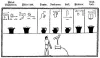
Kemetic · The Liturgy of Funerary Offerings · 4 of 5
The Seventh Ceremony — And Ceremonies Following
THE ceremonies of purification are now ended. The new body in which the KA is to dwell has been made by means of them. Its bones, and head, and mouth have been brought into a state of ceremonial purity, it contains the fluid of life, and all its humours, and
The Sem priest holding the "Kef-pesesh."
warmth, and its face is enveloped with an emanation from the Eye of Horus, and the odour of purity has been restored to it. It is not, however, prepared to enjoy the offerings which are about to be presented to it, because its jaw-bones, which have been pressed out
of their places under the process of mummification, have no freedom of movement. To "establish" the jaw-bones was the next thing. The SEM priest took in his hands the instrument called "KEF PESESH," i.e., "the overcomer of the divisions," the shape of which was, and presented it before the face of the mummy, or touched it with it. Meanwhile the Kher heb said these words:--
"O Unas, thy two jawbones which were separated have been established."
As the result of these words the jawbones resumed their former positions, and power was given to them to masticate food. It is interesting to note that a specimen of this instrument is preserved in the British Museum (Third Egyptian Room, Table-case M, No. 888). It is made of flint, and was found near Abydos with large numbers of flint knives and tools of the Neolithic Period. If the object be a KEF PESESH, and there is no reason to doubt it, it forms an important proof which connects this ceremony with the Predynastic Period. Compare also another example of this amulet, which is surmounted by the head of a goddess, in the British Museum (Table-case F, Fourth Egyptian Room, No. 505).
THE EIGHTH CEREMONY.
The SEM priest next presented before the face of the mummy two objects of the shape, or made
of iron of the South and iron of the North respectively, and the Kher heb said twice:--
"O Unas, the two gods have opened for thee thy mouth."
The "two gods" are, of course, Horus and Set. It will be noted that in the text of Unas the two iron objects which represent Horus and Set are in the form of axe-heads attached to handles, and that in the
The Sem priest presenting.
text of Peta-Amen-apt they are in the form. Amulets in both forms are known, for, as Professor Maspero has pointed out, small axes, with heads of metal and handles of wood, have been found in the tombs. and also small angles of haematite, of which many examples exist in our museums. 1 The application of these objects to the mouth of the mummy was, no
doubt, intended to supplement the presentation of the KEF PESESH.
Footnotes
66:1 E.g., British Museum, Table-case F, Fourth Egyptian Room, Nos. 510-520.
THE NINTH CEREMONY.
The first object presented to the mummy after the opening of the mouth was sel, or ser, which has been translated both by "butter" and "cheese." The Vignette represents the SEM priest offering a vessel with four balls, or round cakes, of some substance in it,
The Sem priest presenting cheese.
and, when we remember that the Egyptians have never made butter in our sense of the word, we are justified in accepting Dümichen's rendering of "cheese." 1 Whilst the four cakes of cheese were being offered, the Kher heb said the following words:--
"O Unas, the Eye of Horus hath been presented
unto thee, and with it the god passeth (or, cometh); I have brought it unto thee: place thou it in thy mouth."
Footnotes
67:1 The Egyptian is probably the original of the Coptic ; compare Genesis xviii. 8 (ed. Ciasca, p. 18).
THE TENTH CEREMONY.
The SEM priest next brought in a vessel four balls, or round cakes, called shaku, and whilst he presented these the Kher heb said:--
The Sem priest presenting shaku.
O Unas, the SHAKU Of Osiris have been presented unto thee, the SHAKU from the top of the breast of Horus, of his body hast thou taken to thy mouth."
The exact meaning of the word shaku is unknown, but it seems clear that the object symbolized the nipples on the breast of Horus, or the nipples on the breast of his mother Isis, which the god had taken into his mouth.
THE ELEVENTH CEREMONY.
In the next ceremony the SEM priest offered a vessel of milk and a vessel of whey (?), and whilst he did so the Kher heb said:--
"[That which is] from the breast of thy sister Isis, the emission of thy mother, thou hast taken possession of for thy mouth."
The Sem priest presenting a vessel of milk and a vessel of whey (?).
The text of Peta-Amen-apt is somewhat fuller, and reads:--
"[That which floweth] from the breast of Horus, and is of his body, hath been presented unto thee for thy mouth. That which cometh from the breast of thy sister Isis, the emission of thy mother, hath been seized by thee for thy mouth, and thou openest thy mouth by means of it."
THE TWELFTH CEREMONY.
The ceremonies symbolizing the nursing of Horus by Osiris having been performed, the SEM priest took libation vases of pure water of the north, i.e., from the Delta, not water with natron dissolved in it, and went
The Sem priest pouring water from a libation vase into a libation bowl held by a ministrant.
round the mummy, sprinkling it on all sides as he went, whilst the Kher heb said four times:--
"This libation is for thee, O Osiris, this libation is for thee, O Unas; it cometh forth from thy son, it cometh forth from Horus.
"I have come and I have brought unto thee the Eye of Horus, that thy heart may be refreshed therewith.
"I have brought it [and placed it] under thee, [under] thy sandals, and I have presented unto thee that which floweth forth from thee. Whilst it is with thee there shall be no stoppage of thy heart, and it shall be with thee, with the things (or, persons) which come forth at the [sound of] the voice."
The powers which the deceased enjoyed upon earth having now been bestowed upon him once more, or upon his KA, he is in the position of being able to
The Sem priest presenting a vessel of white wine and a vessel of black.
partake of the symbolic offerings which are about to be made to him, and to assimilate them after they have been transformed into spiritual meat and drink by the words of the Kher heb.
THE THIRTEENTH CEREMONY.
The SEM priest took in his hands two vessels, one filled with white and the other with black wine,
each holding one hathes measure, and as he presented them to the deceased, the Kher heb said:--
"Thou hast taken possession of that which hath flowed forth from the Eyes of Horus, and when they (i.e., the wines) are in front of thee they illumine thy face."
The white and the black wine were not intended to be drunk, but to be poured over the head and forehead of the deceased, so that the strength in them might be transmitted to his face. The wines, being regarded as emanations from the Eyes of Horus, the White and the Black, contained the divine power which existed in the Eyes of the god, and they transferred to the deceased the might of the Day and the Night.
THE FOURTEENTH CEREMONY.
In the next ceremony the SEM priest offered a bread-cake, of the kind called Hem, which was presented for the "lifting up of the face" of the deceased. This name is followed by the word tchaut, the exact meaning of which is not easy to say. In the "Hem"-cake Dümichen 1 thought he saw the original of a cake in use among the Egyptians which was stamped with a figure of a vanquished hippopotamus; this beast was the symbol of Set, or Typhon, as we know from the texts, and from Plutarch, 2 who says that he was chained. In the pictures of the chained hippopotamus 3 the head of the monster is
turned back," i.e., he is looking behind him, and it is possible that the name "Hem," which means "to turn back," was given to cakes because they were stamped with a figure of the animal in this attitude. The words pat tchaut Maspero renders by "Gâteau de passage," and Dümichen by "Hem-Brod wohlschmeckendes (?) the former rendering gives the better sense. The "Gâteau de passage" is the equivalent of the round bread-cake which is common all over Egypt and the
The Sem priest presenting the Hem cake.
Sudan at the present day, and it is the first thing with which the native provides himself when he is about to set out on a journey. Whilst the SEM offers the hem cake the Kher heb says:--
"Day hath made an offering unto thee in the sky.
"The South and the North have caused an offering to be made unto thee.
"Night hath made an offering unto thee.
"The South and the North have made an offering unto thee.
"An offering is brought unto thee. An offering thou seest, of an offering thou hearest.
"There is an offering before thee, an offering behind thee, an offering with thee."
Footnotes
72:1 Grabpalast, i., p. 23.
72:2 De Iside, Cap. 50.
72:3 Naville, Mythe d'Horus, pll. 3 fl.
THE FIFTEENTH CEREMONY.
The offering of "bread for the journey" is followed
The Sem priest presenting a ball of incense.
by that of onions. The SEM priest presented five onions to the deceased whilst the Kher heb said:--
"Osiris Unas, the white teeth of Horus are presented unto thee that they may fill thy mouth."
THE SIXTEENTH CEREMONY.
The Vignette which illustrates the next ceremony shows us the SEM priest kneeling before a small table
on which rests a bread-cake, which is called "the Uten-cake, for the lifting up of the face." Whilst this bread-cake is being offered, the Kher heb said, according to the text of Unas, four times:--
"SUTEN HETEP TA to the KA of Unas."
These words were followed by:--
"Osiris Unas, the Eye of Horus hath been presented unto thee--the bread which thou eatest."
The Sem priest offering the Uten cake.
According to the text of Peta-Amen-apt the Uten-cake is to be divided into two equal parts, and the words "Suten hetep ta, to the KA of Peta-Amen-apt" are to be said four times in connection with each half. Whilst the SMEN priest offers these the Kher heb says four times:--
"Osiris, the Eye of Horus hath been presented unto thee--the bread which thou eatest, and thy mouth hath been opened thereby."
It has been said above (p. 21) that, though the words
suten hetep ta may at one time have been intended to mean "May the king give an offering," it is clear they had already lost this meaning when the funerary texts were inscribed on the mastabas at Sakkarah. The passage from the text of Unas is an important proof that such is the case, for it is quite clear that the king is not entreated to give to Unas an offering. Here the words suten hetep ta occur some forty lines from the beginning of the Liturgy, where, in the ordinary course of things, we should expect them to appear. From the fact that they are ordered to be recited four times in one text, and eight times in the other, we are fully justified in believing that they are the opening words of a formula which was composed in primitive times and recited by priests and relatives on behalf of the dead, and that they were used by pious folk, as Dümichen first pointed out, in much the same way as "Paternoster" and "Ave Maria" are used in our own times. It may be noted too in passing that the passage from the Liturgy under consideration presents us with one of the oldest examples of the use of the formula "suten hetep ta en ka en," "May there be a royal offering to the KA of," which is so common on stelae from the XIIth Dynasty downwards.
THE SEVENTEENTH AND EIGHTEENTH CEREMONIES.
In the next two ceremonies the SEM priest offers two vessels of wine to the deceased, each containing a Hathes measure; one vessel is made of some white
material, and the other of black. Whilst the former is being offered the Kher heb says:--
"Osiris Unas, the Eye of Horus hath been presented unto thee; it hath been snatched from the hand of Set, and thou hast taken possession of it for thy mouth, and thou hast opened thy mouth therewith."
And whilst the latter is being offered he says:--
"Osiris Unas, thy mouth is opened by that which
The Sem priest presenting a white vessel of wine.
floweth(?) from thee." The words "Eye of Horus which hath been snatched from the hand of Set" refer to the belief that it was Set, the god of darkness, who swallowed the sun and moon during eclipses, and devoured the moon piecemeal after it was fourteen days old. The Eye of Horus was restored to him sometimes by Shu, who snatched it out of the hand of Set, 1 but more
frequently by Thoth, who is often represented in the form of an ibis-headed man carrying the Eye of Horus before him in his hands. As the Eye of Horus was the abode of disembodied souls and spirits, the presentation of this eye to the mummy, or statue, was equivalent to restoring to it the soul of the deceased. In this passage, and throughout the Liturgy generally,
The Sem priest presenting a white vessel of wine.
the fundamental idea of the presentation of objects which are symbolic of the Eye of Horus is to bring back to the deceased his KA and BA, i.e., soul and the various members of his spiritual and mental economy.
The wine in the black vessel is declared to be the fluids or humours which ran out of the deceased before death, or during the process of preparing him for the tomb. They are here restored to him in the form of wine, the nature of which is changed by the words of the Kher heb.
Footnotes
77:1 Lefébure, Le Mythe Osirien, p. 87; Moret, Rituel, p. 84.
THE NINETEENTH CEREMONY.
The process of restoring to the deceased the fluid of his body is continued in the next ceremony, wherein the SEM priest presents to him a black stone vase, containing hent beer. Whilst he is doing this the Kher heb says:--
"Osiris Unas, there hath been presented unto thee
The Sem priest presenting a black stone vessel of Hent beer.
that which hath been pressed out of thee, which hath come forth from thee."
THE TWENTIETH CEREMONY.
After the presentation of the wine and beer the SEM priest took in his hands a small table, or stand, on which were placed several bread-cakes of different shapes and kinds, called "Tchesert," i.e., "the
holy table." With this he advanced to the deceased, and whilst he offered it to him the Kher heb said:--
"O Ra, may the worship which thou hast in heaven and all the worship which is offered to thee be to Unas, and may everything which is offered to thy body be offered to the KA of Unas; and may everything which is offered to his body be thine."
The Sem priest presenting the holy table of offerings.
From this passage we learn that the deceased is identified with Ra, and that it was expected that he would share with Ra the praises, and worship, and offerings which were dedicated to him. The offerings made to the deceased were intended for Ra, upon whom devolved the duty of feeding him with a portion of them. The bread-cakes of earth were transmuted into the "bread of everlastingness," and the wine into the "wine of eternity," whereon Ra lived.
THE TWENTY-FIRST CEREMONY.
In the next ceremonies the various kinds of bread and cakes on the "Tchesert" table were offered one by one. The first was the tept, and as the SEM priest presented it the Kher heb said:--
"Unas, the Eye of Horus hath been presented unto thee for thy tasting."
The Sem priest presenting the Tept cake.
Here there is a play on the words tept, a "kind of bread," and tep, "to taste."
THE TWENTY-SECOND CEREMONY.
The next offering was the ah which according to Dümichen was not a bread-cake, but a lump of cooked meal, like the Puls of the Romans and the Polenta of the modern Italians. According to Maspero, it was a flat cake mixed with fat, and perhaps sweetened, and folded like a pancake. Whilst the SEM
priest presents this the Kher heb pronounces a formula, which in the Unas text seems to mean,
"The darkness (or, the night) becometh denser and denser," and in the text of Peta-Amen-apt,
"The ah food is spread out before thee like a field."
It is clear that in the one text there is a play of words in ahah and akka, and in the other in ahah and ah, but the exact meanings of the sentences are unknown because we do not understand the allusions.
The Sem priest presenting the Ah meal.
[paragraph continues] Dümichen thought that the word akka, i.e., "darkness or night," referred to the colour of the ah-cake, and that it might have been baked to a brown colour which was so dark in comparison with the tept cake that it appeared to be black.
THE TWENTY-THIRD CEREMONY.
In this ceremony the SEM priest offered the breast of some animal, and as he did so the Kher heb said:--
"Unas, the Eye of Horus hath been presented unto thee so that it may embrace thee (or, be united unto thee)."
The breast naturally symbolized the act of embracing, which was in itself an important ceremony. When Horus embraced the deceased, the act of embracing him "smote Set," and when he had snatched his Eye out of the hand of the god of evil, "he gave to the deceased his heart, and the power which was therein." 1
The Sem priest presenting the breast.
When, in the Tale of the Two Brothers, Anpu restored to Batau his heart, each embraced the other. 2 Life
was given to a statue by embracing it, and when a living person, priest, or relative embraced a mummy, his, or her, object was to reunite the bones, to knit together afresh the flesh, and to give order to the members of the body, which in primitive times had been dislocated, like the body of Osiris, and then put together, piece by piece, to form a complete whole. 1 As to the breast itself, we may note in passing that in the Levitical law it was ordered that the breast of a ram should be waved for a wave offering before the Lord (Leviticus vii. 30).
Footnotes
83:1 See Teta, l. 173., and Moret's excellent remarks in Rituel, p. 88.
83:2 Papyrus D'Orbiney, pl. xiv., ll. 3, 4.
84:1 Moret, Rituel, p. 89.
THE TWENTY-FOURTH CEREMONY.
The next four ceremonies deal with the offering of wine and three kinds of beer. The SEM priest presented
a white vessel of wine to the deceased, and as he did so the Kher heb said:--
"Unas, the Eye of Horus hath been presented unto thee, which was snatched from the hand of Set, and was rescued for thee, and thou dost open thy mouth with it."
The Sem priest presenting a stone vessel of wine.
THE TWENTY-FIFTH CEREMONY.
He next offered a black vessel containing a hent measure of beer, 1 while the Kher heb said.--
The Sem priest presenting a stone vessel of beer.
"Unas, there hath been presented unto thee that which hath been pressed out and cometh forth from Osiris."
Footnotes
85:1 Or, "a vessel containing a hent measure of black beer."
THE TWENTY-SIXTH CEREMONY.
This was followed by an offering of an iron vessel
containing one hent measure of beer, 1 and at the same time the Kher heb said:--
"Unas, the Eye of Horus hath been presented unto thee, which was rescued for thee; there is no iron therein, and it belongeth to thee."
In the "iron vessel" we may probably see an allusion to the iron spear with which Horus defended himself against the attack of Set. If this be so we are to understand from the text that the strength of the iron
The Sem priest presenting an iron vessel of beer.
weapon is transferred to the vessel, which in turn transfers it to the beer. From the beer the deceased obtains the magical power of Horus which will enable him to repulse any attack made upon him by Set.
Footnotes
86:1 Or, "a vessel containing a hent measure of iron beer."
THE TWENTY-SEVENTH CEREMONY.
The SEM priest then offered a hetemet vessel containing
one hent measure of beer, 1 and as he did so the Kher heb said:--
"Unas, the Eye of Horus hath been presented unto thee that thou mayest be filled therewith."
At this point in the service the SEM priest paused in his presentation of offerings to the deceased, and made ready to pour out further libations to him. Having dissolved three cakes of natron in pure water, he took four vases of the solution, and walked round the
The Sem priest presenting a stone vessel of beer.
mummy, or statue, and sprinkled it on all sides, whilst the Kher heb recited the following, words four times:--
"This libation is for thee, O Osiris, this libation is for thee; it cometh forth from thy son, it cometh forth from Horus.
"I have come and I have brought unto thee the Eye of Horus that thy heart may be refreshed thereby. I
have brought it to thy feet, and have presented unto thee that which hath flowed and come forth from thee. Whilst it is with thee there shall be no stoppage of thy heart, and it shall be with thee, with the things (or, persons) which come forth at the [sound of] the voice." 1 (The Vignette is a duplicate of that given on page 42.)
Footnotes
87:1 Or, "a vessel containing a hent measure of hetemet beer."
88:1 From indications given in the text of Pepi II. it is clear that at this place in the series of ceremonies articles of apparel and jewellery were offered one by one to the deceased, and that appropriate words of dedication were recited during their presentation. See Maspero, Pyramides de Saqqarah, p. 361.
THE TWENTY-EIGHTH TO THIRTY-FOURTH CEREMONIES.
These seven ceremonies deal with the anointing of the mummy, or statue, with seven kinds of unguents, which are called:--
1. Seth heb,
2. Hekenu,
3. Sefth,
4. Neshnem,
5. Tuatu,
6. Hatet ash,
7. Hatet Thehennu,
The SEM priest offered a vessel of the Seth heb unguent, and the Kher heb said four times:--
"Osiris Unas, I have filled thine eye for thee with metchet oil."
He, next offered a vessel of Hekenu. Unguent, and the Kher heb said:--
"Osiris Unas, there hath been presented unto thee
THE SEVEN UNGUENTS.
The Sem priest pouring out libations.
that which hath been pressed out from thy face."
He next offered a vessel of Seft unguent, and the Kher heb said:--
"Osiris Unas, the Eye of Horus hath been presented unto thee, and [Set] hath been made weak in respect of thee thereby."
The Seft unguent was dark in colour, and symbolized Set, the god of darkness, and as it represented the
greasy emanation of his face this god was supposed to suffer through its absence.
The SEM priest next offered a vessel of Neshnem unguent, and the Kher heb said:--
"Osiris Unas, the Eye of Horus hath been presented unto thee, that it may unite itself unto thee."
He next offered a vessel of Tuatu. unguent, and the Kher heb said:--
"Osiris Unas, the Eye of Horus hath been presented unto thee, that the gods may be brought unto thee thereby."
In the text of Peta-Amen-apt the reading is:--
"[Osiris] Peta-Amen-apt, the Eye of Horus hath been presented unto thee. It hath been brought [unto thee] that thou mayest worship (or, give thanks to) the gods by means of it."
The SEM priest then offered a vessel of the finest cedar oil, Hatet ash, and a vessel of the finest oil of the Thehennu (Hatet Thehennu), and the Kher heb said:--
"O ye Oils, O ye Oils, which are on the forehead of Horus [place ye yourselves on the forehead of the Osiris Unas, make ye him to smell sweet in possessing you], make ye him to become a KHU (i.e., Spirit) through possessing you, make ye him to have his SEKHEM (i.e., Vital Power) in his body, make ye him to have openings before his eyes, and let all the KHU (i.e., Spirits) see him, and let them all hear his name. Behold, Osiris Unas, the Eye of Horus hath been
brought unto thee, for it hath been seized that it may be before thee."
THE THIRTY-FIFTH CEREMONY.
In this ceremony the materials with which the eyes of the deceased are to be painted are offered. The SEM priest took a bag of Uatch and a bag of Mestemet, and as he offered them the Kher heb said:--
A bag of Uatch and a bag of Mestemet.
"Osiris Unas, I have painted for thee the Eye of Horus with Mestemet so that there may be health to thy face."
The eye-paint called Uatch was first used as a medicine for the eyes, and only later as an ornament; it was a preparation of copper. The eye-lids were first smeared with oil or some unguent, and the powder was
applied to them by means of a short, thin stick made of wood, bone, or metal, which among the Arabs is called a "needle." The eye-paint Mestemet, which appears in Coptic under the form, or, was made from antimony, and its use was general; it was used daily, and was believed to protect the eye against ophthalmia. In modern times preparations of lead, black oxide of manganese, the lamp-black of burnt almonds, &c., are commonly used as "Kohl," or eye-paint.
THE THIRTY-SIXTH CEREMONY.
In the next ceremony the SEM priest offered two linen bandlets, or scarves, or sashes, called unkhu to the deceased, and as he did so the Kher heb said-
"Watch thou in peace. The goddess TAAT watcheth in peace, the goddess TAAT watcheth in peace. The Eye of Horus which is in the city of Pe-Tep watcheth in peace. The Eye of Horus which is in the temple houses of Net watcheth in peace. Receive thou the milk-[white] and bleached bandlets of the goddess Ur-a. Cause ye, O bandlets, that the Two Lands may submit to this Unas, even as they bow down before Horus, and make ye the Two Lands to be in awe of Unas, even as they are terrified before Set. Tarry ye before Unas in his divinity. Open ye his way at the head of the KHU (or, Spirits), and let him stand at the head of the Spirits. O Anpu-Khenti Amenti, forwards, forwards, to the Osiris Unas."
The two bandlets are assumed to have been made by the goddess Taat, who presided over the apparel of the deceased, and provided them with raiment made by her own hands; as she wove the bandlets she wove into them her magical protection, which not only preserved their wearers from the discomforts of nakedness, but assured to them the respect of the gods and spirits who
The Sem priest presenting two bandlets.
saw them. One bandlet also carried with it the protection of the Horus-god who dwelt in the city of Pe-Tep, or Buto, and the other the protection of the Horus-god who dwelt in the city of Net (Neith). Horus of re-Tep was the son of Isis-Uatchit, and Horus of Sais was the son of Net, the goddess to whom
the invention of the art of weaving was attributed. The city of Sais was famous in all ages for the production of textile fabrics, and here was situated "Hetmenkh," the "Temple of woven stuffs." 1 The opening lines of this passage in the Liturgy are differently translated by Dümichen and Maspero. In his translation of the text of Unas Maspero rendered the signs by "Vêts-toi," "clothe thyself," but later he came to the conclusion that is not the equivalent of, and that it is to be read res, i.e., "Watch," or "Keep vigil." Thus his renderings are:--
Vêts-toi en paix! Vêts ton vêtement en paix! Que Taït se vête--Vêtements de fête, deux--en paix! Œil d'Hor dans Doup, en paix! Œil d'Horus dans les demeures de Nit, en paix! Reçois le linge blanc! Donne qu'elles se courbent pour cet Ounas, les deux terres, &c.
Veille en paix! veille Tait en paix, veille Taitit en paix! Œil d'Hor qui est dans Dopou en paix, veille Œil d'Hor qui est dans les Châteaux de Nit en paix! La plus brillante(?) des nourrices(?), celle qui orne le maitre du tombeau (?), donne que les deux terres se courbent devant ce Pepi Nofirkerî, &c. 2
The rendering of Dümichen agrees with the older rendering of Maspero as far as "Nit, en paix!" but
for the following words he has "Nimin in Empfang die milchfarbige und die gebleichte von der Göttin Ur-a. Bewirket, dass sich in Ehrfurcht beugen die Länder," &c. 1
At this stage in the service an interval appears to have been allowed to the deceased to absorb the meat and drink offerings which had been presented to him, and to take possession of the bandlets, &c. In the temples the presentation of offerings to the god was nearly always accompanied by a burning of incense, 2 for the gods rejoiced in the mingled odours of the objects offered and the burning incense.
Footnotes
94:1 De Rougé, Geographie, p. 26.
94:2 Pyramides de Saqqarah, p. 362.
95:1 Grabpalast, i. 28.
95:2 Moret, Rituel, p. 119.
THE THIRTY-SEVENTH CEREMONY.
The SEM priest next burned incense, and as he was doing this the Kher heb said four times:--
"Let him advance! Let him advance with his KA! Horus advanceth with his KA, Set advanceth with his KA, Thoth advanceth with his KA, Sep advanceth with his KA, Osiris advanceth with his KA, Khenti-Maati advanceth with his KA, thy backbone, advanceth with thy KA.
"Hail, Unas! The arm of thy KA is before thee.
"Hail, Unas! The arm of thy KA is behind thee.
"Hail, Unas! The leg of thy KA is before thee.
"Hail, Unas! The leg of thy KA is behind thee.
"Osiris Unas, I have given unto thee the Eye of Horus, and thy face is filled therewith, and the perfume of the Eye of Horus spreadeth itself over thee."
The Sem priest presenting burning incense.
THE THIRTY-EIGHTH CEREMONY.
This censing of the mummy, or statue, was followed by another set of libations. Whilst the SEM priest was sprinkling the deceased with water in which two grains, or cakes, of incense had been dissolved, the Kher heb said four times:--
"This libation is for thee, O Osiris, this libation is
for thee, O Unas; it cometh forth from thy son, it cometh forth from Horus.
"I have come and I have brought unto thee the Eye of Horus, that thy heart may be refreshed therewith. I have brought it [and placed it] under thee, [under
The Sem priest pouring water from a libation vase into a libation bowl held by a ministrant.
thy sandals,] and I have presented unto thee that which floweth forth from thee. Whilst it is with thee there shall be no stoppage of thy heart, and it shall be to thee with the things (or, persons) which come forth at the [sound of] the voice."