Hellenic · Prolegomena to the Study of Greek Religion · 1 of 2
Prolegomena to the Study of Greek Religion (Part 1)
PROLEGOMENA TO THE STUDY OF GREEK RELIGION
Jane Ellen Harrison (1922)
Prolegomena to the Study of Greek Religion: Page Index
Introduction
Table of Contents
Chapter I. Olympian and Chthonic Ritual
Chapter II. The Anthesteria
PROLEGOMENA TO THE STUDY OF GREEK RELIGION
by Jane Ellen Harrison
Cambridge University Press
Third Edition
NOTE: THIS ETEXT IS IN PROGRESS AND INCLUDES THE FIRST TWO CHAPTERS ONLY.
ARTURO ET MARGARITAE VERRALL
HUIC AMICAE MEAE CONSTANTISSIMAE
ILLI ET AMICO ET MAGISTRO
HUNC LIBRUM DEDICO
INTRODUCTION.
THE object of the following pages is to draw attention to some neglected aspects of Greek religion.
Greek religion, as set forth in popular handbooks and even in more ambitious treatises, is an affair mainly of mythology, and moreover of mythology as seen through the medium of literature. In England, so far as I am aware, no serious attempt has been made to examine Greek ritual. Yet the facts of ritual are more easy definitely to ascertain, more permanent, and at least equally significant. What a people does in relation to its gods must always be one clue, and perhaps the safest, to what it thinks. The first preliminary to any scientific understanding of Greek religion is a minute examination of its ritual.
This habit of viewing Greek religion exclusively through the medium of Greek literature has brought with it an initial and fundamental error in method--an error which in England, where scholarship is mainly literary, is likely to die hard. For literature Homer is the beginning, though every scholar is aware that he is nowise primitive; for theology, or--if we prefer so to call it--mythology, Homer presents, not a starting-point, but a culmination, a complete achievement, an almost mechanical accomplishment, with scarcely a hint of origines, an accomplishment moreover, which is essentially literary rather than religious, sceptical and moribund already in its very perfection. The Olympians of Homer are no more primitive than his hexameters. Beneath this splendid surface lies a stratum of religious conceptions, ideas of evil, of purification, of atonement, ignored or suppressed by Homer, but reappearing in later poets and notably in Aeschylus. It is this substratum of religious conceptions, at once more primitive and more permanent, that I am concerned
to investigate. Had ritual received its due share of attention, it had not remained so long neglected.
I would guard against misapprehension. Literature as a starting-point for investigation, and especially the poems of Homer, I am compelled to disallow; yet literature is really my goal. I have tried to understand primitive rites, not from love of their archaism, nor yet wholly from a single-minded devotion to science, but with the definite hope that I might come to a better understanding of some forms of Greek poetry. Religious convention compelled the tragic poets to draw their plots from traditional mythology, from stories whose religious content and motive were already in Homer's days obsolete. A knowledge of, a certain sympathy with, the milieu of this primitive material is one step to the realization of its final form in tragedy. It is then in the temple of literature, if but as a hewer of wood and drawer of water, that I still hope to serve.
As the evidence to be set before the reader is necessarily somewhat complex in detail, and the arguments of the successive chapters closely interdependent, it may be well at the outset to state, as simply as may be, the conclusions at which I have arrived, and to summarize briefly the steps of the discussion.
In Chapter I. it is established that the Greeks themselves in classical times recognized two forms of ritual, Olympian and Chthonic. It is further seen that the characteristic ritual of Homeric days was of the kind known to them as Olympian. Sacrifice in Homer takes the form of an offering to the god to induce his favour. Its formulary is do ut des. Moreover the sacrificial banquet to which the god is bidden is shared by the worshipper. In sharp contradistinction to this cheerful sacrificial feast, when we examine the supposed festival of Zeus at Athens, the Diasia, we find rites of quite other significance; the sacrifice is a holocaust, it is devoted, made over entirely to the god, unshared by the worshipper, and its associations are gloomy. The rites of the Diasia, though ostensibly in honour of Zeus, are found really to be addressed to an underworld snake on whose worship that of Zeus has been superimposed.
In the three chapters that follow, on the festivals of the
[paragraph continues] Anthesteria, Thargelia, and Thesmophoria, held respectively in the spring, summer, and autumn, the Olympian ritual superimposed is taken as known and only alluded to in passing. The attention is focussed on the rites of the underlying stratum.
In the Anthesteria, ostensibly sacred to Dionysos, the main ritual is found to be that of the placation of ghosts. Ghosts, it is found, were placated in order that they might be kept away; the formulary for these rites is not, as with the Olympians, do ut des, but do ut abeas. The object of these rites of Aversion, practised in the spring, is found to be strictly practical; it is the promotion of fertility by the purgation of evil influences.
The ritual of the Thargelia is even snore primitive and plain-spoken. In this festival of the early summer, ostensibly dedicated to Apollo, the first-fruits of the harvest are gathered in. The main gist of the festival is purification, necessary as a preliminary to this ingathering. Purification is effected by the ceremonial of the pharmakos. Though the festival in classical days was 'sacred to' Apollo, the pharmakos is nowise a 'human sacrifice' to a god, but a direct means of physical and moral purgation, with a view to the promotion and conservation of fertility.
Thus far it will be seen that the rites of the lower stratum are characterized by a deep and constant sense of evil to be removed and of the need of purification for its removal; that the means of purification adopted are primitive and mainly magical nowise affects this religious content.
This practical end of primitive ceremonies, the promotion of fertility by magical rites, comes out still more strongly in the autumn sowing festival of the Thesmophoria. Here the women attempt, by carrying certain magical sacra, the direct impulsion of nature. In connection with these sacra of the Thesmophoria the subject of 'mysteries' falls to be examined. The gist of all primitive mysteries is found to be the handling or tasting of certain sacra after elaborate purification. The sacra are conceived of as having magical, i.e. divine, properties. Contact with them is contact with a superhuman potency, which is taboo to the unpurified. The gist of a mystery is often the removal of a taboo. From the Olympian religion 'mysteries' appear to have been wholly absent.
In Chapter V. we pass from ritual to theology, from an examination of rites performed to the examination of the beings to whom these rites were addressed. These beings, it is found, are of the order of sprites, ghosts, and bogeys, rather than of completely articulate gods, their study that of demonology rather than theology. As their ritual has been shown to be mainly that of the Aversion of evil, so they and their shifting attributes are mainly of malevolent character. Man makes his demons in the image of his own savage and irrational passions. Aeschylus attempts, and the normal man fails, to convert his Erinyes into Semnai Theai.
In Chapter VI. the advance is noted from demonology to theology, from the sprite and ghost to the human and humane god. The god begins to reflect not only human passions but humane relations. The primitive association of women with agriculture is seen to issue in the figures of the Mother and the Maid, and later of the Mother and the Daughter, later still in the numerous female trinities that arose out of this duality. In Chapter VII. the passage from ghost to god is clearly seen, and the humane relation between descendant and ancestor begets a kindliness which mollifies and humanizes the old religion of Aversion. The culminating point of the natural development of an anthropomorphic theology is here reached, and it is seen that the goddesses and the 'hero-gods' of the old order are, in their simple, non-mystic humanity, very near to the Olympians.
At this point comes the great significant moment for Greece, the intrusion of a new and missionary faith, the religion of an immigrant god, Dionysos.
In Chapter VIII. the Thracian origin of Dionysos is established. In his religion two elements are seen to coexist, the worship of an old god of vegetation on which was grafted the worship of a spirit of intoxication. The new impulse that he brought to Greece was the belief in enthusiasm, the belief that a man through physical intoxication at first, later through spiritual ecstasy, could pass from the human to the divine.
This faith might have remained in its primitive savagery, and therefore for Greece ineffective, but for another religious impulse, that known to us under the name of Orpheus. To the
discussion of Orphism the last four chapters IX.-XII. are devoted.
In Chapter IX. I have attempted to show that the name Orpheus stands for a real personality. I have hazarded the conjecture that Orpheus came from Crete bringing with him, perhaps ultimately from Egypt, a religion of spiritual asceticism which yet included the ecstasy of the religion of Dionysos. Chapter X. is devoted to the examination of the Orphic and Dionysiac mysteries. It has been shown that before the coming of the Orphic and Dionysiac religion the mysteries consisted mainly in the handling of certain sacra after elaborate purification. By handling these sacra man came into contact with some divine potency. To this rudimentary mysticism Orphism added the doctrine of the possibility of complete union with the divine. This union was effected in the primitive Cretan rite of the Omophagia by the physical eating of the god; union with the divine was further symbolically effected by the rite of the Sacred Marriage, and union by adoption by the rite of the Sacred Birth. The mission of Orphism was to take these primitive rites, originally of the crudest sympathetic magic, and inform them with a deep spiritual mysticism. The rite of the Omophagia found no place at Eleusis, but the other two sacramental rites of union, the Sacred Marriage and the Sacred Birth, formed ultimately its central mysteries.
With the doctrine and ritual of union with the divine there came as a necessary corollary the doctrine that man could attain the divine attribute of immortality. Orphic eschatology is the subject of Chapter XI. Its highest spiritual form, the belief that perfect purity issued in divinity and hence in immortality, is found expressed in the Orphic tablets. Its lower expression, the belief in a Hades of eternal punishment as contrasted with the shadowy after-world of Homer, is seen in the vases of Lower Italy and the eschatology denounced by Plato.
Finally in Chapter XII. it is shown how, as a concomitant to their Eschatology, the Orphics, unlike Homer, developed a Cosmogony, and with this Cosmogony was ultimately bound up a peculiar and philosophic theology. In the fifth century B.C. the puppet-show of the Olympians was well-nigh played out, but the two gods of the Orphics remained potent. In ritual they worshipped Dionysos, but their theoretical theology recognized
[paragraph continues] Eros as source of all things. The Eros of the Orphics was a mystery-being, a daimon rather than a theos, a potency wholly alien to the clear-cut humanities of Olympus.
With the consideration of Orphism it has become, I hope, abundantly clear why at the outset attention was focussed on the primitive rites of Aversion and Purification rather than on the Service of the Olympians. The ritual embodied in the formulary do ut des is barren of spiritual content. The ritual embodied in do ut abeas contains at least the recognition of one great mystery of life, the existence of evil. The rites of the Olympians were left untouched by the Orphics; the rites of purification and of sympathetic magic lent them just the symbolism they needed. Moreover in theology the crude forms of demons were more pliant material for mysticism than the clear-cut limitations and vivid personality of the Olympians. Orphism was the last word of Greek religion, and the ritual of Orphism was but the revival of ancient practices with a new significance.
The reader will note that in the pages that follow, two authors, Plutarch and Euripides, have been laid under special contribution. Plutarch's gentle conservatism made him cling tenaciously to antique faith. According to him, one function of religion was to explain and justify established rites, and in the course of his attempted justification he tells us many valuable ritual facts. Euripides, instant in his attack on the Olympian gods, yet treats with respect the two divinities of Orphism, Dionysos and Eros. I have suggested that, born as he was at Phlya, the ancient home of Orphic mysteries, his attitude on this matter may have been influenced by early associations. In any case, a religion whose chief divinities were reverently handled by Euripides cannot be dismissed as a decadent maleficent superstition.
I would ask that the chapters I have written be taken strictly as they are meant, as Prolegomena. I am deeply conscious that in surveying so wide a field I have left much of interest untouched, still more only roughly sketched in. I wished to present my general theory in broad outline for criticism before filling in details, and I hope in the future to achieve a study of Orphism
that may have more claim to completeness. If here I have dwelt almost exclusively on its strength and beauty, I am not unaware that it has, like all mystical religions, a weak and ugly side.
If in these Prolegomena I have accomplished anything, this is very largely due to the many friends who have helped me; the pleasant task remains of acknowledging my obligations.
My grateful thanks are offered to the Syndics of the University Press for undertaking the publication of this book; to the Syndics of the University Library and the Fitzwilliam Museum for the courtesy they have shown in allowing me free access to their libraries; to my own College, which, by electing me to a Fellowship, has given me for three years the means and leisure to devote myself to writing.
For the illustrations they have placed at my disposal I must record my debt to the Trustees of the British Museum, to the Hellenic Society, the German Archaeological Institute, and the École Française of Athens. The sources of particular plates are acknowledged in the notes. The troublesome task of drawing from photographs and transcribing inscriptions has been most kindly undertaken for me by Mrs Hugh Stewart.
Passing to literary obligations, it will be evident that in the two first chapters I owe much, as regards philology, to the late Mr R. A. Neil. His friendship and his help were lost to me midway in my work, and that loss has been irreparable.
It is a pleasure to me to remember gratefully that to Sir Richard Jebb I owe my first impulse to the study of Orphism. The notes in his edition of the Characters of Theophrastos first led me as a student into the by-paths of Orphic literature, and since those days the problem of Orphism, though often of necessity set aside, has never ceased to haunt me.
To Professor Ridgeway I owe much more than can appear on the surface. The material for the early portion of my book was collected many years ago, but, baffled by the ethnological problems it suggested, I laid it aside in despair. The appearance of Professor Ridgeway's article, 'What people made the objects called Mycenaean?' threw to me an instant flood of light on the
problems of ritual and mythology that perplexed me, and I returned to my work with fresh courage. Since then he has, with the utmost kindness, allowed me to attend his professorial lectures and frequently to refer to him my difficulties. I have thought it best finally to state my own argument independently of his ethnological conclusions, first because those conclusions are, at the time I write, only in part before the public, but chiefly because I hoped that by stating my evidence independently it might, in the comparatively narrow sphere in which I work, offer some slight testimony to the truth of his illuminating theories.
To all workers in the field of primitive religion Dr Frazer's writings have become so part and parcel of their mental furniture that special acknowledgement has become almost superfluous. But I cannot deny myself the pleasure of acknowledging a deep and frequent debt, the more as from time to time I have been allowed to ask for criticism on individual points, and my request, as the notes will show, has always met with generous response.
Mr F. M. Cornford of Trinity College has, with a kindness and patience for which I can offer no adequate thanks, undertaken the revision of my proof-sheets. To him I owe not only any degree of verbal accuracy attained, but also, which is much more, countless valuable suggestions made from time to time in the course of my work. Many other scholars have allowed me to refer to them on matters outside my own competency. Some of these debts are acknowledged in the notes, but I wish specially to thank Dr A. S. Murray, Mr Cecil Smith and Mr A. H. Smith of the British Museum for constant facilities afforded to me in my work there, and Mr R. C. Bosanquet and Mr M. Tod for help in Athens; and, in Cambridge, Dr Haddon, Dr Hans Gadow, Mr Francis Darwin, Mr H. G. Dakyns and Mr A. B. Cook.
My debt to Dr A. W. Verrall is so great and constant that it is hard to formulate. If in one part of my book more than another I am indebted to him it is in the discussion of the Erinyes. Chapter V. indeed owes its inception to Dr Verrall's notes in his edition of the Choephoroi, and its final form to his unwearied criticism. Throughout the book there is scarcely a literary difficulty that he has not allowed me to refer to him, and his sure scholarship and luminous perception have dissipated for me many a mental fog.
Mr Gilbert Murray has written for me the critical Appendix on the text of the Orphic tablets, a matter beyond my competence. Many verse translations, acknowledged in their place, are also by him, and uniformly those from the Bacchae and Hippolytus of Euripides. It is to Mr Murray's translation of the Bacchae that finally, as regards the religion of Dionysos, I owe most. The beauty of that translation, which he kindly allowed me to use before its publication, turned the arduous task of investigation into a labour of delight, and throughout the later chapters of the book, the whole of which he has read for me in proof, it will be evident that, in many difficult places, his sensitive and wise imagination has been my guide.
JANE ELLEN HARRISON.
NEWNHAM COLLEGE, CAMBRIDGE, September 9, 1903.
IN the second edition, errors to which the kindness of friends and reviewers has drawn my attention have been corrected. The tedious task of proof-revision has been again undertaken for me by Mr Cornford. For the index of Classical Passages I have to thank Mr F. C. Green of Trinity College. In the notes many new references have been added to literature that has appeared since my first edition. I would mention especially Dr Frazer's Early History of the Kingship and the invaluable Archiv für Religionswissenschaft, the issue of which in new form since 1904 marks a fresh departure in the study of religion. In my second edition however new material has been indicated rather than incorporated. Save for obvious corrections and added references the book remains substantially unaltered--not, I would ask my friends to believe, because in the lapse of four years my views remain the same, but because on some matters, especially on magic, mimetic ritual and the mysteries, I hope before long, in a volume of Epilegomena, to develope certain suggestions and to remedy many shortcomings.
JANE ELLEN HARRISON.
NEWNHAM COLLEGE, CAMBRIDGE. December, 1907.
Save for the addition of a few references the third edition is substantially the same as the second. In my Epilegomena now published will be found the further development of my views.
JANE ELLEN HARRISON.
NEWNHAM COLLEGE, CAMBRIDGE. August 8, 1921.
TABLE OF CONTENTS.
CHAPTER I.
OLYMPIAN AND CHTHONIC RITUAL.
Mr Raskin on the absence of fear in the Greek genius. Religion, to writers of the fifth century B.C., mainly a matter of festivals. In the Euthyphron religion is 'doing business with the gods,' a form of 'tendance' (θεραπεία). Contrast of `g deisidaimonía`, fear of spirits.' Plutarch on 'fear of spirits.' Distinction drawn by Isocrates and others between Olympian and apotropaic ritual. Contrast between 'Tendance' (θεραπεία) and 'Aversion' (ἀποτροπή). Sacrifice to Zeus in Homer is a banquet shared. Contrast of the ritual of the Diasia. The holocaust or uneaten sacrifice. Ritual of the Diasia addressed primarily to an underworld snake. Superposition of the Homeric Zeus. Evidence of art. The 'Dian' fleece, not the 'fleece of Zeus' but the fleece of magical purification. Examination of the Attic calendar. The names of festivals not connected with the names of Olympian divinities. The ritual of these festivals belongs to a more primitive stratum than that of the Olympians, pp. 1-31.
CHAPTER II.
THE ANTHESTERIA. THE RITUAL OP GHOSTS AND SPRITES.
The Anthesteria, ostensibly dedicated to Dionysos, a spring festival of the revocation and aversion of ghosts. Examination of the rites of the three days. Meaning of the Chytroi, the Choes and the Pithoigia. Derivation of the word Anthesteria. Rites of purgation among the Romans in February. The Feralia and Lupercalia. The 'ritual of devotion' (ἐναγισμοί). Contrast of θύειν and . The word θύειν used of burnt sacrifice to the Olympians, the word ἐναγίζειν of 'devotion' to underworld deities. The ritual of ἀπόνιμμα. Gist of the word ἐναγίζειν is purgation by means of placation of ghosts. Contrast of ἱερεῖον, the victim sacrificed and eaten, with σφάγιον, the victim sacrificed and 'devoted.' The σφάγια in use for the taking of oaths, for purification, for omens, for sacrifice to winds and other underworld powers. Elements of 'tendance' in the ritual of 'aversion,' pp. 32-76.
CHAPTER III.
HARVEST FESTIVALS. THE THARGELIA, KALLYNTERIA, PLYNTERIA.
The Thargelia an early summer festival of first-fruits. The Eiresione. Object of the offering of first-fruits a release from taboo. The Australian Intichiuma. Removal of taboo developes into idea of consecration, dedication, sacrifice. The material of sacrifice. The god fares as the worshipper, but sometimes, from conservatism, fares worse. Instances in ritual of survival of primitive foods. The οὐλοχύται, the pelanos and the nephalia. The fireless sacrifice. The bringing in of first-fruits preceded by ceremonies of purification. The pharmakos. Details of the ritual. The pharmakos only incidentally a 'human sacrifice.' Its object physical and spiritual purgation. Meaning of the term. The pharmakos in Egypt, at Chaeronea, at Marseilles. Analogous ceremonies. The Charila at Delphi. The Bouphonia. The Stepterion. Further ceremonies of purification. The Kallynteria, Plynteria, Vestalia. General conclusion: in the Thargelia the gist of sacrifice is purification, a magical cleansing as a preparation for the incoming of first-fruits, pp. -.
CHAPTER IV.
THE WOMEN'S FESTIVALS. THESMOPHORIA, ARREPHORIA, SKIROPHORIA, STENIA, HALOA.
Importance of these festivals as containing the germ of 'Mysteries.' Detailed examination of the ritual of the Thesmophoria. The Kathodos and Anodos, the Nesteia, the Kalligeneia. Gist of the rites the magical impulsion of fertility by burying sacra in the ground. Magical rites preceded by purification and fasting. Analogy of Arrephoria, Skirophoria and Stenia with Thesmophoria. Meaning of the word Thesmophoria, the carrying of magical sacra. Magical spells, curses and law. θεσμός and νόμος. The curse and the law. The Dirae of Teos. The Haloa, a festival of the threshing-floor, later taken over by Dionysos. Tabooed foods. Eleusinian Mysteries a primitive harvest-festival. Order of the ritual. The pig of purification. Other rites of purification. The tokens of the mysteries. Ancient confessions rather of the nature of Confiteor than Credo. The fast and the partaking of the kykeon. The Kernophoria. Ancient mysteries in their earliest form consist of the tasting of first-fruits and the handling of sacra after preliminary purification, pp. -.
CHAPTER V.
THE DEMONOLOGY OF GHOSTS, SPRITES AND BOGEYS.
Primitive demonology constantly in flux. Various connotations of the word Ker. The Ker as evil sprite, the Ker as bacillus of disease. The Keres of Old Age and Death. The Ker as Harpy and Wind-Daimon. The Ker as Fate in Homer and Hesiod. The Ker as Gorgon. Origin of the Gorgoneion. Apotropaic masks. The Gorgon developed from the Gorgoneion. The Graiae. The Evil Eye. The Ker as Siren. The Sirens of Homer. Problem of the bird-form in art. The Siren as midday daimon. The Siren on funeral monuments. The bird-form of the soul in Greece and Egypt. Plato's Sirens. The Ker as Sphinx. Mantic aspect of Sphinx. The Sphinx as Man-slaying Ker, as Funeral Monument. The Ker as Erinys. The Erinyes as angry Keres. Erinys an adjectival epithet. The Erinyes primarily the ghosts of slain men crying for vengeance. The Erinyes developed by Homer and Herakleitos into abstract ministers of vengeance. The Erinyes of Aeschylus more primitive than the Erinyes of Homer. The blood-curse in the Choephoroi. The Erinyes of the stage. The Erinyes analogous to Gorgons and Harpies, but not identical. The wingless Erinyes of Aeschylus. The winged Erinyes of later art. The Poinae. The Erinys as snake. The Semnai Theai. New cult at Athens. New underworld ritual. The transformation of Erinyes into Semnai Theai. The Eumenides at Colonos, at Megalopolis, at Argos, pp. -.
CHAPTER VI.
THE MAKING OF A GODDESS.
Anthropomorphism. Gradual elimination of animal forms. The gods begin to mirror human relations and at first those of 'matriarchal' type. The Mother and the Maid, two forms of one woman-goddess. The Great Mother as Πότνια θηρῶν, as Kourotrophos. Influence of agriculture. Relation of women to primitive agriculture. Demeter and Kore as Mother and Maid rather than Mother and Daughter. Gradual predominance of the Maid over the Mother. The Anodos of the Maiden. Influence of mimetic agricultural rites. The evidence of vase-paintings. Pandora Mother and Maid. The Hesiodic story. The Maiden-Trinities. Origin of Trinities from the duality of Mother and Maid. Korai, Charites, Aglaurides, Nymphs. The Judgment of Paris a rivalry of three dominant Korai-- Hera, Athene and Aphrodite. Evidence of vase-paintings. Development of Athene, her snake- and bird-forms. Athene finally a frigid impersonation of Athens. Development of Aphrodite. Myth of her sea-birth. Its origin in a ritual bath. The Ludovisi throne. Ultimate dominance of the mother-form of Aphrodite as Genetrix. Hera as maiden. Her marriage with Zeus. Intrusion of Olympian 'patriarchal' cults on the worship of the Mother and the Maid. Evidence from art, pp. -.
CHAPTER VII.
THE MAKING OF A GOD.
The passage from ghost to god more plainly seen in the cult of heroes than in that of heroines. Instances from heroine-worship. Helen and Hebe. The hero as snake. Origin of the bearded snake. Heroes called by adjectival cultus-titles rather than personal names. The 'nameless' gods of the Pelasgians. The name 'hero' adjectival. Origin of supposed 'euphemistic' titles. The 'Blameless' Aigisthos. The 'Blameless' Salmoneus. Antagonism between the gods proper of the Olympian system and local heroes. Beneficence of the heroes. Asklepios and the heroes of healing. Asklepios originally a hero-snake. Evidence of votive reliefs. Amynos and Dexion. The 'Hero-Feasts.' Cult of Hippolytus. Zeus Philios. Hero-Feasts lead to Theoxenia. Type of the Hero-Feast taken over by Dionysos. Evidence from reliefs, pp. -.
CHAPTER VIII.
DIONYSOS.
Mystical character of the religion of Dionysos. Dionysos an immigrant Thracian. The legend of Lycurgus. Historical testimony. In Euripides Dionysos an oriental. Explanation of apparent discrepancy. The Satyrs. Analogy with the Centaurs. The Satyrs represent an indigenous people who became worshippers of Dionysos. Cheiron the good Centaur. The Maenads not merely mythological. The Thyiades of historical times. The Maenads, Thyiades, Bacchants, women possessed by Dionysos. They are the nurses of the god and worship him as Liknites. Dionysos son of Semele. Semele the Earth-Mother. Cult of thunder-smitten places. Dionysos son of Zeus. Zeus adopts Dionysos as god of the grape. Examination of the titles Bromios, Braites, Sabazios. All three are titles of a god of a cereal intoxicant. The cereal intoxicant preceded in the North the intoxicant made from the grape. Tragedy the song of the cereal drink. Dionysos emerges from obscurity as god of the grape. Dionysos the tree and vegetation god. Evidence of art. The 'Principle of Moisture.' Dionysos the Bull-god. Animal incarnations. The 'return to nature.' Dithyrambos and the Dithyramb. Dithyrambos the Mystery-Babe. Plutarch on the Dithyramb. Possible association with the Bee-Maidens, the Thriae. Moderation of the Greek in the use of wine. Sacramentalism of eating and drinking. The ecstasy of aceticism, pp. -.
CHAPTER IX.
ORPHEUS.
Problem of relation between Orpheus and Dionysos. Analogy and contrast between the two. Orpheus a Thracian; a magical musician. Possible Cretan origin of Orpheus. The island route from Crete to Thrace. The death of Orpheus. Representations on vase-paintings. Orpheus an enemy of the Maenads. His burial and the cult at his tomb. His oracle at Lesbos. His relation to Apollo. Orpheus a real man, a reformer, and possibly a martyr; heroized but never deified. Orpheus as reformer of Bacchic rites. Influence of Orphism at Athens. New impulse brought by Orphism into Greek religion. Spiritualization of the old Dionysiac doctrine of divine possession. Contrast with the anthropomorphism of Homer and Pindar. Consecration the keynote of Orphic religion, pp. -.
CHAPTER X.
ORPHIC AND DIONYSIAC MYSTERIES.
Our chief source a fragment of the Cretans of Euripides. The Idaean Zeus the same as Zagreus. The Omophagia or feast of raw flesh. The bull-victim. Bull-worship in Crete. The Minotaur. Evidence of Clement of Alexandria as to the Omophagia. Narrative of Firmicus Maternas. Analogous Omophagia among primitive Arabs. Account of Nilus. Sacramental union with the god by eating his flesh. Reminiscences of human sacrifice in Greek tradition. The Titans and the infant Zagreus. The Titans white-earth men. The smearing with gypsum. The Orphic doctrine of the dismembered god. The Mountain Mother. Her image on a Cretan seal impression. The Kouretes her attendants. The final consecration of the mystic. Meaning of the word ὁσιωθείς, 'consecrated.' Orphic taboos. Orphic formalism. Parody of Orphic rites of initiation in the Clouds of Aristophanes. The 'shady side' of Orphism. The Liknophoria. Dionysos Liknites. Symbolism of the liknon. Purification, rebirth. The liknon and the Homeric ptyon. The liknon in marriage ceremonies. The Sacred Marriage. Orphic elements in Eleusinian Ritual. Iacchos at Eleusis. The Liknophoria at Eleusis. The Sacred Marriage and the Sacred Birth at Eleusis. Thessalian influence, Brimo. Thracian influence, Eumolpos. Dionysos at Eleusis. As child, and as grown man. The pantomime element in the cult of Dionysos. Its influence on the Eleusinian Mysteries, pp. -.
CHAPTER XI.
ORPHIC ESCHATOLOGY.
The tablets our chief source for Orphic doctrines. Their provenance and general character. The Petelia tablet of the British Museum. Analogous tablets from Crete. The Well of Mnemosyne. Parallels in Fiji and Egypt. Lethe in Greek Literature. Lethe in the ritual of Trophonios. The river of Eunoë, Good Consciousness, in Dante. The Sybaris tablets. The tablet of Caecilia Secundina. The confession of Ritual Acts on the Sybaris tablets. The attainment of divinity through purification. The escape from the Wheel. The kid and the milk. The formulary of adoption. Eschatology on Orphic vases from Lower Italy. Orpheus in Hades. The tortured criminals. Development by Orphism of doctrine of eternal punishment. The Danaides and the Uninitiated, pp. -.
CHAPTER XII.
ORPHIC COSMOGONY.
Orphic theology as seen in the Hymns. The World-Egg. Use of Eggs in Orphic ritual of purification. Birth of Eros from World-Egg. Complex origin of Orphic Eros. Eros as Herm. Eros as Ker of life. Evidence of art. Eros as Ephebos. Eros and the Earth-Mother. Eros present at the Anodos. Evidence of art. The Mystery-cult at Phlya, the birthplace of Euripides. Pythagorean revival of the cult of the Mother. The mystic Eros as Phanes and Protogonos. Contaminatio of Eros and Dionysos. Popular Orphism on vases from Thebes. Eros as Proteurhythmos. The divinities of Orphism are demons rather than gods. Orphism resumed, pp. -.
CRITICAL APPENDIX ON THE ORPHIC TABLETS
pp. -
INDEX OF CLASSICAL PASSAGES
pp. -
I. Greek
pp. ,
II. General
pp. -
CHAPTER I.
OLYMPIAN AND CHTHONIC RITUAL.
‘δαίμοσι μειλιχίοισιν ἱλάσματα καὶ μακάρεσσιν οὐρανίοις.’
IN characterizing the genius of the Greeks Mr Ruskin says: 'there is no dread in their hearts; pensiveness, amazement, often deepest grief and desolation, but terror never. Everlasting calm in the presence of all Fate, and joy such as they might win, not indeed from perfect beauty, but from beauty at perfect rest.' The lovely words are spoken of course mainly with reference to art, but they are meant also to characterize the Greek in his attitude towards the invisible, in his religion--meant to show that the Greek, the favoured child of fortune yet ever unspoilt, was exempt from the discipline to which the rest of mankind has been subject, never needed to learn the lesson that in the Fear of the. Lord is the beginning of Wisdom.
At first sight it seems as though the statement were broadly true. Greek writers of the fifth century B.C. have a way of speaking of; an attitude towards, religion, as though it were wholly a thing of joyful confidence, a friendly fellowship with the gods, whose service is but a high festival for man. In Homer sacrifice is but, as it were, the signal for a banquet of abundant roast flesh and sweet wine; we hear nothing of fasting, of cleansing, and atonement. This we might perhaps explain as part of the general splendid unreality of the heroic saga, but sober historians of the fifth century B.C. express the same spirit. Thucydides is assuredly by nature no reveller, yet religion is to him in the main 'a rest from toil.' He makes Pericles say 1: 'Moreover we have
provided for our spirit very many opportunities of recreation, by the celebration of games and sacrifices throughout the year.'
Much the same external, quasi-political, and always cheerful attitude towards religion is taken by the 'Old Oligarch 1: He is of course thoroughly orthodox and even pious, yet to him the main gist of religion appears to be a decorous social enjoyment. In easy aristocratic fashion he rejoices that religious ceremonials exist to provide for the less well-to-do citizens suitable amusements that they would otherwise lack. 'As to sacrifices and sanctuaries and festivals and precincts, the People, knowing that it is impossible for each poor man individually to sacrifice and feast and have sanctuaries and a beautiful and ample city, has discovered by what means he may enjoy these privileges. The whole state accordingly at the common cost sacrifices many victims, while it is the People who feast on them and divide them among themselves by lot'; and again 2, as part of the splendour of Athens, he notes that 'she celebrates twice as many religious holidays as any other city.' The very language used by this typical Athenian gentleman speaks for itself. Burnt-sacrifice (θυσία), feasting, agonistic games, stately temples are to him the essence of religion; the word sacrifice brings to his mind not renunciation but a social banquet; the temple is not to him so much the awful dwelling-place of a divinity as an integral part of a 'beautiful and ample city.'
Thucydides and Xenophon need and attempt no searching analysis of religion. Socrates of course sought a definition, a definition that left him himself sad and dissatisfied, but that adequately embodied popular sentiment and is of importance for our enquiry. The end of the Euthyphron is the most disappointing thing in Plato; Socrates extracts from Euthyphron what he thinks religion is; what Socrates thought he cannot or will not tell 3.
Socrates in his enquiry uses not one abstract term for religion --the Greeks have in fact no one word that covers the whole field--he uses two 4, piety (τὸ εὐσεβές) and holiness (τὸ ὅσιον).
[paragraph continues] Euthyphron of course begins with cheerful confidence: he and all other respectable men know quite well what piety and holiness are. He willingly admits that 'holiness is a part of justice,' that part of justice that appertains to the gods; it is giving the gods their due. He also allows, not quite seeing to what the argument is tending, that piety and holiness are 'a sort of tendance (θεραπεία) of the gods.' This 'tendance,' Socrates presses on, 'must be of the nature of service or ministration,' and Euthyphron adds that it is the sort of service that servants show their masters. Socrates wants to know in what particular work and operation the gods need help and ministration. Euthyphron answers with some impatience that, to put it plainly and cut the matter short, holiness consists in 'a man understanding how to do what is pleasing to the gods in word and deed, i.e. by prayer and sacrifice. Socrates eagerly seizes his advantage and asks: 'You mean then that holiness is a sort of art of praying and sacrificing?' 'Further,' he adds, 'sacrifice is giving to the gods, prayer is asking of them, holiness then is a art of asking and giving.' If we give to the gods they must want something of us, they must want to 'do business with us.' 'Holiness is then an art in which gods and men do business with each other.' So Socrates triumphantly concludes, to the manifest discomfort of Euthyphron, who however can urge no tenable objection. He feels as a pious man that the essence of the service or tendance he owes to the gods is of the nature of a freewill tribute of honour, but he cannot deny that the gods demand this as a quid pro quo.
Socrates, obviously unfair though he is, puts his finger on the weak spot of Greek religion as orthodoxly conceived in the fifth century B.C. Its formula is do ut des. It is, as Socrates says, a 'business transaction' and one in which, because god is greater than man, man gets on the whole the best of it. The argument of the Euthyphron is of importance to us because it clearly defines one, and a prominent, factor in Greek religion, that of service (θεραπεία); and in this service, this kindly 'tendance,' there is no element of fear. If man does his part in the friendly transaction, the gods will do theirs. None of the deeper problems of what we moderns call religion are even touched: there is no question of sin, repentance, sacrificial atonement, purification, no fear of judgment to come, no longing after a future complete beatitude.
[paragraph continues] Man offers what seems to him in his ignorance a reasonable service to gods conceived of as human and rational. There is no trace of scepticism; the gods certainly exist, otherwise as Sextus Empiricus 1 quaintly argues 'you could not serve them': and they have human natures. 'You do not serve Hippocentauri, because Hippocentauri are non-existent.'
To the average orthodox Greek the word θεραπεία, service, tendance, covered a large, perhaps the largest, area of his conception of religion. It was a word expressing, not indeed in the Christian sense a religion whose mainspring was love, but at least a religion based on a rational and quite cheerful mutual confidence. The Greeks have however another word expressive of religion, which embodies a quite other attitude of mind, the word δεισιδαιμονία, fear of spirits; fear, not tendance, fear not of gods but of spirit-things, or, to put it abstractly, of the supernatural.
It is certainly characteristic of the Greek mind that the word δεισιδαιμονία and its cognates early began to be used in a bad sense, and this to some extent bears out Mr Ruskin's assertion. By the time of Theophrastos ὁ δεισιδαίμων is frankly in our sense the superstitious man,' and superstition Theophrastos defines as not just and proper reverence but simply cowardice in regard to the supernatural.' Professor Jebb 2 has pointed out that already in Aristotle the word δεισιδαίμων has about it a suspicion of its weaker side. An absolute ruler, Aristotle 3 says, will be the more powerful if his subjects believe that he fears the spiritual beings' (ἐὰν δεισιδαίμονα νομίζωσιν εἶναι) but he adds significantly 'he must show himself such without fatuity' (ἄνευ ἀβελτερίας).
Plutarch has left us an instructive treatise on 'the fear of the supernatural.' He saw in this fear, this superstition, the great element of danger and weakness in the religion that he loved so well. His intellect steeped in Platonism revolted from its unmeaning folly, and his gentle gracious temperament shrank from its cruelty. He sees 4 in superstition not only an error, a wrong judgment of the mind, but that worse thing a 'wrong judgment inflamed by passion.' Atheism is a cold error, a mere dislocation of the mind: superstition is a 'dislocation complicated, inflamed,
by a bruise.' 'Atheism is an apathy towards the divine which fails to perceive the good: superstition is an excess of passion which suspects the good to be evil; the superstitious are afraid of the gods yet fly to them for refuge, flatter and yet revile them, invoke them and yet heap blame upon them.'
Superstition grieved Plutarch in two ways. He saw that it terrified men and made them miserable, and he wanted all men to be as cheerful and kindly as himself; it also made men think evil of the gods, fear them as harsh and cruel. He knew that the canonical religion of the poets was an adequate basis for superstitious fear, but he had made for himself a way out of the difficulty, a way he explains in his treatise on 'How the poets ought to be taken.' 'If Ares be evil spoken of we must imagine it to be said of 'War, if Hephaistos of Fire, if Zeus of Fate, but if anything honourable it is said of the real gods 1.' Plutarch was too gentle to say sharply and frankly:
'If gods do aught that's shameful, they are no gods 2,'
but he shifted the element of evil, of fear and hate, from his theological ideals to the natural and purely human phenomena from which they had emerged. He wants to treat the gods and regard them as he himself would be treated and regarded, as kindly civilized men. 'What!' he says 3, 'is he who thinks there are no gods an impious man, while he who describes them as the superstitious man does, does he not hold views much more impious? Well anyhow I for my part would rather people would say of me there never was or is any such a man as Plutarch, than that they should say Plutarch is an unstable, changeable fellow, irritable, vindictive, and touchy about trifles; if you invite friends to dinner and leave out Plutarch, or if you are busy and omit to call on him, or if you do not stop to speak to him, he will fasten on you and bite you, or he will catch your child and beat him, or turn his beast loose into your crops and spoil your harvest.'
But though he is concerned for the reputation of the gods, his chief care and pity are for man. Atheism shuts out a man, he says, from the pleasant things of life. 'These most pleasant things,' he adds 4 in characteristic fashion, 'are festivals and feastings in
connection with sacred things, and initiations and orgiastic festivals, and invocations and adorations of the gods. At these most pleasant things the atheist can but laugh his sardonic laugh, but the superstitious man would fain rejoice and cannot, his soul is like the city of Thebes:
"It brims with incense and burnt sacrifice And brims with paeans and with lamentations."
[paragraph continues] A garland is on his head and pallor on his face, he offers sacrifice and is afraid, he prays and yet his tongue falters, he offers incense and his hand trembles, he turns the saying of Pythagoras into foolishness: "Then we become best when we approach the gods, for those who fear spirits when they approach the shrines and dwellings of the gods make as though they came to the dens of bears and the holes of snakes and the lairs of sea-monsters."' In his protest against the religion of fear Plutarch rises to a real eloquence 1. 'He that dreads the gods dreads all things, earth and sea, air and heaven, darkness and light, a voice, a silence, a dream. Slaves forget their masters in sleep, sleep looses their fetters, salves their gangrened sores, but for the superstitious man his reason is always adreaming but his fear always awake.'
Plutarch is by temperament, and perhaps also by the decadent time in which he lived, unable to see the good side of the religion of fear, unable to realize that in it was implicit a real truth, the consciousness that all is not well with the world, that there is such a thing as evil. Tinged with Orphism as he was, he took it by its gentle side and never realized that it was this religion of fear, of consciousness of evil and sin and the need of purification, of which Orphism took hold and which it transformed to new issues. The cheerful religion of 'tendance' had in it no seeds of spiritual development; by Plutarch's time, though he failed to see this, it had done its work for civilization.
Still less could Plutarch realize that what in his mind was a degradation, superstition in our sense, had been to his predecessors a vital reality, the real gist of their only possible religion. He deprecates the attitude of the superstitious man who enters the presence of his gods as though he were approaching the hole of a snake, and forgets that the hole of a snake had been to his ancestors,
and indeed was still to many of his contemporaries, literally and actually the sanctuary of a god. He has explained and mysticized away all the primitive realities of his own beloved religion. It can, I think, be shown that what Plutarch regards as superstition was in the sixth and even the fifth century before the Christian era the real religion of the main bulk of the people, a religion not of cheerful tendance but of fear and deprecation. The formula of that religion was not do ut des 'I give that you may give,' but do ut abeas 'I give that you may go, and keep away.' The beings worshipped were not rational, human, law-abiding gods, but vague, irrational, mainly malevolent δαίμονες, spirit-things, ghosts and bogeys and the like, not yet formulated and enclosed into god-head. The word δεισιδαιμονία tells its own tale, but the thing itself was born long before it was baptized.
Arguments drawn from the use of the word δεισιδαιμονία by particular authors are of necessity vague and somewhat unsatisfactory; the use of the word depends much on the attitude of mind of the writer. Xenophon 1 for example uses δεισιδαιμονία in a good sense, as of a bracing confidence rather than a degrading fear. 'The more men are god-fearing, spirit-fearing (δεισιδαίμονες), the less do they fear man.' It would be impossible to deduce from such a statement anything as to the existence of a lower and more 'fearful' stratum of religion.
Fortunately however we have evidence, drawn not from the terminology of religion, but from the certain facts of ritual, evidence which shows beyond the possibility of doubt that the Greeks of the classical period recognised two different classes of rites, one of the nature of 'service' addressed to the Olympians, the other of the nature of 'riddance' or aversion' addressed to an order of beings wholly alien. It is this second class of rites which haunts the mind of Plutarch in his protest against the 'fear of spirits'; it is to this second class of rites that the 'Superstitious Man' of Theophrastos was unduly addicted; and this second class of rites, which we are apt to regard as merely decadent, superstitious, and as such unworthy of more than a passing notice and condemnation, is primitive and lies at the very root and base of Greek religion.
First it must clearly be established that the Greeks themselves recognised two diverse elements in the ritual of their state. The evidence of the orator Isocrates 1 on this point is indefeasible. He is extolling the mildness and humanity of the Greeks. In this respect they are, he points out, 'like the better sort of gods.' 'Some of the gods are mild and humane, others harsh and unpleasant.' He then goes on to make a significant statement: 'Those of the gods who are the source to us of good things have the title of Olympians, those whose department is that of calamities and punishments have harsher titles; to the first class both private persons and states erect altars and temples, the second is not worshipped either with prayers or burnt-sacrifices, but in their case we perform ceremonies of riddance.' Had Isocrates commented merely on the titles of the gods, we might fairly have said that these titles only represent diverse aspects of the same divinities, that Zeus who is Maimaktes, the Raging One, is also Meilichios, Easy-to-be-entreated, a god of vengeance and a god of love. But happily Isocrates is more explicit; he states that the two classes of gods have not only diverse natures but definitely different rituals, and that these rituals not only vary for the individual but are also different by the definite prescription of the state. The ritual of the gods called Olympian is of burnt-sacrifice and prayer, it is conducted in temples and on altars: the ritual of the other class has neither burnt-sacrifice nor prayer nor, it would seem, temple or altar, but consists in ceremonies apparently familiar to the Greek under the name of ἀποπομπαί, 'sendings away.'
For ἀποπομπαί the English language has no convenient word. Our religion still countenances the fear of the supernatural, but we have outgrown the stage in which we perform definite ceremonies to rid ourselves of the gods. Our nearest equivalent to ἀποπομπαί is 'exorcisms,' but as the word has connotations of magic and degraded superstition I prefer to use the somewhat awkward term 'ceremonies of riddance.'
Plato more than once refers to these ceremonies of riddance. In the Laws 2 he bids the citizen, if some prompting intolerably
base occur to his mind, as e.g. the desire to commit sacrilege, 'betake yourself to ceremonies of riddance, go as suppliant to the shrines of the gods of aversion, fly from the company of wicked men without turning back.' The reference to a peculiar set of rites presided over by special gods is clear. These gods were variously called ἀποτρόπαιοι and ἀποπομπαῖοι, the gods of Aversion and of Sending-away.
Harpocration 1 tells us that Apollodorus devoted the sixth book of his treatise Concerning the gods to the discussion of the θεοὶ ἀποπομπαῖοι, the gods of Sending-away. The loss of this treatise is a grave one for the history of ritual, but scattered notices enable us to see in broad outline what the character of these gods of Aversion was. Pausanias 2 at Titane saw an altar, and in front of it a barrow erected to the hero Epopeus, and 'near to the tomb,' he says, 'are the gods of Aversion, beside whom are performed the ceremonies which the Greeks observe for the averting of evils.' Here it is at least probable, though from the vagueness of the statement of Pausanias not certain, that the ceremonies were of an underworld character such as it will be seen were performed at the graves of heroes. The gods of Aversion by the time of Pausanias, and probably long before, were regarded as gods who presided over the aversion of evil; there is little doubt that to begin with these gods were the very evil men sought to avert. The domain of the spirits of the underworld was confined to things evil. Babrius 3 tells us that in the courtyard of a pious man there was a precinct of a hero, and the pious man was wont to sacrifice and pour libations to the hero, and pray to him for a return for his hospitality. But the ghost of the dead hero knew better; only the regular Olympians are the givers of good, his province as a hero was limited to evil only. He appeared in the middle of the night and expounded to the pious man this truly Olympian theology:
'Good Sir, no hero may give aught of good; For that pray to the gods. We are the givers Of all things evil that exist for men.'
[paragraph continues] It will be seen, when we come to the subject of hero-worship, that this is a very one-sided view of the activity of heroes. Still it remains, broadly speaking, true that dead men and the powers of the underworld were the objects of fear rather than love, their cult was of 'aversion' rather than 'tendance.'
A like distinction is drawn by Hippocrates 1 between the attributes, spheres, and ritual of Olympian and chthonic divinities. He says: we ought to pray to the gods, for good things to Helios, to Zeus Ouranios, to Zeus Ktesias, to Athene Ktesia, to Hermes, to Apollo; but in the case of things that are the reverse we must pray to Earth and the heroes, that all hostile things may be averted.'
It is clear then that Greek religion contained two diverse, even opposite, factors: on the one hand the element of service (θεραπεία), on the other the element of aversion 2 (ἀποτροπή). The rites of service were connected by ancient tradition with the Olympians, or as they are sometimes called the Ouranians: the rites of aversion with ghosts, heroes, underworld divinities. The rites of service were of a cheerful and rational character, the rites of aversion gloomy and tending to superstition. The particular characteristics of each set of rites will be discussed more in detail later; for the present it is sufficient to have established the fact that Greek religion for all its superficial serenity had within it and beneath it elements of a darker and deeper significance.
So far we have been content with the general statements of Greek writers as to the nature of their national religion, and the evidence of these writers has been remarkably clear. But, in order to form any really just estimate, it is necessary to examine in detail the actual ritual of some at least of the national festivals. To such an examination the next three chapters will be devoted.
The main result of such an examination, a result which for clearness' sake may be stated at the outset, is surprising. We shall find a series of festivals which are nominally connected with, or as the handbooks say, 'celebrated in honour of' various Olympians; the Diasia in honour of Zeus, the Thargelia of Apollo and Artemis, the Anthesteria of Dionysos. The service of these Olympians we should expect to be of the nature of joyous tendance.' To our surprise, when the actual rites are examined,
we shall find that they have little or nothing to do with the particular Olympian to whom they are supposed to be addressed; that they are not in the main rites of burnt-sacrifice, of joy and feasting and agonistic contests, but rites of a gloomy underworld character, connected mainly with purification and the worship of ghosts. The conclusion is almost forced upon us that we have here a theological stratification, that the rites of the Olympians have been superimposed on another order of worship. The contrast between the two classes of rites is so marked, so sharp, that the unbroken development from one to the other is felt to be almost impossible.
To make this clear, before we examine a series of festivals in regular calendar order, one typical case will be taken, the Diasia, the supposed festival of Zeus; and to make the argument intelligible, before the Diasia is examined, a word must be said as to the regular ritual of this particular Olympian. The ritual of the several Olympian deities does not vary in essentials; an instance of sacrifice to Zeus is selected because we are about to examine the Diasia, a festival of Zeus, and thereby uniformity is secured.
Agamemnon 1, beguiled by Zeus in a dream, is about to go forth to battle. Zeus intends to play him false, but all the same he accepts the sacrifice. It is a clear instance of do ut des.
The first act is of prayer and the scattering of barley grains; the victim, a bull, is present but not yet slain:
'They gathered round the bull and straight the barley grain did take, And ’mid them Agamemnon stood and prayed, and thus he spake: O Zeus most great, most glorious, Thou who dwellest in the sky And storm-black cloud, oh grant the dark of evening come not nigh At sunset ere I blast the house of Priam to black ash, And burn his doorways with fierce fire, and with my sword-blade gash His doublet upon Hector's breast, his comrades many a one Grant that they bite the dust of earth ere yet the day be done.'
Next follows the slaying and elaborate carving of the bull for the banquet of gods and men:
'When they had scattered barley grain and thus their prayer had made, The bull's head backward drew they, and slew him, and they flayed His body and cut slices from the thighs, and these in fat They wrapped and made a double fold, and gobbets raw thereat They laid and these they burnt straightway with leafless billets dry And held the spitted vitals Hephaistos' flame anigh-- The thighs they burnt; the spitted vitals next they taste, anon The rest they slice and heedfully they roast till all is done-- When they had rested from their task and all the banquet dight, They feasted, in their hearts no stint of feasting and delight.'
Dr Leaf 1 observes on the passage: 'The significance of the various acts of the sacrifice evidently refers to a supposed invitation to the gods to take part in a banquet. Barley meal is scattered on the victim's head that the gods may share in the fruits of the earth as well as in the meat. Slices from the thigh as the best part are wrapped in fat to make them burn and thus ascend in sweet savour to heaven. The sacrificers after roasting the vitals taste them as a symbolical sign that they are actually eating with the gods. When this religious act has been done, the rest of the victim is consumed as a merely human meal.'
Nothing could be simpler, clearer. There is no mystic communion, no eating of the body of the god incarnate in the victim, no awful taboo upon what has been offered to, made over to, the gods, no holocaust. Homer knows of victims slain to revive by their blood the ghosts of those below, knows of victims on which oaths have been taken and which are utterly consumed and abolished, but the normal service of the Olympians is a meal shared. The gods are as Plato 2 would say 'fellow guests' with man. The god is Ouranios, so his share is burnt, and the object of the burning is manifestly sublimation not destruction.
With the burnt-sacrifice and the joyous banquet in our minds we turn to the supposed festival of Zeus at Athens and mark the contrast, a contrast it will be seen so great that it compels us to suppose that the ritual of the festival of the Diasia had primarily nothing whatever to do with the worship of Olympian Zeus.
THE DIASIA.
Our investigation begins with a festival which at first sight seems of all others for our purpose most unpromising, the Diasia 3. Pollux, in his chapter 4 on 'Festivals which take their names from the divinities worshipped,' cites the Diasia as an instance--'the
[paragraph continues] Mouseia are from the Muses, the Hermaia from Hermes, the Diasia and Pandia from Zeus (Διός), the Panathenaia from Athene.' What could be clearer? It is true that the modern philologist observes what naturally escaped the attention of Pollux, i.e. that the i in Diasia is long, that in Διός short, but what is the quantity of a vowel as against the accredited worship of an Olympian?
To the question of derivation it will be necessary to return later, the nature of the cult must first be examined. Again at the outset facts seem against us. It must frankly be owned that as early as the middle of the seventh century B.C. in common as well as professional parlance, the Diasia was a festival of Zeus, of Zeus with the title Meilichios.
Our first notice of the Diasia comes to us in a bit of religious history as amusing as it is instructive, the story of the unworthy trick played by the Delphic oracle on Cylon. Thucydides 1 tells how Cylon took counsel of the oracle how he might seize the Acropolis, and the priestess made answer that he should attempt it on 'the greatest festival of Zeus.' Cylon never doubted that 'the greatest festival of Zeus' was the Olympian festival, and having been (B.C. 640) an Olympian victor himself, he felt that there was about the oracle 'a certain appropriateness.' But in fine oracular fashion the god had laid a trap for the unwary egotist, intending all the while not the Olympian festival but the Attic Diasia, 'for,' Thucydides explains, 'the Athenians too have what is called the Diasia, the greatest festival of Zeus, of Zeus Meilichios.' The passage is of paramount importance because it shows clearly that the obscurity lay in the intentional omission by the priestess of the cultus epithet Meilichios, and in that epithet as will be presently seen lies the whole significance of the cult. Had Zeus Meilichios been named no normal Athenian would have blundered.
Thucydides goes on to note some particulars of the ritual of the Diasia; the ceremonies took place outside the citadel, sacrifices were offered by the whole people collectively, and many
Schol. ad loc. ....
of those who sacrificed offered not animal sacrifices but offerings in accordance with local custom. The word ἱερεῖα, the regular ritual term for animal sacrifices, is here opposed to θύματα ἐπιχώρια, local sacrifices. But for the Scholiast the meaning of 'local sacrifices' would have remained dubious; he explains, and no doubt rightly, that these customary 'local sacrifices' were cakes made in the shape of animals. The principle in sacris simulata pro veris accipi was and is still of wide application, and as there is nothing in it specially characteristic of the Diasia it need not be further exemplified.
Two notices of the Diasia in the Clouds of Aristophanes 1 yield nothing. The fact that Strepsiades bought a little cart at the Diasia for his boy or even cooked a sausage for his relations is of no significance. Wherever any sort of religious ceremony goes on, there among primitive peoples a fair will be set up and outlying relations will come in and must be fed, nor does it concern us to decide whether the cart bought by Strepsiades was a real cart or as the Scholiast suggests a cake-cart. Cakes in every conceivable form belong to the common fund of quod semper quod ubique. Of capital importance however is the notice of the Scholiast on line 408 where the exact date of the Diasia is given. It was celebrated on the 8th day of the last decade of the month Anthesterion--i.e. about the 14th of March. The Diasia was a Spring festival and therein as will be shown later (p. 52) lies its true significance.
From Lucian we learn that by his time the Diasia had fallen somewhat into abeyance; in the Icaro-Menippos Zeus complains that his altars are as cold as the syllogisms of Chrysippos. Worn out old god as he was, men thought it sufficient if they sacrificed every six years at Olympia. 'Why is it,' he asks ruefully, 'that for so many years the Athenians have left out the Diasia?' It is significant that here again, as in the case of Cylon, the Olympian Zeus has tended to efface from men's mind the ritual of him who bore the title Meilichios. The Scholiast 2 feels that some explanation of an obsolete festival is desirable, and explains: 'the Diasia, a festival at Athens, which they keep with a certain element of
chilly gloom (στυγνότης), offering sacrifices to Zeus Meilichios.' This ' chilly gloom ' arrests attention at once. What has Zeus of the high heaven, of the upper air, to do with 'chilly gloom,' with things abhorrent and abominable? Styx is the chill cold water of death, Hades and the Erinyes are 'chilly ones' (στυγεροί), the epithet is utterly aloof from Zeus. The Scholiast implies that the 'chilly gloom' comes in from the sacrifice to Zeus Meilichios. Zeus quâ Zeus gives no clue, it remains to examine the title Meilichios.
Xenophon in returning from his Asiatic expedition was hindered, we are told 1, by lack of funds. He piously consulted a religious specialist and was informed that 'Zeus Meilichios' stood in his way and that he must sacrifice to the god as he was wont to do at home. Accordingly on the following day Xenophon 'sacrificed and offered a holocaust of pigs in accordance with ancestral custom and the omens were favourable.'
The regular ancestral ritual to Zeus Meilichios was a holocaust of pigs, and the god himself was regarded as a source of wealth, a sort of Ploutos. Taken by itself this last point could not be pressed, as probably by Xenophon's time men would pray to Zeus pure and simple for anything and everything; taken in conjunction with the holocaust and the title Meilichios, the fact, it will presently be seen, is significant. There is of course nothing to prove that Xenophon sacrificed at the time of the Diasia, though this is possible; we are concerned now with the cult of Zeus Meilichios in general, not with the particular festival of the Diasia. It may be noted that the Scholiast, on the passage of Thucydides already discussed, says that the 'animal sacrifices' at the Diasia were πρόβατα, a word usually rendered 'sheep'; but if he is basing his statement on any earlier authority πρόβατα may quite well have meant pig or any four-legged household animal; the meaning of the word was only gradually narrowed down to 'sheep.'
It may be said once for all that the exact animal sacrificed is not of the first importance in determining the nature of the god. Pigs came to be associated with Demeter and the underworld
divinities, but that is because these divinities belong to a primitive stratum, and the pig then as now was cheap to rear and a standby to the poor. The animal sacrificed is significant of the status of the worshipper rather than of the content of the god. The argument from the pig must not be pressed, though undoubtedly the cheap pig as a sacrifice to Zeus is exceptional.
The manner of the sacrifice, not the material, is the real clue to the significance of the title Meilichios. Zeus as Meilichios demanded a holocaust, a whole burnt-offering. The Zeus of Homer demanded and received the tit-bits of the victim, though even these in token of friendly communion were shared by the worshippers. Such was the custom of the Ouranioi, the Olympians in general. Zeus Meilichios will have all or nothing. His sacrifice is not a happy common feast, it is a dread renunciation to a dreadful power; hence the atmosphere of 'chilly gloom.' It will later be seen that these un-eaten sacrifices are characteristic of angry ghosts demanding placation and of a whole class of underworld divinities in general, divinities who belong to a stratum of thought more primitive than Homer. For the present it is enough to mark that the service of Zeus Meilichios is wholly alien to that of the Zeus of Homer. The next passage makes still clearer the nature of this service.
Most fortunately for us Pausanias, when at Myonia in Locris, visited 1 a sanctuary, not indeed of Zeus Meilichios, but of 'the Meilichians.' He saw there no temple, only a grove and an altar, and he learnt the nature of the ritual. 'The sacrifices to "the Meilichians" are at night-time and it is customary to consume the flesh on the spot before the sun is up.' Here is no question of Zeus; we have independent divinities worshipped on their own account and with nocturnal ceremonies. The suspicion begins to take shape that Zeus must have taken over the worship of these dread Meilichian divinities with its nocturnal ceremonial. The suspicion is confirmed when we find that Zeus Meilichios is, like the Erinyes, the avenger of kindred blood. Pausanias 2 saw near the Kephissos 'an ancient altar of Zeus Meilichios; on it Theseus received purification from the descendants of Phytalos after he had slain among other robbers Sinis who was related to himself through Pittheus.'
Again Pausanias 1 tells us that, after an internecine fray, the Argives took measures to purify themselves from the guilt of kindred blood, and one measure was that they set up an image of Zeus Meilichios. Meilichios, Easy-to-be-entreated, the Gentle, the Gracious One, is naturally the divinity of purification, but he is also naturally the other euphemistic face of Maimaktes, he who rages eager, panting and thirsting for blood. This Hesychius 2 tells us in an instructive gloss. Maimaktes-Meilichios is double-faced like the Erinyes-Eumenides. Such undoubtedly would have been the explanation of the worship of Zeus Meilichios by any educated Greek of the fifth century B.C. with his monotheistic tendencies. Zeus he would have said is all in all, Zeus Meilichios is Zeus in his underworld aspect--Zeus-Hades.
Pausanias 3 saw at Corinth three images of Zeus, all under the open sky. One he says had no title, another was called He of the underworld (χθόνιος), the third The Highest. What earlier cults this triple Zeus had absorbed into himself it is impossible to say.
Such a determined monotheism is obviously no primitive conception, and it is interesting to ask on what facts and fusion of facts it was primarily based. Happily where literature and even ritual leave us with suspicions only, art compels a clearer definition.
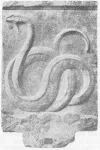
The two reliefs in figs. 1 and 2 were found at the Peiraeus and are now in the Berlin Museum 4. From the inscription on the relief in fig. 1 and from numerous other inscribed reliefs found with it, it is practically certain that at the place in which they were found Zeus Meilichios was worshipped. In any case the relief in fig. 1 is clearly dedicated to him. Above the splendid coiled beast is plainly inscribed to Zeus Meilichios'
(Διὶ Μειλιχίῳ). We are brought face to face with the astounding fact that Zeus, father of gods and men, is figured by his worshippers as a snake.
FIG. 1
So astonishing is the inscription that M. Foucart 1, who first discussed these reliefs, suggested that in Zeus Meilichios we have merely a Hellenic rendering of a Phenician divinity, Baal Melek or Moloch. The worship of such a divinity would be well in place at the harbour of Munychia, and as M. Foucart points out, the names of the dedicators lack the demotic. Unfortunately for this interesting theory we have no evidence that 'Moloch' was ever worshipped in snake form. Another way out of the difficulty was sought; the snake it was suggested was, not the god himself, but his attribute. But this solution does not square with facts. Zeus is one of the few Greek gods who never appear attended by a snake. Asklepios, Hermes, Apollo, even Demeter and Athene have their snakes;
[paragraph continues] Zeus never. Moreover when the god developed from snake form to human form, as, it will later be shown, was the case with Asklepios, the snake he once was remains coiled about his staff or attendant at his throne. In the case of Zeus Meilichios in human form the snake he once was not disappears clean and clear.
FIG. 2 The explanation of the snake as merely an attribute is indeed impossible to any unbiassed critic who looks at the relief in fig. 2. Here clearly the snake is the object worshipped by the woman and two men who approach with gestures of adoration. The colossal size of the beast as it towers above its human adorers is the Magnificat of the artist echoed by the worshippers. When we confront the relief in fig. 3, also found at the Peiraeus, with those in figs. 1 and 2, the secret is out at last. In fig. 3 a man followed by a woman and child approaches an altar, behind which is seated a bearded god holding a sceptre and patera for libation. Above is clearly inscribed 'Aristarche to Zeus Meilichios' (Ἀριστάρχη Διὶ Μειλιχίῳ). And the truth is nothing more or less than this. The human-shaped Zeus has slipped himself quietly into the place of the old snake-god. Art sets plainly forth what has been dimly shadowed in ritual and mythology. It is not that Zeus the Olympian has an underworld aspect'; it is the cruder fact that he of the upper air, of the thunder and lightning, extrudes an ancient serpent-demon of the lower world, Meilichios. Meilichios is no foreign Moloch, he is home-grown, autochthonous before the formulation of Zeus.
How the shift may have been effected art again helps us to
FIG. 3
conjecture. In the same sanctuary at the Peiraeus that yielded the reliefs in figs. 1 and 2 was found
FIG. 4 the inscribed relief 1 in fig. 4. We have a similar bearded snake and above is inscribed 'Heracleides to the god.' The worshipper is not fencing, uncertain whether he means Meilichios or Zeus; he brings his offering to the local precinct where the god is a snake and dedicates it to the god, the god of that precinct. It is not monotheism, rather it is parochialism, but it is a conception tending towards a later monotheism. When and where the snake is simply 'the god,' the fusion with Zeus is made easy.
In fig. 5 is figured advisedly a monument of snake worship, which it must be distinctly noted comes, not from the precinct of Zeus Meilichios at the Peiraeus, but from_ Eteonos in Boeotia. When we come to the discussion of hero-worship, it will be seen that all over Greece the dead hero was worshipped in snake form
and addressed by euphemistic titles akin to that of Meilichios. The relief from Boeotia is a good instance of such worship and is
FIG. 5
chosen because of the striking parallelism of its art type with that of the Peiraeus relief in fig. 3. The maker of this class of votive reliefs seems to have kept in stock designs of groups of pious worshippers which he could modify as required and to which the necessary god or snake and the appropriate victim could easily be appended. Midway in conception between the Olympian Zeus with his sceptre and the snake demon stands another relief 1 (fig. 6), also from the Peiraeus sanctuary. Meilichios is human, a snake no longer, but he is an earth god, he bears the cornucopia 2, his victim is the pig. He is that Meilichios to whom Xenophon offered the holocaust of pigs, praying for wealth; he is also the Zeus-Hades of Euripides. We might have been tempted to call him simply Hades or Ploutos but for the inscription [Κριτο]βόλη Διὶ Μειλιχίῳ, 'Kriloboule to Zeus Meilichios,' which makes the dedication certain.
By the light then of these reliefs the duality, the inner discrepancy of Zeus Meilichios admits of a simple and straightforward solution. It is the monument of a superposition of cults.
But the difficulty of the name of the festival, Diasia, remains. There is no reason to suppose that the name was given late; and, if primitive, how can we sever it from Διός?
FIG. 6
It is interesting to note that the ancients themselves were not quite at ease in deriving Diasia from Διός. Naturally they were not troubled by difficulties as to long and short vowels, but they had their misgivings as to the connotation of the word, and they try round uneasily for etymologies of quite other significance. The Scholiast on Lucian's Timon 1 says the word is probably derived from διασαίνειν 'to fawn on,' 'to propitiate.' Suidas 2 says it comes from διαφυγεῖν αὐτοὺς εὐχαῖς τὰς ἄσας, because in the Diasia 'men escaped from curses by prayers.' If etymologically absurd, certainly, as will be seen, a happy guess.
Such derivations are of course only worth citing to show that even in ancient minds as regards the derivation of Diasia from Διός misgiving lurked.
The misgiving is emphasized by the modern philologist. The derivation of Diasia with its long from Διός with its short i is scientifically improbable if not impossible. Happily another derivation that at least satisfies scientific conditions has been suggested by Mr R. A. Neil. Not only does it satisfy scientific conditions but it also confirms the view arrived at by independent
investigation of the ritual and art representations of Zeus Meilichios. Mr Neil 1 suggests that in several Greek words showing the stem δῑο this stem may stand by the regular falling away of the medial σ for δῑσο and is identical with the Latin dīro 2. dirus, he notes, was originally a purely religious word. Such words would be the Dīasia, whatever the termination may be, the Δῖα of Teos, and perhaps the Πάνδια of Athens. Seen in the light of this new etymology the Diasia becomes intelligible: it is the festival of curses, imprecations; it is nocturnal and associated with rites of placation and purgation, two notions inextricably linked in the minds of the ancients.
We further understand why Meilichios seems the male double of Erinys and why his rites are associated with 'chilly gloom.' The Diasia has primarily and necessarily nothing to do with Διός, with Zeus; it has everything to do with 'dirae,' magical curses, exorcisms and the like. The keynote of primitive ritual, it will become increasingly clear, is exorcism.
In the light of this new derivation it is possible further to explain another element in the cult of Zeus Meilichios hitherto purposely left unnoticed, the famous Διὸς κώδιον, the supposed 'fleece of Zeus.' The Διὸς κώδιον is, I think, no more the fleece of Zeus than the Diasia is his festival.
Polemon, writing at the beginning of the second century B.C., undoubtedly accepted the current derivation, and on the statement of Polemon most of our notices of 'the fleece of Zeus' appear to be based. Hesychius 3 writes thus: 'The fleece of Zeus: they use this expression when the victim has been sacrificed to Zeus, and those who were being purified stood on it with their left foot.
[paragraph continues] Some say it means a great and perfect fleece. But Polemon says it is the fleece of the victim sacrificed to Zeus.
But Polemon is by no means infallible in the matter of etymology, though invaluable as reflecting the current impression of his day. Our conviction that the Διὸς κώδιον is necessarily 'the fleece of Zeus' is somewhat loosened when we find that this fleece was by no means confined to the ritual of Zeus, and in so far as it was connected with Zeus, was used in the ritual only of a Zeus who bore the titles Meilichios and Ktesios. Suidas 1 expressly states that 'they sacrifice to Meilichios and to Zeus Ktesios and they keep the fleeces of these (victims) and call them "Dian," and they use them when they send out the procession in the month of Skirophorion, and the Dadouchos at Eleusis uses them, and others use them for purifications by strewing them under the feet of those who are polluted.'
It is abundantly clear that Zeus had no monopoly in the fleece supposed to be his; it was a sacred fleece used for purification ceremonies in general. He himself had taken over the cult of Meilichios, the Placable One, the spirit of purification; we conjecture that he had also taken over the fleece of purification.
Final conviction comes from a passage in the commentary of Eustathius 2 on the purification of the house of Odysseus after the slaying of the suitors. Odysseus purges his house by two things, first after the slaying of the suitors by water, then after the hanging
of the maidens by fire and brimstone. His method of purifying is a simple and natural one, it might be adopted to-day in the disinfecting of a polluted house. This Eustathius notes, and contrasts it with the complex magical apparatus in use among the ancients and very possibly still employed by the pagans of his own day. He comments as follows: 'The Greeks thought such pollutions were purified by being "sent away." Some describe one sort of purifications some others, and these purifications they carried out of houses after the customary incantations and they cast them forth in the streets with averted faces and returned without looking backwards. But the Odysseus of the poet does not act thus, but performs a different and a simpler act, for he says:
"Bring brimstone, ancient dame, the cure of ills, and bring me fire That I the hall may fumigate."'
In the confused fashion of his day and of his own mind Eustathius sees there is a real distinction but does not recognise wherein it lies. He does not see that Homer's purification is actual, physical, rational, not magical. He goes on: 'Brimstone is a sort of incense which is reputed to cleanse pollutions. Hence the poet distinguishes it, calling it "cure of ills." In this passage there are none of the incantations usual among the ancients, nor is there the small vessel in which the live coals were carried and thrown away vessel and all backwards.'
What half occurs to Eustathius and would strike any intelligent modern observer acquainted with ancient ritual is that the purification of the house of Odysseus is as it were scientific; there is none of the apparatus of magical 'riddance.' Dimly and darkly he puts a hesitating finger on the cardinal difference between the religion of Homer and that of later (and earlier) Greece, that Homer is innocent, save for an occasional labelled magician, of magic. The Archbishop seems to feel this as something of a defect, a shortcoming. He goes on: 'It must be understood that purifications were effected not only as has just been described, by means of sulphur, but there are also certain plants that were useful for this purpose; at least according to Pausanias there is verbena, a plant in use for purification, and the pig was sometimes employed for such purposes, as appears in the Iliad.' This mention of means of purification in general brings irresistibly to the mind of Eustathius a salient instance, the very
fleece we are discussing. He continues: 'Those who interpret the word διοπομπεῖν say that they applied the term δῖον to the fleece of the animal that had been sacrificed to Zeus Meilichios in purifications at the end of the month of Maimakterion 1 when they performed the Sendings and when the castings out of pollutions at the triple ways took place: and they held in their hands a sender which was they say the kerukeion, the attribute of Hermes, and from a sender of this sort, pompos, and from the δῖον, the fleece called "Dian," they get the word διοπομπεῖν, divine sending.'
From this crude and tentative etymological guessing two important points emerge. Eustathius does not speak of the 'fleece of Zeus,' but of the Dian or perhaps we may translate divine fleece. δῖος is with him an adjective to be declined, not the genitive of Ζεύς. This loosens somewhat the connection of the fleece with Zeus, as the adjective δῖος could be used of anything divine or even magical in its wonder and perfection. Further, and this is of supreme importance, he connects the Dian fleece with the difficult word διοπομπεῖν, and in this lies the clue to its real interpretation. 'That this,' he goes on--meaning his derivation of διοπομπεῖν from πομπός the kerukeion of Hermes and δῖον the divine fleece--'is so we find from special investigation, but in more general parlance by διοπομπεῖν and ἀποδιοπομπεῖν is meant the sending away of unclean things in the name of Zeus Averter of Evil.' Eustathius evidently gets nervous; his 'special investigation' is leading him uncomfortably near the real truth, uncomfortably far from the orthodox Zeus, so he pulls himself up instinctively.
The explanation of the strange word ἀποδιοπομπεῖν, to which Eustathius at the close of his remarks piously reverts, is still accredited by modern lexicons. ἀποδιοπομπεῖσθαι--the middle form is the more usual--means, we are told, 'to avert threatened evils by offerings to Zeus 2.' Are scholars really prepared to believe that ἀποδιοπομπεῖσθαι means, to put it shortly, 'to Zeus things away'? The lexicons after this desperate etymology proceed: 'hence, to conjure away, to reject with abhorrence,' and finally, under a heading apart, 'ἀποδιοπομπεῖσθαι οἶκον, to purify a house.' Surely from beginning to end the meaning inherent in the word
is simply 'to rid of pollution'; ἀποδιοπομπεῖσθαι is substantially the same as ἀποπέμπειν, to send away, to get rid of, but--and this is the important point--the element διο emphasizes the means and method of the 'sending.' The quantity of the ι in ἀποδιοπομπεῖσθαι we have no means of knowing, the ι in Diasia the feast of Zeus Meilichios is long, the ι in the δῖον κώδιον used in his service is long, the δῖον κώδιον is used in ritual concerned with διοπομπούμενα, its purpose is ἀποδιοπομπεῖσθαι. Is it too bold to see in the mysterious διο the same root as has been seen in Diasia and to understand ἀποδιοπομπεῖσθαι as 'to effect riddance by magical imprecation or deprecation'?
The word dirus is charged with magic, and this lives on in the Greek word δῖος which is more magical than divine. It has that doubleness, for cursing and for blessing, that haunts all inchoate religious terms. The fleece is not divine in our sense, not definitely either for blessing or for cursing; it is taboo, it is 'medicine,' it is magical. As magical medicine it had power to purify, i.e. in the ancient sense, not to cleanse physically or purge morally, but to rid of evil influences, of ghostly infection.
Magical fleeces were of use in ceremonies apparently the most diverse, but at the bottom of each usage lies the same thought, that the skin of the victim has magical efficacy as medicine against impurities. Dicaearchus 1 tells us that at the rising of the dog-star, when the heat was greatest, young men in the flower of their age and of the noblest families went to a cave called the sanctuary of Zeus Aktaios, and also (very significantly it would seem) called the Cheironion; they were girded about with fresh fleeces of triple wool. Dicaearchus says that this was because it was so cold on the mountain; but if so, why must the fleeces be fresh? Zeus Aktaios, it is abundantly clear, has taken over the cave of the old Centaur Cheiron; the magic fleeces, newly slain because all 'medicine' must be fresh, belong to his order as they belonged to the order of Meilichios.
Again we learn that whoever would take counsel of the oracle of Amphiaraos 2 must first purify himself, and Pausanias himself
adds the explanatory words, 'Sacrificing to the god is a ceremony of purification.' But the purification ceremony did not, it would appear, end with the actual sacrifice, for he explains, 'Having sacrificed a ram they spread the skin beneath them and go to sleep, awaiting the revelation of a dream'; here again, though the name is not used, we have a δῖον κώδιον, a magic fleece with purifying properties. It is curious to note that Zeus made an effort to take over the cult of Amphiaraos, as he had taken that of Meilichios; we hear of a Zeus Amphiaraos 1, but the attempt was not a great success; probably the local hero Amphiaraos, himself all but a god, was too strong for the Olympian.
The results of our examination of the festival of the Diasia are then briefly this. The cult of the Olympian Zeus has overlaid the cult of a being called Meilichios, a being who was figured as a snake, who was a sort of Ploutos, but who had also some of the characteristics of an Erinys; he was an avenger of kindred blood, his sacrifice was a holocaust offered by night, his festival a time of 'chilly gloom.' A further element in his cult was a magical fleece used in ceremonies of purification and in the service of heroes. The cult of Meilichios is unlike that of the Olympian Zeus as described in Homer, and the methods of purification characteristic of him wholly alien. The name of his festival means 'the ceremonies of imprecation.'
The next step in our investigation will be to take in order certain well-known Athenian festivals, and examine the ceremonies that actually took place at each. In each case it will be found that, though the several festivals are ostensibly consecrated to various Olympians, and though there is in each an element of prayer and praise and sacrificial feasting such as is familiar to us in Homer, yet, when the ritual is closely examined, the main part of the ceremonies will be seen to be magical rather than what we should term religious. Further, this ritual is addressed, in so far as it is addressed to any one, not to the Olympians of the upper air, but to snakes and ghosts and underworld beings; its
main gist is purification, the riddance of evil influences, this riddance being naturally prompted not by cheerful confidence but by an ever imminent fear.
In the pages that follow but little attention will be paid to the familiar rites of the Olympians, the burnt-sacrifice and its attendant feast, the dance and song; our whole attention will be focussed on the rites belonging to the lower stratum. This course is adopted for two reasons. First, the rites of sacrifice as described by Homer are simple and familiar, needing but little elucidation and having already received superabundant commentary, whereas the rites of the lower stratum are often obscure and have met with little attention. Second, it is these rites of purification belonging to the lower stratum, primitive and barbarous, even repulsive as they often are, that furnished ultimately the material out of which 'mysteries' were made--mysteries which, as will be seen, when informed by the new spirit of the religions of Dionysos and Orpheus, lent to Greece its deepest and most enduring religious impulse.
ATTIC CALENDAR.
NOTE. Names of Festivals selected for special discussion are printed in large type. Names of Festivals incidentally discussed in italics.
1.
Hecatombaion
July, August
Kronia, Panathenaia
2.
Metageitnion
Aug., September
3.
Boedromion
Sept., October
Eleusinia and Greater Mysteries
4.
Pyanepsion
Oct., November
THESMOPHORIA. Pyanepsia and Oschophoria [Id. Oct. (Oct. 15) October Horse]
5.
Maimakterion
Nov., December
‘Διὸς κώδιον’
6.
Poseideon
Dec., January
Haloa
7.
Gamelion
Jan., February
8.
Anthesterion
Feb., March
ANTHESTERIA, DIASIA, Lesser Mysteries [XV. Kal. Mart. (Feb. 15) Lupercalia] [(Feb. 21) Feralia]
9.
Elaphebolion
March, April
Dionysia
10.
Munychion
April, May
Munychia, Brauronia
11.
Thargelion
May, June
THARGELIA, Kallynteria, Plynteria (May 15 Argei, June 15 Vestalia, Q. St. D. F.)
12.
Skirophorion
June, July
Skirophoria, Arrephoria, Dipolia, Bouphonia
The Athenian official calendar began in the month Hecatombaion (July-August) at the summer's height. In it was
celebrated the great festival of the Panathenaia, whose very name marks its political import. Such political festivals, however magnificent and socially prominent, it is not my purpose to examine; concerning the gist of primitive religious conceptions, they yield us little. The Panathenaia is sacred rather to a city than a goddess. Behind the Panathenaia lay the more elementary festival of the Kronia, which undoubtedly took its name from the faded divinity Kronos; but of the Kronia the details known are not adequate for its fruitful examination.
A cursory glance at the other festivals noted in our list shows that some, though not all, gave their names to the months in which they were celebrated, and (a fact of high significance) shows also that with one exception, the Dionysia, these festivals are not named after Olympian or indeed after any divinities. Metageitnia, the festival of 'changing your neighbours,' is obviously social or political. The Eleusinia are named after a place, so are the Munychia and Brauronia. The Thesmophoria, Oschophoria, Skirophoria and Arrephoria are festivals of carrying something; the Anthesteria, Kallynteria, Plynteria festivals of persons who do something; the Haloa a festival of threshing-floors, the Thargelia of first fruits, the Bouphonia of ox-slaying, the Pyanepsia of bean-cooking. In the matter of nomenclature the Olympians are much to seek.
The festivals in the table appended are arranged according to the official calendar for convenience of reference, but it should be noted that the agricultural year, on which the festivals primarily depend, begins in the autumn with sowing, i.e. in Pyanepsion. The Greek agricultural year fell into three main divisions, the autumn sowing season followed by the winter, the spring with its first blossoming of fruits and flowers beginning in Anthesterion, and the early summer harvest (ὀπώρα) beginning in Thargelion, the month of first-fruits; to this early harvest of grain and fruits was added with the coming of the vine the vintage in Boedromion, and the gathering in of the later fruits, e.g. the fig. All the festivals fall necessarily much earlier than the dates familiar to us in the North. In Greece to-day the wheat harvest is over by the middle or end of June.
No attempt will be made to examine all the festivals, for two practical reasons, lack of space and lack of material, but fortunately
for us we have adequate material for the examination of one characteristic festival in each of the agricultural seasons, the Thesmophoria for autumn, the Anthesteria for spring, the Thargelia for early summer, and in each case the ceremonies of the several seasons can be further elucidated by the examination of the like ceremonies in the Roman calendar. To make clear the superposition of the two strata, which for convenience' sake may be called Olympian and chthonic, the Diasia 1 has already been examined. In the typical festivals now to be discussed a like superposition will be made apparent, and from the detailed examination of the lower chthonic stratum it will be possible to determine the main outlines of Greek religious thought on such essential points as e.g. purification and sacrifice.
It would perhaps be more methodical to begin the investigation with the autumn, with the sowing festival of the Thesmophoria, but as the Thesmophoria leads more directly to the consummation of Greek religion in the Mysteries it will be taken last. The reason for this will become more apparent in the further course of the argument. We shall begin with the Anthesteria.
Footnotes
1:1 Thuc. II. 38, and in the same spirit Plato (Legg. 653 n) writes ....
2:1 Ps.-Xen. Rep. Athen. n. 99.
2:2 Ps.-Xen. Rep. Athen. III. 8.
2:3 Plat. Euthyph. 15 D.
2:4 So far as it is possible to distinguish the two, τὸ εὐσεβές is religion from man's side, his attitude towards the gods, τὸ ὅσιον religion from the gods' side, the claim they make on man. τὸ ὅσιον is the field of what is made over, consecrated to the gods. The further connotations of the word as employed by Orphism will be discussed later. 'Holiness' is perhaps the nearest equivalent τὸ ὅσιον in the Euthyphron.
4:1 Sext. Empir. adv. Math. ix. 123.
4:2 The Characters of Theophrastus, p. 264.
4:3 Arist. Polit. p. 1315 a 1.
4:4 Plut. de Superstit. I.
5:1 Plut. de aud. poet. 4.
5:2 Eur. frg. 292.
5:3 Plut. de Superstit. X.
5:4 Plut, de Superstit. IX.
6:1 Plut. de Superstit. III.
7:1 Xen. Cyropaed. III. 3. 58.
8:1 Isocr. Or. v. 117.
8:2 Plat. Legg. 854 B ....
9:1 Harpocrat. s.v. ἀποπομπάς.
9:2 P. II. 11. 1.
9:3 Babr. Fab. 63.
10:1 Hippocr. περὶ ἐνυπνίων 639, ....
10:2 English has no convenient equivalent for ἀποτροπή, which may mean either turning ourselves away from the thing or turning the thing away from us. Aversion, which for lack of a better word I have been obliged to adopt, has too much personal and no ritual connotation. Exorcism is nearer, but too limited and explicit. Dr Oldenberg in apparent unconsciousness of θεραπεία and ἀποτροπή uses in conjunction the two words Cultus and Abwehr. To his book, Die Religion des Veda, though he hardly touches on Greek matters, I owe much.
11:1 Hom. Il. II. 421.
12:1 Companion to the Iliad, p. 77. I have advisedly translated οὐλοχύται by barley grain, not meal, because I believe the οὐλοχύταιto be a primitive survival of the custom of offering actual grain, but this disputed question is here irrelevant. I follow Dr H. von Fritze, Hermes XXXII. 1897, p. 236.
12:2 Legg. 653 ξυνεορταστάς.
12:3 The sources for the Diasia are all collected in the useful and so far as I am aware complete work, Oskar Band, Die Attischen Diasien--ein Beitrag zur Griechischen Heortologie, Wissenschaftliche Beilage zum Programm der Victoriaschule, Ostern 1883 (Berlin). Many of the more important sources are easily accessible in Mr Farnell's Cults of the Greek States, vol. I. pp. 171, 172. Mr Farnell regards Zeus Meilichios as merely a form of the Olympian Zeus, not as a contaminatio of two primarily distinct religious conceptions.
12:4 On. I. 37.
13:1 Thucyd. I. 126 ....
14:1 vv. 864 and 408.
14:2 Luc. Icaro-Menip. 24 schol. ad loc. ....
15:1 Xen Anab. VII. 9. 4. .... The incident probably took place in February, the month of the Diasia. See Mr H. G. Dakyns, Xen. vol. I. p. 315.
16:1 P. x. 38. 8.
16:2 P. I. 37. 4.
17:1 P. II. 20. 1.
17:2 Hesych. s.v. Μαιμάκτης· μειλίχιος, καθάρσιος.
17:3 P. II. 2. 8.
17:4 Permission to republish the two reliefs figured here and that in fig. 5 has been courteously granted me by Professor Kekulé von Stradowitz, Director of the Berlin Museum, and I owe to his kindness the excellent photographs from which the reproductions are made. From the official catalogue (Beschreibung der Antiken Skulpturen in Berlin) I quote the following particulars as to material, provenance &c.
1. Cat. 722, H. 0•58, Br. 0•31. Hymettus marble found with No. 723 at the Zea harbour not far from Ziller's house. Taken to Berlin 1872. Inscribed ΔΙΙ ΜΕΙΛΙΧΙΩΙ. Date fourth century D.C., see CIA. II. 3, 1581, cf. CIA. II. 3. 1578, 1582, 1583.
2. Cat. 723, material, provenance, date, same as 722.
18:1 Bull. de Corr. Hell. vii. p. 507. I regret that in the first edition of my book I treated M. Foucart's theory with, I fear, scant ceremony. The possibility of a contaminatio between the Phenician Baal and Zeus Meilichios cannot be lightly dismissed. For a discussion of the subject see especially Clermont-Ganneau, Le dieu Satrape, p. 65, on the river Meilichos at Patrae, and Lagrange, Etudes sur les Religions Sémitiques, p. 105. But until evidence is forthcoming of the snake-form of Moloch it is simpler to see in the snake Meilichios an indigenous snake demon of the under world.
20:1 Bull. de Corr. Hell. 1883, p. 510.
21:1 From a photograph (Peiraeus 12) published by kind permission of the German Archaeological Institute, see Eph. Arch. 1886, p. 47.
21:2 The cornucopia would be a natural attribute for Zeus Ktesios who Dr Martin Nilsson kindly tells me appears in snake form (inscribed) on a votive relief in the local Museum at Thebes.
22:1 Lucian, Tim. c. 7.
22:2 Suidas s.v. Διάσια.
23:1 J.H.S. XIX. p. 114, note 1.
23:2 Mr P. Giles kindly tells me that a rare Sanskrit word dveshas meaning 'hate' and the like exists and phonetically would nearly correspond to the Latin dirus. The corresponding form in Greek would appear as δειος, unless in late Greek. But from the end of the fifth century B.C. onwards the pronunciation would be the same as δῖος, and if the word survived only in ritual terms it would naturally be confused with δῖος. Almost all authorities on Latin however regard the ru in dirus as a suffix containing an original r as in mirus, durus etc. This view, which would be fatal to the etymology of dirus proposed in the text, seems supported by a statement of Servius (if the statement be accurate) on Aen. III. 235 'Sabini et Umbri quae nos mala dira appellant,' as, though s between vowels passes in Latin and Umbrian into r, it remains an s sound in Sabine.
23:3 Hesych. s.v. .... From Athenaeus also we learn that Polemon had treated in some detail of the 'fleece of Zeus'; Athenaeus says (XI. p. 478 c), ......
24:1 Suidas s.v. .... For Δία Gaisford conjectures Διὸς but from the passage of Eustathius (see infr.) it is clear that we must read δῖα.
24:2 Eustath. ad Od. XXII. 481 § 1934-5 .... Eustathius passes on to speak of purification by blood and the φαρμακοί, see .
26:1 Maimaktes, it will be remembered, is the other face of Meilichios, see supra.
26:2 See Liddell and Scott, s.v.
27:1 Dicaearch. Frg. Hist. II. 262.
27:2 P. I. 34. 2-5. Strabo (VI. p. 284) says that the Daunians when they consulted the oracle of the hero Calchas sacrificed a black ram to him and slept on the fleece. The worshippers of the 'Syrian Goddess,' Lucian says (De Syr. Dea 35), knelt on the p. 28 ground and put the feet and the head of the victim on their heads. He probably means that they got inside the skin and wore it with the front paws tied round the neck as Heracles wears the lion-skin.
28:1 Dicaearchus I. 6.
31:1 For all questions respecting Zeus I am now able to refer to Mr A. B. Cook's great work Zeus, a study in ancient religion, Cambridge University Press, 1914. I would draw special attention to his criticism of my view of the Diasia which will appear in vol. II of Zeus.
CHAPTER II.
THE ANTHESTERIA.
THE RITUAL OF GHOSTS AND SPIRITS.
OUR examination of the unpromising Diasia has so far led us to the following significant, if somewhat vague, results. The festival in all probability did not originally belong to Zeus, but to a being called Meilichios, a snake god or demon. The worship of this being was characterized by nightly ceremonies, holocausts which the sun might not behold; it was gloomy in character, potent for purification. The name of the festival is probably associated with dirae, curses, imprecations.
The Diasia, gloomy though it is, is a spring festival and its significance will be yet more plainly apparent if we examine another, the other spring festival of the Greeks, i.e. the Anthesteria, which gives its name to the first spring month Anthesterion.
If we know little about the Diasia; about the Anthesteria 1 we know much. Apollodorus, quoted by Harpocration, tells us that the whole festival collectively was called Anthesteria, that it was celebrated in honour of Dionysos, and that its several parts, i.e. its successive days, were known as Pithoigia (cask-opening), Choes (cups), Chytroi (pots). The exact date of the festival is fixed, the three successive days falling from the 11th to the 13th of Anthesterion 2.
On the first day, the 11th of Anthesterion, i.e. the Pithoigia, Plutarch 1' tells us 'they broached the new wine at Athens. It was an ancient custom,' he adds, 'to offer some of it as a libation before they drank it, praying at the same time that the use of the drug (φαρμάκου might be rendered harmless and beneficial to them.' This is a clear case of the offering of first-fruits 2. Among his own people, the Boeotians, Plutarch adds, 'the day was called the day of the Good Spirit 3, the Agathos Daimon, and to him they made offerings. The month itself was known as Prostaterios.' The scholiast to Hesiod 4 tells us that the festival was an ancestral one (ἐν τοῖς πατρίοις), and that it was not allowable to hinder either household slaves or hired servants from partaking of the wine.
The casks once opened, the revel set in and lasted through the next day (the Choes or Cups) and on through the third (the Chytroi or Pots). The day of the Choes seems to have been the climax, and sometimes gave its name to the whole festival.
It is needless to dwell on all the details of what was in intent a three days' fair. A 'Pardon' in the Brittany of to-day affords perhaps the nearest modern analogy. The children have holidays, fairings are bought, friends are feasted, the sophists get their fees, the servants generally are disorganized, and every one down to the small boys, as many a vase-painting tells us, is more or less drunk. There is a drinking contest presided over by the King Archon, he who first drains his cup gets a cake, each man crowns his cup with a garland and deposits the wreath in keeping of the priestess of the sanctuary of Dionysos in the Marshes. On the day of the Cups takes place the august ceremony of the wedding of the wife of the King Archon to the god Dionysos. On that day alone in all the year the temple of Dionysos is opened 5.
On the third day, the Chytroi or Pots, there was a dramatic contest 6 known as Χύτρινοι, Pot-contests. During this third day the revel went on; Aristophanes 7 has left us the
picture of the drunken mob thronging the streets at the holy Pot-Feast:
'O brood of the mere and the spring, Gather together and sing From the depths of your throat By the side of the boat Coäx, as we move in a ring.
As in Limnae we sang the divine Nyseïan Giver of Wine, When the people in lots With their sanctified Pots Came reeling around my shrine.'
The scholiast on the Acharnians 1, a play which gives us a lively picture of the festival, says that the Choes and the Chytroi were celebrated on one day. The different days and acts of the whole Anthesteria were doubtless not sharply divided, and if each day was reckoned from sunrise to sunset confusion would easily arise.
So far a cursory inspection clearly shows that the Anthesteria was a wine-festival in honour of Dionysos. Moreover we have the definite statement of Thucydides 2 that 'the more ancient Dionysia were celebrated on the 12th day of the month Anthesterion in the temple of Dionysos in the Marshes.' The reference can only be to the Choes, so that the festival of the Choes seems actually to have borne the name Dionysia. Harpocration 3 goes even further; he says, quoting Apollodorus, that 'the whole month was sacred to Dionysos.'
A more searching examination of the sources reveals beneath the surface rejoicings, as in the case of the Diasia, another and more primitive ritual, and a ritual of widely different significance. It has escaped no student of Greek festivals that through the Anthesteria there ran 'a note of sadness.' Things were not altogether so merry as they seemed. This has been variously explained, as due to the 'natural melancholy of the spring,' or more recently as evidence of the fact that Dionysos had his 'chthonic side' and was the 'Lord of souls.' A simpler explanation lies at the door.
The clue to the real gist of the Anthesteria is afforded by
a piece of ritual performed on the last day, the Chytroi. The Greeks had a proverbial expression spoken, we are told, of those who 'on all occasions demand a repetition of favours received.' It ran as follows: 'Out of the doors! ye Keres; it is no longer Anthesteria.' Suidas 1 has preserved for us its true signification; it was spoken, he says, 'implying that in the Anthesteria the ghosts are going about in the city.' From this fragmentary statement the mandate, it is clear, must have been spoken at the close of the festival, so we cannot be wrong in placing it as the last act of the Chytroi.
The statement of Suidas in itself makes the significance of the words abundantly clear, but close parallels are not wanting in the ritual of other races. The Lemuria at Rome is a case in point. According to Ovid 2 each father of a family as the festival came round had to lay the ghosts of his house after a curious and complex fashion. When midnight was come and all was still, he arose and standing with bare feet he made a special sign with his fingers and thumb to keep off any ghost. Thrice he washes his hands in spring water, then he turns round and takes black beans into his mouth; with face averted he spits them away, and as he spits them says, ' These I send forth, with these beans I redeem myself and mine.' Nine times he speaks, and looks not back. The ghost, they believe, picks them up and follows behind if no one looks. Again he touches the water and strikes the brass of Temesa and begs the ghost to leave his house. When nine times he has said, 'Shades of my fathers, depart' (Manes exite paterni!),
he looks back and holds that the rite has been duly done. We cannot impute to the Anthesteria all the crude minutiae of the Lemuria, but the content is clearly the same--the expulsion of ancestral ghosts. The Lemuria took place not in the spring but in the early summer, May--a time at which ceremonies of purification were much needed.
A second striking parallel is recorded by Mr Tylor 1. He says of a like Sclavonic custom, 'when the meal was over the priest rose from the table and hunted out the souls of the dead like fleas with these words: "Ye have eaten and drunk, souls, now go, now go".' Dr Oldenberg 2 calls attention to another analogy. In sacrifices in India to the dead the souls of ancestors are first invoked, then bidden to depart, and even invited to return again after the prescribed lapse of a month.
The formula used at the close of the Anthesteria is in itself ample proof that the Anthesteria was a festival of All Souls; here at last we know for certain what was dimly shadowed in the Diasia, that some portion at least of the ritual of the month' Anthesterion was addressed to the powers of the underworld, and that these powers were primarily the ghosts of the dead. The evidence is not however confined to an isolated proverbial formulary. The remaining ritual of the Chytroi confirms it. Before they were bidden to depart the ghosts were feasted and after significant fashion.
The scholiast on Aristophanes 3 commenting on the words τοῖς ἱεροῖσι Χύτροισι, 'at the holy Pot-feast,' explains the ceremonies as follows: 'The Chytroi is a feast among the Athenians; the cause on account of which it is celebrated is explained by Theopompos who writes thus: . . . . . "They have the custom of sacrificing at this feast, not to any of the Olympian gods at all, but to Hermes Chthonios"; and again in explaining the wordχύτρα, pot: "And of the pot which all the citizens cook none of the priests tastes,
they do this on the (13th) day"; and again: "Those present appease Hermes on behalf of the dead".' The scholiast on another passage in Aristophanes 1 says substantially the same, but adds, again on the authority of Theopompos, that the practice of cooking the dish of seeds was observed by those who were saved from the deluge on behalf of those who perished. The deluge is of course introduced from a desire to get mythological precedent; the all-important points are that the χύτρα, the dish of grain and seeds, was offered to none of the Olympians, not even to Dionysos in whose honour the festival was ostensibly celebrated, but only to Hermes Chthonios, Hermes of the Underworld, and that of this sacrifice no man tasted. It was no sacrifice of communion, but like the holocaust made over utterly to dread chthonic powers, and behind this notion of sacrifice to the underworld deities lay the still earlier notion that it was dead men's food, a supper for the souls.
Before we leave the χύτρα it is necessary to examine more precisely the name of the day, Chytroi. August Mommsen 2 has emphasized the fact, too much neglected, that the name of the festival is masculine, οἱ χύτροι not αἱ χύτραι. The feminine form χύτραι means pots artificially made; the masculine form χύτροι, which occurs far less frequently, means in ordinary parlance natural pots, i.e. holes in the ground. Pausanias 3 speaks of a certain natural bath at Thermopylae which the country people called 'the Chytroi of the women'; and Herodotos 4 describes it in the same terms. Theophrastos 5 in his History of Plants speaks of a certain plant as growing in a place between the Kephisos and the Melas, the place being called Pelekania, i.e. certain hollows in the marsh, the so-called Pot-holes.' Hesychius 6, interpreting οἱ χύτρινοι, says they are 'the hollow places of the earth through which springs come up.' The word κολυμβήθρα itself, in classical Greek a natural pool, became in mediaeval Greek a font, and it may be
noted that the natural chasms that occur in western Yorkshire still locally bear the name of 'Pots.'
It is possible therefore that the festival took its name from natural holes in the ground in the district of the Limnae where it was celebrated, a district to this day riddled with Turkish cisterns made of great earthen jars (πίθοι). Such holes may have been used for graves, and were in many parts of Greece regarded as the constant haunt of ghosts going up and down. They were perhaps the prototypes of the 'chasms in the earth' seen in the vision of Er 1. Near akin were the megara or chasms of Demeter at Potniae 2, and the clefts on and about the Pnyx where the women celebrated the Thesmophoria (). Such chasms would be the natural sanctuaries of a Ge and ghost cult.
It is obvious that the two forms χύτροι and χύτραι would easily pass over into each other, and it is hard to say which came first. It is also to be noted that, though the masculine form more often means natural hole, it is also used for artificial pot. Pollux 3, in discussing 'the vessels used by cooks,' says that when Delphilos speaks of the big pot (χύτρον μέγαν) at the cook's, he clearly means the χύτρα, not the foot-pan (χυτρόμοδα). Though the form χύτροι ultimately established itself, the associations of χύτρα, artificial pot, seem to have prevailed, and these associations are important and must be noted.
Hesychius 4 says that by φαρμακή is meant the χύτρα which they prepared for those who cleansed the cities. From the scholiast on the Choephoroi of Aeschylus 5 we learn that the Athenians purified their houses with a censer made of a pot; 'this they threw away at the meeting of three ways and went away without turning back: Here we have of course the origin of 'Hecate's suppers.' These were primarily not feasts for the goddess but purification ceremonies, of which, as no mortal might taste them, it was supposed an infernal goddess partook. The day of the Chytroi was a day of such purifications. From some such notion arose the Aristophanic word ἐγχυτρίζειν, 'to pot,' i.e. to utterly ruin and destroy, to make away with. The scholiast 6 explains it as
referring to the practice of exposing children, but Suidas 1 knows of another meaning; he says the ἐγχυτρίστριαι were those 'women who purified the unclean, pouring upon them the blood of the victim,' and also those who 'poured libations to the dead,' those in a word who performed ceremonies of placation and purgation.
It is curious that, though most modern writers from Crusius onwards have recognised that the Chytroi was a dies nefastus and in the main a festival of ghosts, this day has been separated off from the rest of the Anthesteria, and the two previous days have been regarded as purely drinking festivals:--the Pithoigia the opening of the wine-cask, the Choes the drinking of the wine-cups. And yet for the second day, the Choes, literary testimony is explicit. Spite of the drinking contest, the flower-wreathed cups and the wedding of Dionysos, all joyful elements of the service of the wine-god, the Choes was a dies nefastus, an unlucky day, a day to be observed with apotropaic precautions. Photius 2, in explaining the words μιαρὰ ἡμέρα, 'day of pollution,' says such a day occurred 'in the Choes in the month of Anthesterion, in which (i.e. during the Choes) they believed that the spirits of the dead rose up again. From early morning they used to chew buckthorn and anointed their doors with pitch.' Buckthorn, known to modern botanists as Rhamnus catharticus, is a plant of purgative properties. The ancient Athenian, like the modern savage, believed that such plants have the power of keeping off evil spirits, or rather perhaps of ejecting them when already in possession: Chewing a substance was naturally a thorough and efficient way of assimilating its virtues. The priestess of Apollo chewed the laurel leaf. It seems possible that she may have primarily had to do this rather as a means of ejecting the bad spirits than to obtain inspiration from the good. Fasting is a substantial safe-guard, but purgation more drastically effective. The prophylactic properties of rhamnus, buckthorn, were well known to the ancients. Dioscorides 3 in his Materia Medica
writes, 'it is said that branches of this plant attached to doors or hung up outside repel the evil arts of magicians.' Possibly, in addition to the chewing of buckthorn, branches of it were fastened to doors at the festival of the Choes, and served the same purpose as the pitch. Pitch, Photius tells us in commenting on rhamnus, was on account of its special purity used also to drive away sprites at the birth of a child--always a perilous moment 1
It is not easy to imagine an enlightened citizen of the Athens of the fifth century B.C., an Aeschylus, a Pericles, chewing buckthorn from early dawn to keep off the ghosts of his ancestors, but custom in such matters has an iron hand. If the masters of the house shirked the chewing of buckthorn, the servants would see to it that the doors were at least anointed with pitch; it is best to be on the safe side in these matters, and there is the public opinion of conservative neighbours to be considered. Be this as it may, it is quite clear that the day of the Choes was a day of ghosts like the day of the Chytroi.
But, if the ceremonies of the Choes clearly indicate the 'unlucky' nature of the day, what is to be made of the name? Nothing, as it stands. Choes, Cups, are undeniably cheerful. But, as in the case of Chytroi, there may have been a confusion between approximate forms; the two words χοή, funeral libation, and χοῦς, cup, have a common stem χοϝ. May not χόες have superimposed itself on χοαί, wine-cups upon funeral libations? A scholiast on Aristophanes 2 seems to indicate some such a contaminatio. In explaining the word χοάς, he says the meaning is 'pourings forth, offerings to the dead or libations. An oracle was issued that they must offer libations (χοάς) yearly to those of the Aetolians who had died, and celebrate the festival so called.' Here the name of a festival Χοάς is oxytone, and though we cannot
assume that it was identical with the Athenian Choes, it looks as if there was some confusion as to the two analogous forms.
If we view the Choes as Χοαί, the Cups as Libations, the anomalous and, as it stands, artificial connection of Orestes with the festival becomes at once clear. At the drinking bout of the Choes, we learn from Athenaeus 1 and other authorities, the singular custom prevailed that each man should drink by himself. A mythological reason was sought to account for this, and the story was told 2 that Orestes, polluted by the blood of his mother, came to Athens at the time of the celebration of the Choes. The reigning king, variously called Pandion and Phanodemus, wished to show him hospitality, but religious scruple forbade him to let a man polluted enter the Sanctuaries or drink with those ceremonially clean. He therefore ordered the Sanctuaries to be shut and a measure of wine (χοῦς) to be set before each man severally, and bade them, when they had finished drinking, not to offer up the garlands with which they had been crowned in the Sanctuaries, because they had been under the same roof with Orestes; but he bade each man place his wreath round his own cup, and so bring them to the priestess at the precinct of the Limnae. That done, they were to perform the remaining sacrifices in the Sanctuary. From this, Athenaeus adds, the festival got the name of Cups. The mad Orestes in the Iphigenia in Tauris 3 tells the same tale and naïvely states that, though he was hurt by the procedure, he dare not ask the reason, knowing it all too well.
The whole account is transparently aetiological. Some mythological precedent is desired for the drinking bout of the Choes, based as it was on a ceremony of funeral libations; it is sought and found or rather invented in the canonical story of Orestes, and he is made to say in a fashion almost too foolish even for a madman:
'And this I learn, that my mishaps became A rite for the Athenians; and Pallas' folk Have still this custom that they reverence The Choan vessel.'
If we suppose that the Cups (χόες) were originally Libations (χοαί), the somewhat strained punctilio of the host becomes at least intelligible. Orestes is polluted by the guilt (ἄγος) of his
mother's blood, he finds the people in the Limnae 1, close to the Areopagos, celebrating the Χοαί, the libations to the dead; till he is purified from kindred blood he cannot join: all is simple and clear.
If the Choes were in intent χοαί, the Cups Libations, the ceremony has an interesting parallel in a rite performed at the Eleusinian mysteries. Athenaeus 2, in discussing various shapes of cups says: 'The plemochoë is an earthen vessel shaped like a top that stands fairly steady; some call it, Pamphilos tells us, the cotyliscus. And they use it at Eleusis on the last day of the mysteries, which takes its name Plemochoai from the cup. On this day they fill two plemochoae and set them up, the one towards the East, the other towards the West, and pronounce over them a magic formula. The author of the Peirithous mentions them, whether he be Ktesias the Tyrant or Euripides, as follows:
"That these plemochoae down the Chthonian chasm With words well-omened we may pour."'
It is at least significant that a compound of the word χοή should both give its name to a festival day and to a vessel used in chthonic ritual.
The Chytroi and Choes then bear unmistakeably a character of gloom, and in their primary content are festivals of ghosts. But what of the Pithoigia? Surely this day is all revel and jollity, all for Dionysus?
Had we been dependent on literature alone, such would have been our inevitable conclusion. In Plutarch's account of the Pithoigia (p. 33), the earliest and fullest we possess, there is no hint of any worship other than that of the wine-god, no hint of possible gloom. Eustathius 3 indeed tells of a Pithoigia or Jar-opening which was 'not of a festal character, but in every respect unlucky,' but this is the Pithoigia, the Jar-opening, of Pandora. Here we have a hint that a Pithoigia need not be an opening of wine-jars; there are other jars, other openings, but save for the existence of one small fragile monument the significance of the hint would have escaped us.
In the vase-painting in fig. 7 from a lekythos in the University Museum of Jena 1 we see a Pithoigia
FIG. 7 of quite other and more solemn intent. A large pithos is sunk deep into the ground. It has served as a grave. In primitive days many a man, Diogenes-like, lived the ' life of the jar' ζωὴ πίθου), but not from philosophy, rather from dire necessity. During the Peloponnesian war, when the city was crowded with refugees, a jar (πιθάκνη) was a welcome shelter 2. A man's home during his life is apt to be his grave in death. In the Dipylon Cemetery at Athens, at Aphidna 3, at Corfu, at Thoricus, and in many another burying place, such grave pithoi have come to light. From the grave-jar in fig. 7 the lid has been removed; out of it have escaped, fluttering upward, two winged Keres or souls, a third soul is in the act of emerging, a fourth is diving headlong back into the jar. Hermes Psychopompos, with his magic staff in his hand, is evoking, revoking the souls. The picture is a speaking commentary on the Anthesteria; we seem to hear the mandate Out of the doors! ye souls; it is no longer Anthesteria!' The Pithoigia of the Anthesteria is the primitive Pithoigia of the grave-jars, later overlaid by the Pithoigia of the wine-jars.
The vase-painting in fig. 7 must not be regarded as an actual conscious representation of the Athenian rite performed on the first day of the Anthesteria. It is more general in content; it is in fact simply a representation of ideas familiar to every Greek, that the pithos was a grave-jar, that from such grave-jars souls
escaped and to them necessarily returned, and that Hermes was Psychopompos, Evoker and Revoker of souls. The vase-painting is in fact only another form of the scene so often represented on Athenian white lekythoi, in which the souls flutter round the grave-stele. The grave jar is but the earlier form of sepulture; the little winged figures, the Keres, are identical in both classes of vase-painting.
The nature of these Keres will be further analysed when we come to the discussion of primitive demonology. For the present it is enough to note that the Keres in the vase-paintings and the Keres of the Anthesteria are regarded as simply souls of dead men, whereas the little winged phantoms that escape from Pandora's jar are indeed ghosts, but ghosts regarded rather as noisome sprites than as spirits; they are the source of disease and death rather than dead men's souls. The jar of Pandora is not so much a grave as a store-house of evil; the pithos as store-house not only of wine but of grain and all manner of provisions was familiar to the Greeks. The ordinary pithos was pointed at the base and buried permanently in the earth like a Turkish cistern; a row of such pithoi, like those recently unearthed at Cnossus, might serve equally as a wine-cellar or a granary or a cemetery.
The attributes of Hermes in the vase-painting in fig. 7are noticeable. In one hand he holds his familiar herald's staff, the kerykeion. But, and this is the interesting point, he is not using it; it is held in the left hand, inert; it is merely attributive, present out of convention. The real implement of his agency in revoking the souls is held uplifted in the right hand; it is his rhabdos, his magic wand.
This rhabdos is, I think, clearly to be distinguished from the kerykeion, though ultimately the two became contaminated. The kerykeion or herald's staff is in intent a king's sceptre held by the herald as deputy; it is a staff, a walking-stick, a βάκτρον, by which you are supported; the rhabdos is a simple rod, even a pliable twig, a thing not by which you are supported but with which you sway others. It is in a word the enchanter's wand.
It is with a rhabdos that Circe 1 transforms the comrades of
[paragraph continues] Odysseus into swine; it is as magical as the magic potion they drink:
'Straight with her rhabdos smote she them and penned them in the sties.'
With the rhabdos Hermes 1 led the ghosts of the slain suitors to Hades. He held in his hand
'His rhabdos fair and golden wherewith he lulls to rest The eyes of men whoso he will, and others by his hest He wakes from sleep. He stirred the ghosts; they followed to their doom And gibbered like the bats that throng and gibber in the gloom.'
This magic wand became the attribute of all who hold sway over the dead. It is the wand, not the sceptre, that is the token of life or death, as Pindar 2 shows:
'Nor did Hades the king Forget his wand to wave Whereby he doth bring Shapes of men dying Adown the hollow roadway of the grave.'
The rhabdos as magic wand was πεισίβροτος, enchanter of the dead, before it became as sceptre πεισίβροτος, ruler of mortals.
Eustathius tells us in the passage already discussed 3, that the kerykeion was also called πομπός, conductor, and that it was carried in the hands of those who performed ceremonies of purification. He is trying, it will be remembered, to derive the words διοπομπεῖν and ἀποδιοπομπεῖν. When an ancient author is trying to derive words, we are bound to accept his statements only with the utmost caution; still in this particular instance there seems no reason for suspecting the statement that the kerykeion was called πομπός; it is dragged in quite gratuitously, and does not help out the proposed derivation. What Eustathius says is this: 'At the end of the month Maimakterion they perform ceremonies of sending, among which was the carrying of the magic fleece, and there take
place then throwings out of purifications at the crossways, and they hold in their hands the pompos (i.e. conductor), which they say is the kerykeion, the attribute of Hermes.' The object of the whole ceremony is 'to send out polluted things.' It is, I think, significant that the kerykeion, or rather to be strictly accurate the rhabdos 1, was carried in apotropaic ceremonies, presumably with a view to exorcise bad spirits, which as will appear later were regarded as the source of all impurities. It is the other face of revocation; the rhabdos is used either for the raising or the laying of ghosts, for the induction (ἐπαγωγή) of good spirits, for the exorcism (ἀποτροπή) of bad.
In discussing the Anthesteria on a previous occasion 2, I felt confident that in the opening of the grave-jars we had the complete solution of the difficulty of the unlucky character of the day Pithoigia. It seems to me now in the light of further investigation that another ritual element may have gone to its determination.
Plutarch 3, in discussing the nature of the sacred objects committed to the care of the Vestal Virgins, makes the following notable statement: 'Those who pretend to have most special knowledge about them (i.e. the Vestal Virgins) assert that there are set there two jars (πίθοι) of no great size, of which the one is open and empty, the other full and sealed up, and neither of them may be seen except by these all-holy virgins. But others think that this is false, and that the idea arose from the fact that the maidens then placed most of their sacred things in two jars, and hid them underground below the temple of Quirinus, and that the place even now is called from that by the title Pithisci (Doliola).' We have two other notices of these Doliola. Varro 4 says: 'The place which is called Doliola is at the Cloaca Maxuma, where people are not allowed to spit. It is so called from the jars beneath the earth. Two accounts are given of these jars: some
say they contain the bones of dead bodies, others that after the death of Numa Pompilius certain sacred objects (religiosa quaedam) were buried there.' Festus 1 gives substantially the same account, but he says that the sacred objects were buried there when the Gauls invaded the city.
Of jars containing 'sacra' we have in Greece no knowledge, but it is significant to find that Zeus, who was the heir to so much antique ritual, had on his threshold in Olympus two jars, one containing good the other evil 2:
'Jars twain upon Zeus' threshold ever stood; One holds his gifts of evil, one of good.'
With some such notion as that of the Pithoigia must have been connected the ceremony of the opening of the mundus or round pit on the Palatine. Festus 3 tells us that on three days in the year, August 24, October 5, November 6, the lapis manalis that covered it was removed. Varro, quoted by Macrobius 4, adds: 'when the mundus is open, the gate of the doleful underworld gods is open.'
It has been shown that the ritual of each of the several days points determinedly ghost-wards. The names in each case admit at least of chthonic interpretation. It remains to examine the collective name Anthesteria.
The ancients sought and found what was to them a satisfactory etymology. Istros, writing in the third century B.C. and quoted by Harpocration, says that Anthesterion is the blossoming month because then 'the most of the things that spring from the earth blossom forth 5.' The Etymologicon Magnum 6 offers an easy-going alternative: feast and month bear their names either because the earth then began to blossom, or because they offered flowers at the festival.
It was not the habit of those days to trouble about 'verb-stems' and 'nouns of the agent in τηρ,' but it is surprising to find that the dubious guess hazarded by Istros should have passed so long
unchallenged by modern science, the more so as flowers have but a general and accidental connection with the ritual of the feast. Are scholars really content with an etymology that makes of the Anthesteria the festival of those who 'did the flowers'?
In a recent paper in the Hellenic Journal 1 Dr A. W. Verrall has faced the difficulty and offered a new solution. The names of festivals, he points out, are no exception to the rule that nouns in τηριο are normally formed from verb-stems through the 'noun of the agent' in τηρ, and take their sense from the action described by the verb, as σωτήριος, λυτήριος, βουλευτήριον. In like fashion the names of festivals ending in τηρια describe the action in which the ceremony consisted, or with which it was chiefly connected. Thus ἀνακλητήρια is a feast or ceremony of ἀνάκλησις, ἀνακαλυπτήρια of ἀνακάλυψις and so on. Prima facie then a derivation of Anthesteria should start from the assumption that the stem is verbal.
'But we need not assume that the verbal stem is ἀνθεσ- Perhaps ἀνθεσ- itself needs analysis; and for the first syllable there is an obviously possible origin in the preposition ἀν- (ἀνά), of which so many examples (e.g. = ἀνάθεμα) are preserved in the poets. The verb-stem will then be θεσ-, which is in fact a verb-stem and has more than one meaning. The meaning which would perhaps in any case have suggested itself first, and which now seems especially attractive, is that which appears in the archaic verb θέσασθαι or θέσσασάθαι to pray or pray for 2, and in the adjectives πολύθεστος and ἀπόθστος. Prayers and invocations addressed to the dead were a regular part of the proceedings by which they were brought back to the world of the living. The compound would, after the analogy of άνακαλεῖν and the like, bear the sense to raise by prayer or to recall by prayer, literally "to pray up " or "pray back." And ἀνθεστήρια, derived from ἀναθέσσασθαι, would be the feast of revocation, the name, as usual, signifying the action in which the ceremony consisted and which was the object of it 3.'
In connection with this new and illuminating etymology, it is interesting to note that even in their misguided derivation from
[paragraph continues] the ancients themselves lay stress not so much on the flowers as on the rising up 1, the ἀνθεῖν ἐκ τῆς γῆς. Under the word Ἄνθεια the Etymologicon Magnum says 'a title of Hera when she sends up (ἀνίησι) fruits,' where there seems a haunting of the true meaning though none of the form 2.
Dr Verrall declines to assert positively the derivation of Anthesteria he propounds, but a second philological argument brings certain conviction. Mr R. A. Neil suggests that the root which appears in Greek as θες may appear as fes fer in Latin. This gives us the delightful equation or rather analogy ἀν-θεσ-τήρια, in-fer-iae. Of course inferiae is usually taken as from inferi, infra etc., but no Latin word ought to have medial f except when preceded by a separable prefix. To make certainty more certain we have the Feralia, the festival of All Souls, kept from the 13th to the 21st of the month of Fe(b)ruary. The month of purification is the month of rites to the dead, in a word purgation is the placation of souls. This is true for Latin and Greek alike and will emerge more clearly when we come to study in detail the ritual of the month of February.
ANTHESTERION AND FEBRUARY.
The general analogy between the months of Anthesterion and February, and the fact that both alike were unlucky and given over to the service of the dead, was clear to the ancients themselves. The scholiast on Lucian's Timon 3, commenting on the word Diasia, says: 'The day is unlucky . . . there were among the Greeks certain days which brought with them complete idleness
and cessation of business, and which were called unlucky (ἀποφράδες). On these days no one would accost any one else, and friends would positively have no dealings with each other, and even sanctuaries were not used. These times were so accounted on the analogy of the month of February, when also it was the custom to sacrifice to those below, and all that month was dedicated to the dead and accompanied by gloom, everything going on in an unusual fashion just as the Athenians celebrated the Diasia in gloom.' Clearly to the scholiast the Diasia is but one element of a month given over to the dead.
The meaning of Anthesterion, the significance of its ceremonies, have been effectively overlaid by the wine-god and his flower garlands, but with the Romans there was no such superposition and consequently no misunderstanding. They clearly realized two things, that February was the month of the dead, and that it was the month of purification. Plutarch in his Roman Questions 1 asks 'Why was Decimus Brutus wont to sacrifice to the dead in December, whereas all other Romans offered libations and sacrifices to the dead in the month of February?' In his twenty-fifth Question 2, while discussing the reasons why the days following respectively the Calends, Nones and Ides of each month were unlucky, he tells us that the Romans 'used to consecrate the first month of the year to the Olympian gods, but the second to the gods of the earth, arid in this second month (February) they were wont to practise certain purifications and to sacrifice to the dead.' Athenaeus 3 states that 'Juba the Mauretanian said that the month of February was so called from the terrors of the lower world, with regard to means taken for riddance from such alarms at the time when the winter is at its height, and it is the custom to offer libations to the dead on several days.' Juba the Mauretanian must have known quite well that in February the winter was not at its height. He states correctly the fact that February was a month devoted to ceremonies for the riddance of terrors from the under-
world, but carelessly adds an impossible reason for the selection of this particular month.
Ovid is of all witnesses the most weighty because his testimony is in part unconscious. In the opening words of the second book of the Fasti 1, after an invocation to Janus, he goes straight to the question of what the Romans meant by the word februum; he notes that the term was applied to many things, wool, a branch from a pine-tree, grain roasted with salt, and finally concludes that any thing by which the soul was purged was called by his rude ancestors februum.'
'Denique quodcumque est, quo pectora nostra piantur, Hoc apud intonsos nomen habebat avos.'
The month he feels sure got its name from these 'februa' or purifications, but he asks 'was it because the Luperci purified all the soil with the strips of skin and accounted that a purification or atonement, or was it because when the dies ferales were accomplished then owing to the fact that the dead were appeased there was a season of purity?'
'Mensis ab his dictus secta quia pelle Luperci Omne solum lustrant idque piamen habent? Aut quia placatis sunt tempora pura sepulcris, Tunc cum ferales praeteriere dies?'
Both the ceremonials, the Lupercalia and the Feralia, were, he knows, cathartic: that Fe(b)rua and Feralia were etymologically and significantly the same naturally he does not guess. Still less could he conjecture that etymologically February and Anthesterion are in substance one.
The two great February festivals 2 to which Ovid alludes are of course the Feralia and the Lupercalia, celebrated respectively on the 21st and 15th of February.
The Feralia was but the climax of a series of days beginning on Feb. 13th and devoted to ceremonies of the worship of ancestors, Parentalia. It is curious that, though the Lemuria (May 9-13) were marked as Nefasti, none of the days of the Parentalia were so marked: still from the 13th to the 21st marriages were forbidden,
temples closed, and magistrates appeared without their insignia; clearly there was some lingering dread of ghosts that might be about. Parentalia and Feralia alike were ceremonies wholly devoted to the placation of ghosts.
In the Lupercalia, on the other hand, it is purification rather than placation that is the prominent feature in the rites. Much in the Lupercalia is obscure, and especially the origin of its name, but one ritual element is quite certain. Goats and a dog were sacrificed, two youths girt themselves in the skins of the slain goats, they held in their hands strips of the hides of the victims. They ran round a certain prescribed portion of the city, and as they ran smote the women they met with the strips of shin. These strips of skin were among the things known as februa, purifiers, and by their purifying power they became fertility charms.
'Forget not in your speed, Antonius, To touch Calpurnia, for our elders say The barren touchèd in this holy chase Shake off their sterile curses 1.'
There has been much needless discussion as to whether in ceremonies where striking and beating occur the object is to drive out evil spirits or to stimulate the powers of fertility. Primitive man does not so narrowly scrutinize and analyse his motives. To strike with a sacred thing, whether with a strip of skin from a victim or a twig from a holy tree, was to apply what the savage of to-day would call 'good medicine.' Precisely how it worked, whether by expulsion or impulsion, is no business of his.
When the Catholic makes the sacred sign of the Cross over his food, is he, need he be, quite clear as to whether he does it to induce good or to exorcise evil? The peasant mother of to-day may beat her boy partly with a view to stirring his dormant moral impulses, but it is also, as she is careful to explain, with intent to 'beat the mischief out of him.' In the third Mime of Herondas 2 the mother is explicit as to the expulsive virtue of beating. Her boy is a gambler and a dunce, so she begs the schoolmaster to
'Thrash him upon his shoulders till his spirit, Bad thing, is left just hovering on his lips.'
She is in the usual primitive dilemma: his spirit is bad but it is his life; it is kill and cure.
The strips of goat-skin were februa 1, purifying, and thereby fertility charms. As such they cast sudden illumination on the 'magic fleece' already discussed. The animal sacrificed, be it sheep or goat or dog, is itself a placation to ghosts or underworld powers; hence its skin becomes of magical effect: the deduction is easy, almost inevitable. The primary gist of the sacrifice is to appease and hence keep off evil spirits; it is these evil spirits that impair fertility: in a word purification is the placation of ghosts.
The question 'What was purity to the ancients?' is thus seen to be answered almost before it is asked. Purity was not spiritual purity in our sense--that is foreign to any primitive habit of thought, nor was it physical purity or cleanliness--it was possible to be covered from head to foot with mud and yet be ceremonially pure. But so oddly does the cycle of thought come round, that the purity of which the ancients knew was, though in a widely different sense, spiritual purity, i.e. freedom from bad spirits and their maleficent influence. To get rid of these spirits was to undergo purification. In the month of February and Anthesterion the Roman or Greek might, mutatis mutandis, have chanted our Lenten hymn:
'Christian, dost thou see them On the holy ground How the hosts of Midian Prowl and prowl around? Christian, up and smite them!'
Till the coming of the new religion of Dionysos, the Greek notion of purity seems not to have advanced beyond this negative combative attitude, this notion of spiritual forces outside and against them.
The question yet remains 'Why did this purification need to take place in the spring?' The answer is clear. Why did our own near ancestors have spring cleanings?
'Winter rains and ruins are over And all the season of snows and sins, . . . While in green underwood and cover Blossom by blossom the Spring begins.'
Winter is a reckless time with its Christmas and its Saturnalia. There is little for the primitive agriculturist to do and less to fear. The fruits of the earth have died down, the gods have done their worst. But when the dead earth begins to awake and put forth bud and blossom, then the ghosts too have their spring time, then is the moment to propitiate the dead below the earth. Ghosts were placated that fertility might be promoted, fertility of the earth and of man himself.
It is true that the primitive rites of February and Anthesterion, of Romans and Greeks, were in the main of 'riddance.' The ghosts, it would seem from the ritual of the Choes and Chytroi, the chewing of buckthorn, anointing with pitch, the mandate to depart, were feared as evil influences to be averted; but there is curious evidence to show that at the time of the Anthesteria the coming of the ghosts was regarded as a direct promotion of fertility. Athenaeus 1, quoting the Commentaries of Hegesander 2, tells us of a curious tradition among the natives of Apollonia in Chalkis. 'Around Apollonia of Chalkidike there flow two rivers, the Ammites and the Olynthiacus and both fall into the lake Bolbe. And on the river Olynthiacus stands a monument of Olynthus, son of Herakles and Bolbe. And the natives say that in the months of Elaphebolion and Anthesterion the river rises because Bolbe sends the fish apopyris to Olynthus, and at that season an immense shoal of fish passes from the lake to the river Olynthus. The river is a shallow one, scarcely overpassing the ankles, but nevertheless so great a shoal of the fish arrives that the inhabitants round about can all of them lay up sufficient store of salt fish for their needs. And it is a wonderful fact that they never pass by the monument of Olynthus. They say that formerly the people of Apollonia used to perform the accustomed rites to the dead in the month of Elaphebolion, but now they do them in Anthesterion, and that on this account the fish come up in those months only in which they are wont to do honour to the dead.' Here clearly the dead hero is the source of national wealth, the honours done him are the direct impulsion to fertility. The gloomy rites of aversion tend to pass over into a cheerful, hopeful ceremonial of 'tendance.'
To resume, the Anthesteria was primarily a Feast of All Souls: it later 1 became a revel of Dionysos, and at the revel men wreathed their cups with flowers, but, save for a vague and unscientific etymology, we have no particle of evidence that the Anthesteria was ever a Feast of Flowers. The transition from the revocation of ghosts with its dire association to a drunken revel may seem harsh, but human nature is always ready for the shift from Fast to Feast, witness our own Good Friday holiday.
THE RITUAL OF Ἐναγισμοί.
In the light of the ceremonies of the spring month February and Anthesterion, it is now possible to advance a step in the understanding of Greek ritual terminology and through it of Greek religious thought.
In the first chapter the broad distinction was established between sacrifice to the Olympians of the upper air--sacrifice which involved communion with the worshipper, and sacrifice to chthonic powers which forbade this communion--in which the sacrifice was wholly made over to the object of sacrifice. The first, the Olympian sacrifice, is expressed by two terms, θύειν and ἱερεύειν; the second, if the sacrifice is burnt, by ὁλοκαυτεῖν, and as will presently be seen by σφάζειν, also more generally by the term ἐναγίζειν.
As regards the Olympian terms, it is only necessary to say definitely what has already been implied, that θύειν strictly is applicable only to the portion of the sacrifice that was actually burnt with a view to sublimation, that it might reach the gods in the upper air; whilst ἱερεύειν applies rather to the portion unburnt, which was sacred indeed, as its name implies, to the gods, but was actually eaten in communion by the worshipper. With the growing prevalence of burnt sacrifice and the increasing popularity of the Olympians and their service, the word θύειν came to cover the whole field of sacrifice, and in late and careless writers is used for any form of sacrifice burnt or unburnt without any consciousness of its primary meaning.
The term ἱερεύειν is strictly used only of the sacrifice of an animal; ἱερεῖον is the animal victim. Among the Homeric Greeks
sacrifice and the flesh feast that followed were so intimately connected that the one almost implied the other; the ἱερεῖον, the animal victim, was the material for the κρεοδαισία, the flesh feast. So prominent in the Homeric mind was the element of feasting the worshipper that the feast is sometimes the only stated object. Thus Odysseus 1 gives command to Telemachus and his thralls:
'Now get you to my well-built house, the best of all the swine Take you and quickly sacrifice that straightway we may dine.'
Here the object is the meal, though incidentally sacrifice to the gods is implied. It is not that on the occasion of sacrifice to the gods man solemnly communicates, but that when man would eat his fill of flesh food he piously remembers the gods and burns a little of it that it may reach them and incline their hearts to beneficence.
In the Homeric sacrifice there is communion, but not of any mystical kind; there is no question of partaking of the life and body of the god, only of dining with him. Mystical communion existed in Greece, but, as will be later seen, it was part of the worship of a god quite other than these Homeric Olympians, the god Dionysos.