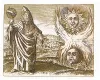
Hellenic · Thrice-Greatest Hermes, Vol. II · 20 of 21
The Perfect Sermon; or The Asclepius (Part 1)
(Text: R. 348-354; Pat. at end. 1)
1. Great is the sermon (logos) which I send to thee, O King—the summing up and digest, as it were, of all the rest.
For it is not composed to suit the many’s prejudice, since it contains much that refuteth them.
Nay, it will seem to thee as well to contradict sometimes my sermons too.
Hermes, my master, in many a conversation, both when alone, and sometimes, too, when Tat was there, has said, that unto those who come across my books, their composition will seem most simple and [most] clear; but, on the contrary, as ’tis unclear, and has the [inner]
meaning of its words concealed, it will be still unclearer, when, afterwards, the Greeks will want to turn our tongue into their own,—for this will be a very great distorting and obscuring of [even] what has been [already] written.
2. Turned into our own native tongue, 1 the sermon (logos) keepeth clear the meaning 2 of the words (logoi) [at any rate].
For that its very quality of sound, the [very] power of the Egyptian names, have in themselves the bringing into act of what is said.
As far as, then, thou canst, O King—(and thou canst [do] all things)—keep [this] our sermon from translation; in order that such mighty mysteries may not come to the Greeks, and the disdainful speech of Greece, with [all] its looseness, and its surface beauty, 3 so to speak, take all the strength out of 4 the solemn and the strong—the energetic 5 speech of Names.
The Greeks, O King, have novel words, energic of “argumentation” [only]; and thus is the philosophizing of the Greeks—the noise of words.
But we do not use words; but we use sounds full-filled with deeds.
3. Thus, then, will I begin the sermon by invocation unto God, the universals’ Lord and Maker, [their] Sire, and [their] Encompasser; who though being All is One, 1 and though being One is All; for that the Fullness of all things is One, and [is] in One, this latter One not coming as a second [One], but both being One.
And this is the idea 2 that I would have thee keep, through the whole study of our sermon, Sire!
For should one try to separate what seems to be both All and One and Same from One,—he will be found to take 3 his epithet of “All” from [the idea of] multitude, and not from [that of) fullness 4—which is impossible; for if he part All from the One, he will destroy the All. 5
For all things must be One—if they indeed are One. Yea, they are One; and they shall never cease being One—in order that the Fullness may not be destroyed.
* * * * *
4. See then in Earth a host of founts of Water and of Fire forth-spirting in its midmost parts; in one and the same [space all] the three
natures visible—of Fire, and Water, and of Earth, depending from one Root. 1
Whence, too, it 2 is believed to be the Treasury 3 of every matter. It sendeth forth of its 4 abundance, and in the place [of what it sendeth forth] receiveth the subsistence from above. 5
For thus the Demiurge 6—I mean the Sun—eternally doth order Heaven and Earth, pouring down Essence, 7 and taking Matter up, drawing both round Himself and to Himself all things, and from Himself giving all things to all.
For He it is whose goodly energies extend not only through the Heaven and the Air, but also onto Earth, right down unto the lowest Depth and the Abyss.
6. And if there be an Essence which the mind alone can grasp, 8 this is his Substance, 9 the reservoir 10 of which would be His Light.
But whence this [Substance] doth arise, or floweth forth, He, [and He] only, knows.
* * * * *
Or rather, in space and nature, He is near unto Himself . . . though as He is not seen by us, . . . understand [Him] by conjecture. 1
7. The spectacle of Him, however, is not left unto conjecture; nay [for] His very rays, 2 in greatest splendour, shine all round on all the Cosmos that doth lie above and lie below.
For He is stablished in the midst, wreathed with the Cosmos, 3 and just as a good charioteer, He safely drives the cosmic team, 4 and holds them in unto Himself, 5 lest they should run away in dire disorder.
The reins are Life, and Soul, and Spirit, Deathlessness, and Genesis.
He lets it, then, drive [round] not far off from Himself—nay, if the truth be said, together with Himself.
8. And in this way He operates 1 all things. To the immortals He distributeth perpetual permanence; and with the upper hemisphere of His own Light—all that he sends above from out His other side, 2 [the side of him] which looks to Heaven—He nourisheth the deathless parts of Cosmos.
But with that side that sendeth down [its Light], and shineth round all of the hemisphere 3 of Water, and of Earth, and Air, He vivifieth, and by births and changes keepeth in movement to and fro the animals 4 in these [the lower] parts of Cosmos. . . .
9. He changes them in spiral fashion, and doth transform them into one another, genus to genus, species into species, their mutual changes into one another being balanced—just as He does when He doth deal with the Great Bodies.
For in the case of every body, [its] permanence [consists in] transformation.
In case of an immortal one, there is no
dissolution; but when it is a mortal one, it is accompanied with dissolution. 1
And this is how the deathless body doth differ from the mortal, and how the mortal one doth differ from the deathless.
10. Moreover, as His Light’s continuous, so is His Power of giving Life to lives continuous, and not to be brought to an end in space or in abundance.
For there are many choirs of daimons round Him, like unto hosts of very various kinds; who though they dwell with mortals, yet are not far from the immortals; but having as their lot from here unto the spaces of the Gods, 2 they watch o’er the affairs of men, and work out things appointed by the Gods—by means of storms, whirlwinds and hurricanes, by transmutations wrought by fire and shakings of the earth, 3 with famines also and with wars requiting [man’s] impiety,—for this is in man’s case the greatest ill against the Gods.
11. For that the duty of the Gods is to give benefits; the duty of mankind is to give worship 4; the duty of the daimons is to give requital.
For as to all the other things men do, through
error, or foolhardiness, or by necessity, which they call Fate, 1 or ignorance—these are not held requitable among the Gods; impiety alone is guilty at their bar.
12. The Sun is the preserver 2 and the nurse of every class. 3
And just as the Intelligible World, 4 holding the Sensible in its embrace, fills it [all] full, distending it with forms of every kind and every shape—so, too, the Sun distendeth all in Cosmos, affording births to all, and strengtheneth them.
When they are weary or they fail, He takes them in His arms again.
13. And under Him is ranged the choir of daimons—or, rather, choirs; for these are multitudinous and very varied, ranked underneath the groups of Stars, 5 in equal number with each one of them.
So, marshalled in their ranks, they are the ministers of each one of the Stars, being in their natures good, and bad, that is, in their activities (for that a daimon’s essence is activity); while
some of them are [of] mixed [natures], good and bad.
14. To all of these has been allotted the authority o’er things upon the Earth; and it is they who bring about the multifold confusion of the turmoils on the Earth—for states and nations generally, and for each individual separately.
For they do shape our souls like to themselves, and set them moving with them,—obsessing nerves, and marrow, veins and arteries, the brain itself, down to the very heart. 1
15. For on each one of us being born and made alive, the daimons take hold on us—those [daimones] who are in service at that moment [of the wheel] of Genesis, who are ranged under each one of the Stars. 2
For that these change at every moment; they do not stay the same, but circle back again.
These, then, descending through the body 3 to the two parts 4 of the soul, set it 5 awhirling, each one towards its own activity.
But the soul’s rational part is set above the lordship of the daimons—designed to be receptacle of God.
16. Who then doth have a Ray shining upon him through the Sun within his rational part—and these in all are few on them the daimons do not act; for no one of the daimons or of Gods has any power against one Ray of God.
As for the rest, they are all led and driven, soul and body, by the daimons—loving and hating the activities of these.
The reason (logos), [then,] is not the love that is deceived and that deceives. 1
The daimons, therefore, exercise the whole of this terrene economy, 2 using our bodies as [their] instruments.
And this economy Hermes has called Heimarmenē. 3
17. The World Intelligible, 4 then, depends from God; the Sensible from the Intelligible [World].
The Sun, through the Intelligible and the Sensible Cosmos, pours forth abundantly the stream from God of Good,—that is, the demiurgic operation.
And round the Sun are the Eight Spheres, dependent from Him—the [Sphere] of the
[paragraph continues] Non-wandering Ones, the Six [Spheres] of the Wanderers, and one Circumterrene.
And from the Spheres depend the daimones; and from these, men.
And thus all things and all [of them] depend from God. 1
18. Wherefore God is the Sire of all; the Sun’s [their] Demiurge; the Cosmos is the instrument of demiurgic operation.
Intelligible Essence regulateth Heaven; and Heaven, the Gods; the daimones, ranked underneath the Gods, regulate men.
This is the host 2 of Gods and daimones. 3
Through these God makes all things for His own self.
And all [of them] are parts of God; and if they all [are] parts—then, God is all.
Thus, making all, He makes Himself; nor ever can He cease [His making], for He Himself is ceaseless. 4
Just, then, as God doth have no end and no beginning, so doth His making have no end and no beginning. 5
* * * * *
Footnotes
266:1 At the end after P. S. A., but the pages are unnumbered.
267:1 This presumably means from the hieroglyphic into the demotic—τῇ πατρῷᾳ διαλέκτῳ ἐρμηνευόμενος.
267:2 Lit. the mind.
267:3 Or, perhaps, smartness.
267:4 Make jejune, so to say—ἐξίτηλον ποιήσῃ.
267:5 That is, “words of power,” words that do things.
268:1 Cf. R. 127, 3; and P. S. A., i. 1.
268:2 Lit. mind.
268:3 The construction is very elliptical; ἐκδεξάμενος simply.
268:4 That is, completeness, perfection,—πληρώματος.
268:5 Cf. Plato, Soph., 259 D, E.
269:1 Cf. P. S. A., iv. 1.
269:2 Sc. Earth.
269:3 A magazine, a store-house,—ταμιεῖον. The term “treasure” (θησαυρός) is found in most lavish use in the Greek-Coptic Gnostic works, and also in Christian Gnostic literature and Jewish Apocalyptic.
269:4 Sc. matter’s.
269:5 τὴν ἄνωθεν ὕπαρξιν,—hyparxis, substance or subsistence, a word of frequent use and highly technical meaning with the last of the Neo-Platonists, especially with Proclus. Cf. C. H., x. (xi.) 2.
269:6 Cf. P. S. A., xxix. 4.
269:7 Lit. bringing or drawing down; κατάγειν = deducere, elicere—used frequently of magic arts.
269:8 νοητὴ οὐσία = intelligibilis essentia.
269:9 ὄγκος = moles, mass, bulk, volume; in later philosophy it means “atom,” and may mean so here, of course in the philosophical and mystic and not in the physical sense.
269:10 ὑποδοχή = receptaculum.
270:1 The text is very corrupt. Patrizzi translates: “Vel quia ipso loco, et natura prope se ipsum existens, non a nobis conspicitur cogit nos per conjecturas intelligere”—which certainly does not represent the Greek. Ménard conjectures brilliantly but in entire emancipation from the text: “Pour comprendre par induction ce qui se dérobe à notre vue, il faudrait être près de lui et analogue à sa nature.” Reitzenstein discovers two lacunas in the text, but does not attempt to fill them. As the text stands, then, all attempt at translation seems hopeless.
270:2 Lit. his very sight,—αὐτὴ ἡ ὄψις, that is, his rays, ὄψις being used of the visual rays which were supposed by the science of the time to proceed from the eyes. Cf. Ex. vii. 4.
270:3 Wearing the Cosmos as a wreath or crown; the visible sun being regarded as a “head.” See “The Perfect Sermon.”
270:4 Lit. car or chariot—ἅρμα.
270:5 Lit. binds it to himself—ἀναδήσας εἰς ἑαυτόν.
271:1 δημιουργεῖ.
271:2 Lit. part.
271:3 κύτος = a, hollow, vase, or vessel.
271:4 That is, those lives subject to death, as opposed to the immortals.
272:1 Compare “Sermon to Tat,” I. (Ménard). Cf. Stob., Ecl, i. 61; 274, 24 W.
272:2 Lit. “the land of these”—that is, of the immortals.
272:3 Cf. Ex. ix. 5.
272:4 Or, to be pious. Cf. P. S. A., ix. 1.
273:1 εἱμαρμένην.
273:2 σωτήρ.
273:3 Or genus.
273:4 Or Cosmos.
273:5 ὑπὸ τὰς τῶν ἀστέρων πλινθίδας. πλινθίς = πλινθίον, and is used of any rectangular figure, and also of groups of stars as in Eratosth. apud Strab., II. i. 35; v. 36 (Lex. Sophocles); compare αἱ τῶν πλινθίων ὑπογραφαί, the fields, or spaces, into which the Augurs divided the heavens, templa, or regiones coeli (Lex. Liddell and Scott).
274:1 Lit. viscera.
274:2 Cf. P. S. A., xxxv. 2.
274:3 Cf. C. H., xiii. (xiv.) 7.
274:4 The two irrational parts, “passion” and “desire” (θυμὸς and ἐπιθυμία).
274:5 The soul.
275:1 This Erōs is the lower love (cf. C. H., i. 18: “love, the cause of death”), not the Divine Love who inspires Hermes in “The Perfect Sermon” and who is mentioned C. H., xviii. 14.
275:2 διοίκησιν.
275:3 Or, Fate; cf. C. H., i. 9; and P. S. A., xix.
275:4 Or, Intelligible Cosmos.
276:1 Cf. P. S. A., iv. 1 n.; and xix.
276:2 Or army, or hierarchy. Compare the “soldier” degree of the Mithriaca.
276:3 Cf. C. H., x. (xi.) 22; and P. S. A., v. 1.
276:4 Cf. C. H., xiv. (xv.), 7 and 5.
276:5 See Commentary to Frag. iv. (Lact., D. I., ii. 15).
Gnosticism and Hermetica
COMMENTARY
CONCERNING THE TlTLE
Patrizzi has run (xvi.) and (xvii.) together, under the title “Definitions of Asclepius—Book I.,” though he clearly saw that (xvii.) did not belong to (xvi.) by his remark, “videntur sequentia ex alio libro sumpta.” He also heads (xvii.) 1-10 “Definitions of Asclepius—Book II.,” and 11-16 “D. of A.—Book III.,” though the contents have evidently nothing to do with such a title.
In the MSS. a later hand has added to the general title a catalogue of contents as follows:
“Of God; Matter; Evil; Fate; the Sun; Intelligible Essence; Divine Essence; Man; the Economy of the Plērōma; the Seven Stars; the Man after the Likeness” 1—for which largely irrelevant list Patrizzi substitutes the title: “Of the Sun and Daimons.”
Reitzenstein (p. 192) is of opinion that this contents-list, and also the similar headings in (xviii.), are due to some Byzantine scribe, who also foolishly interpolated (xvii.).
But even to (xvi.) the title “Definitions of Asclepius” seems very inappropriate; while, on the other hand, we find Lactantius (D. I., ii. 5), in referring to the “incursions of daimones,” claiming that it was a doctrine also of Hermes, and adding:
“Asclepius, his hearer, has also explained the same idea at greater length in that ‘Perfect Sermon’ which he wrote to the King.”
This is quite definite, and the authority of Lactantius should perhaps be preferred to that of the MSS., but as the title would clash with “The Perfect Sermon” of Hermes to Asclepius, and as Lactantius may just
possibly mean “in that initiatory sermon,”—the term perfectus being used in a general and not in an appellative sense,—I have kept the traditional title and placed that of Lactantius second.
A TRADITION CONCERNING THE TRISMEGISTIC LITERATURE
1. Like “The Key”—C. H., x. (xi.)—of Hermes, our treatise is an Epitome 1; Asclepius has previously written a number of Sermons to the King.
The reference to the “Conversations” between Hermes and Asclepius and Tat, sometimes when both the latter were present and sometimes with Asclepius alone, presupposes the existence of this class of Dialogue, and indicates that the Correspondence of Asclepius with the King is a later deposit of our literature. 2
This literary activity of Asclepius is claimed in the introduction to be authorized by Hermes, and, moreover, purports to have been originally written in Demotic Egyptian. In other words, the writer would have us believe that the Greek is a translation from Egyptian. This it clearly is not; and we can only conclude that the “prophecy” as to direct translation is a literary fiction of our author.
2. On the other hand, it is highly probable that our author was in contact with a living tradition, to the effect that the Hermes-teaching was originally Egyptian, and that this was “interpreted” into Greek—that is, into Greek modes of thought, rather than “translated” in the ordinary sense into Greek.
In any case, the contempt shown by our author for the Greek language and “philosophizing,” and his
admiration for Hieroglyphic Egyptian as a “language of the Gods”—a magical tongue, that by its māntric power compelled the understanding of the hearer, by putting him in sympathy with the ideas pictured by the ideograms, or sounded forth by the “names of power” 1—show that he was not only not a Greek, but also no lover of Greek Philosophy.
This is exceedingly puzzling, seeing not only that the majority of the writers of our tractates are plainly deep students and lovers of Plato, but also that the author of our tractate himself also writes very much in the same style as they do.
All of this seems to indicate that in his introduction he was using for his own purposes some tradition about the ancient Thoth-literature that was current in his time. A form of this tradition was also made use of by Philo of Byblus in the first century, when he makes the Phœnician priest Sanchuniathon discover the origin of the Phœnician cosmogony and mystery-teaching in the Books of Taautos, “whom the Egyptian called Thoyth, the Alexandrians Thoth, and the Greeks changed into Hermes.”
Sanchuniathon, he says, “having come across the secret writings that had been discovered and brought from the shrines of the Temples of Ammon,—compositions which were not known to all,—practised by himself the science (τῆν μάθησιν) of all things.” 2
Philo also professes to quote from one of the earliest priests of Phœnicia, a certain Thabiōn, who is said apparently to have got his information from a writing of the Seven Kabiri, and of Asclepius, the pupil of Taautos. This Thabiōn asserted that Taautos was made King of Egypt by Kronos—that is, Ammon. 3
Here we are evidently in contact with certain traditions with regard to Thoth-Hermes, his ancestors and pupils, and secret writings. Presumably many such traditions were floating about, and were used according to the fancy and taste of Hellenistic writers for their own purposes.
But there was also another tradition concerning a certain King Ammon, used in one form by Jamblichus, when he writes:
“It was Hermes who first taught this Path [sc. the Way up to God]. And Bitys, 1 the Prophet, translated [his teachings concerning it] for King Ammon, discovering them in the inner temple in an inscription in the sacred characters at Saïs in Egypt.” 2
What our author and Jamblichus have in common is that there were certain secret teachings of Hermes in the Sacred Language of Ancient Egypt hidden away in the inner shrines of the temples, and that these were translated into the current Egyptian language of the time for a certain King Ammon.
It must, then, have been some tradition of this kind that our author or writer had in mind; he would have it believed that he was writing in the style or according to the model of a certain literature.
Who this King Ammon was can only be guessed at; but to my mind it is probable that the “translations” of Bitys were made in connection with the translation activity of Manetho for King Ptolemy, and this translation was into Greek. Our author, however, would refer it to some Egyptian King, and so seek to invoke the authority of a high antiquity for the treatise he was putting into circulation.
A SPECULATION AS TO DATE
5. What seems to differentiate our treatise from the rest of the tractates, is the prominence its author gives to the doctrine of the Sun as Demiurgic Orderer of all things. This so to speak pantheistic form of Sun-worship is peculiarly Egyptian. 1
Now if we remember the disdainful way in which Greek “philosophizing” is spoken of in the introduction, we may be tempted to take the sentence, “And if there be any essence which the mind alone can grasp” (§ 6), as a somewhat patronizing reference to the Intelligible World of Greek Philosophy, as also the analogy in § 12; but when we turn to §§ 17 and 18 the exposition fully adopts the doctrine of the Intelligible and Sensible Worlds. This is so irreconcilable a contradiction that one is almost compelled to believe that the introduction is by another hand altogether, and that our sermon proper begins with § 3.
But even so, the sermon is addressed to some King or other—“The Perfect Sermon to the King” of Lactantius—without any further qualification. Who, however, this King may have been historically must remain a matter of pure conjecture.
7. When, then, Reitzenstein, pointing to § 7, says that the symbolism of the Sun as a charioteer wearing a crown of rays corresponds with that of the pictures of the Aurelian Sun-god, and adds further it is the Roman Empire-god of the third century, we are quite prepared to acknowledge a similarity of symbolism. But if it is intended to suggest that, therefore, we are to date our document by this similarity, it must be admitted that the indications are far too vague; for the symbolism of the Sun as the ray-crowned charioteer
is fundamental with the cult of Mithras, and is found in Greece long before the Aurelian period.
THE DELINEATION OF THE SUN
It is interesting, however, here to notice that the Sun is “wreathed with cosmos,” and to compare this with the passage concerning the Macro-prosopus in the Untitled Apocalypse of the Coptic Gnostic Codex Brucianus, and especially with the sentence:
“The Hair of His Head is the number of the Hidden Worlds, and the Outline of His Face is the Type of the Æons.” 1
In this Untitled Apocalypse there is a strong Egyptian under-colouring; that, however, the idea of a crown of powers was pre-eminently Egyptian may be seen from many a passage in the Pistis Sophia.
8. It is also of interest to notice that the delineation of the Sun in § 8 reminds us of the Orphic Phanes, especially the reference to the two hemispheres above and below,—the two parts of the Egg in Orphic symbolism.
9. The hint that the sun-life runs in some sort of spiral or serpentine fashion in animals, and that this also is the case with the Great Bodies or Celestial Animals, is of interest.
CONCERNING THE DAIMONES
10. Our author then proceeds to set forth his doctrine of the daimones or ministers of the Gods, who are assigned to the lower hemisphere of operation, from the Earth to the Sun, the Gods presumably occupying the higher hemisphere of activity. These daimones are what a Hindu or Buddhist would call kārmic agents, for they are all connected with what is called the Fate-
[paragraph continues] Sphere, the Instrument or the Wheel of Genesis, or Saṁsāra.
15. These daimones rule over the lower energies of the soul; the higher energy or rational part of the soul is set above them, and is designed to be the “receptacle of God,”—or rather of His Ray,—the Mind proper.
16. With § 16 compare the remarkable passage in one of the Letters of Valentinus:
“One [alone] is Good, whose free utterance is His manifestation through His Son; it is by Him alone that the heart can become pure, when every evil essence has been expelled from it.
“Now its purity is prevented by the many essences which take up their abode in it, for each of them accomplishes its own deeds, outraging it in divers fashions with unseemly lusts.
“As far as I can see, the heart seems to receive somewhat the same treatment as an inn [or caravanserai], which has holes and gaps made in its walls, and is frequently filled with dung, men living filthily in it and taking no care of the place as being someone else’s property. Thus is it with the heart so long as it has no care taken of it, ever unclean and the abode of many daimons.
“But when the Alone Good Father hath regard unto it, it is sanctified and shineth with light; and he who possesseth such a heart is so blessed that ‘he shall see God.’” 1
The language of Valentinus is remarkably like that of our treatises; Valentinus himself was an Egyptian.
17. Entirely Egyptian also is the Scheme of Dependency given in § 17, as we have already pointed out on several occasions, quoting from a Hymn of Valentinus.
The sentence: “Wherefore God is the Sire of all; the Sun’s [their] Demiurge”—distinctly contradicts Reitzenstein’s (p. 198, 1) statement that the Sun in our treatise is worshipped as the All-god. The Sun is He “by whom all things are made,”—the Creative Logos of God. 1
19. The treatise is evidently incomplete; if, however, we turn to the contents-title given at the beginning of these comments we can gain but little information as to what is missing, for the contents there given do not in any but the vaguest fashion correspond to the substance of our treatise, nor do the subjects treated of come in the same order as in the contents-heading. The Divine Essence, Man, the Economy of the Plērōma and the Man after the Likeness, which are clearly not treated of in our text, may then have been treated in the missing portion of our tractate; but this is all we can say.
Footnotes
277:1 R. 348 n.
278:1 Cf. also Ex. i. 16, and Comment.
278:2 This deduction, however, has to be modified by the view we hold as to the authorship of the introduction. See Comment., § 5.
279:1 Cf. R. 269.
279:2 Ap. Euseb., Præp. Ev., I. ix. 29.
279:3 Ibid., I. x. 38, 39.
280:1 Cf. Zosimus (§ 8).
280:2 De Myst., viii. 5.
281:1 Cf. R. 198, 1; and also Comment on § 17 below.
282:1 F. F. F., 549.
283:1 Quoted by Clemens Alexandrinus, Strom., II. xx. 114; P. 489 (ed. Dindorf, ii. 219). See for further critical text, Hilgenfeld (A.), Ketzergesch. d. Urchrist., p. 296; F. F. F., 300, 301.
284:1 Cf. P. S. A., xxix. 5.
Gnosticism and Hermetica
CORPUS HERMETICUM (XVII.)
[OF ASCLEPIUS TO THE KING]
(Text: R. 354; Pat. at end of last piece.)
* * * * *
Asclepius. If thou dost think [of it], O King, even of bodies there are things bodiless. 1
The King. What [are they]?—(asked the King.)
Asc. The bodies that appear in mirrors—do they not seem then to have no body?
The King. It is so, O Asclepius 2; thou thinkest like a God 3!—(the King replied.)
Asc. There are things bodiless as well as these; for instance, forms 1—do not they seem to thee to have no body, but to appear in bodies not only of the things which are ensouled, but also of those which are not ensouled?
The King. Thou sayest well, Asclepius.
Asc. Thus, [then,] there are reflexions of things bodiless on bodies, and of bodies too upon things bodiless—that is to say, [reflexions] of the Sensible on the Intelligible World, and of the [World] Intelligible on the Sensible.
Wherefore, pay worship to the images, O King, since they too have their forms as from the World Intelligible.
(Thereon His Majesty arose and said:)
The King. It is the hour, 2 O Prophet, to see about the comfort of our guests. To-morrow, [then,] will we resume our sacred converse. 3
Footnotes
285:1 Cf. Plat., Soph., 229 D, 240 A, 246 B.
285:2 The corrector of B has changed the name Asclepius into Tat, as he has everywhere in C. H., ii. (iii.); R. 193, 1.
285:3 θείως.
286:1 Or ideas.
286:2 Cf. Plat., Soph., 241 B.
286:3 θεολογῄσομεν.
Gnosticism and Hermetica
COMMENTARY
ON THE ADORATION OF IMAGES
The loss of the end of the previous sermon, and also the loss of almost the whole of (xvii.), is to be accounted for by the falling out of one or more quires from the original MS. of our Corpus, 4 a phenomenon similar to that already remarked in the case of C. H., ii. (iii).
And that this is the fact is brought out interestingly by the note of Reitzenstein (p. 193, 1)—namely, that one of the correctors of one of the copies (Paris MS.) of this faulty original has precisely in these two places changed the name Asclepius into Tat. He was puzzled, and thought that his “correction” would set matters right; as a matter of fact, however, it only adds to the confusion.
What the main subject of our treatise may have been we can hardly conjecture; part of it, however, must have been devoted to an explanation of the rationale of image-adoration,—“Wherefore pay worship to the images, O King,”—of which we hear so much in P. S. A.
These symbolic images of the Gods are said to have their “forms” (ἰδέας) in sympathetic relation with the Intelligible World. These are mutual “reflections,” the one of the other.
Now as the Ka of the God was thought to have immediate relation with the image-symbol of the God, and the Gods were of the Intelligible World,—the statues of the Gods were thought to be images of the Image in some special way; they were regarded as providing a straight path or line of connection between Earth and Heaven, just as a man who made himself like to the Man after the Likeness became in himself a Way Up.
Footnotes
286:4 R. 198.
Gnosticism and Hermetica
CORPUS HERMETICUM (XVIII.)
[THE ENCOMIUM OF KINGS]
(ABOUT THE SOUL’S BEING HINDERED BY THE PASSION OF THE BODY)
(Text: R. 355-360; Pat. at end.)
1. [Now] in the case of those professing the harmonious art of muse-like melody—if, when the piece is played, the discord of the instruments doth hinder their intent, its rendering becomes ridiculous.
For when his instruments are quite too weak for what’s required of them, the music-artist needs must be laughed at by the audience.
For He, with all good will, gives of His art unweariedly; they blame the [artist’s] weakness.
He then who is the Natural Musician-God, not only in His making of the harmony of His [celestial] songs, but also in His sending forth the rhythm of the melody of His own song[s]
right down unto the separate instruments, 1 is, as God, never wearied.
For that with God there is no growing weary.
2. So, then, if ever a musician desires to enter into the highest contest of his art he can—when now the trumpeters have rendered the same phrase of the [composer’s] skill, and afterwards the flautists played the sweet notes of the melody upon their instruments, 2 and they complete the music of the piece with pipe and plectrum—[if any thing goes wrong,] one 3 does not lay the blame upon the inspiration 4 of the music-maker.
Nay, [by no means,]—to him one renders the respect that is his due; one blames the falseness of the instrument, in that it has become a hindrance to those who are most excellent—embarrassing the maker of the music in [the execution of] his melody, and robbing those who listen of the sweetness of the song.
3. In like way also, in our case, let no one of
our audience for the weakness that inheres in body, blame impiously our Race. 1
Nay, let him know God is Unwearied Spirit 2—for ever in the self-same way possessed of His own science, unceasing in His joyous gifts, the self-same benefits bestowing everywhere.
4. And if the Pheidias—the Demiurge—is not responded to, by lack of matter to perfect His skilfulness, although for His own part the Artist has done all he can, let us not lay the blame on Him.
But let us, [rather,] blame the weakness of the string, 3 in that, because it is too slack or is too tight, it mars the rhythm of the harmony.
5. So when it is that the mischance occurs by reason of the instrument, no one doth blame the Artist.
Nay, [more;] the worse the instrument doth chance to be, the more the Artist gains in reputation by the frequency with which his hand doth strike the proper note, 4 and more the love the listeners pour upon that Music-
maker, without 1 the slightest thought of blaming him.
So will we too, most noble [Sirs], set our own lyre in tune again, within, with the Musician!
6. Nay, I have seen one of the artist-folk 2—although he had no power of playing on the lyre—when once he had been trained for the right noble theme, make frequent use of his own self as instrument, and tune the service of his string by means of mysteries, so that the listeners were amazed at how he turned necessitude into magnificence. 3
Of course you know the story of the harper who won the favour of the God who is the president of music-work.
[One day,] when he was playing for a prize, and when the breaking of a string became a hindrance to him in the contest, the favour of the Better One supplied him with another string, and placed within his grasp the boon of fame.
A grasshopper was made to settle on his lyre, through the foreknowledge of the Better One,
and [so] fill in the melody in substitution of the [broken] string. 1
And so by mending of his string the harper’s grief was stayed, and fame of victory was won.
7. And this I feel is my own case, most noble [Sirs]!
For but just now I seemed to make confession of my want of strength, and play the weakling for a little while; but now, by virtue of the strength of [that] Superior One, as though my song about the King had been perfected [by Him, I seem] to wake my muse.
For, you must know, the end of [this] our duty will be the glorious fame of Kings, and the good-will of our discourse (logos) [will occupy itself] about the triumphs which they win.
Come then, let us make haste! For that the singer willeth it, and hath attuned his lyre 2 for this; nay more, more sweetly will he play, more fitly will he sing, as he has for his song the greater subjects of his theme.
8. Since, then, he 3 has the [stringing] of his lyre tuned specially to Kings, and has the key
of laudatory songs, and as his goal the Royal praises, let him first raise himself unto the highest King—the God of wholes.
Beginning, [then,] his song from the above, he, [thus,] in second place, descends to those after His likeness who hold the sceptre’s power 1; since Kings themselves, indeed, prefer the [topics] of the song should step by step descend from the above, and where they have their [gifts of] victory presided o’er for them, thence should their hopes be led in orderly succession.
9. Let, then, the singer start with God, the greatest King of wholes, who is for ever free from death, both everlasting and possessed of [all] the might of everlastingness, the Glorious Victor, the very first, from whom all victories descend to those who in succession do succeed to victory. 2
10. Our sermon (logos) then, doth hasten to descend to [Kingly] praises and to the Presidents of common weal and peace, the Kings—whose lordship in most ancient times was placed upon the highest pinnacle by God Supreme; for whom the prizes have already been prepared even before their prowess in the war; of whom the trophies have been raised even before the shock of conflict.
For whom it is appointed not only to be Kings but also to be best.
At whom, before they even stir, the foreign land 1 doth quake.
* * * * *
(ABOUT THE BLESSING OF THE BETTER [ONE] AND PRAISING OF THE KING)
11. But now our theme (logos) doth hasten on to blend its end with its beginnings—with blessing of the Better [One] 2; and then to make a final end of its discourse (logos) on those divinest Kings who give us the [great] prize of peace.
For just as we began [by treating] of the Better [One] and of the Power Above, so let us make the end bend round again unto the same—the Better [One].
Just as the Sun, the nurse of all the things that grow, on his first rising, gathers unto himself the first-fruits of their yield with his most mighty hands, using his rays as though it were for plucking off their fruits—yea, [for] his rays are [truly] hands for him who plucketh first the most ambrosial [essences] of plants—so, too, should we, beginning from the Better [One], and [thus] recipient of His wisdom’s stream, and turning it upon the garden of our souls above
the heavens, 1—we should [direct and] train these [streams] of blessing back again unto their source, [blessing] whose entire power of germination [in us] He hath Himself poured into us.
12. ’Tis fit ten thousand tongues and voices should be used to send His blessings back again unto the all-pure God, who is the Father of our souls; and though we cannot utter what is fit—for we are [far] unequal to the task—[yet will we say what best we can].
For Babes just born have not the strength to sing their Father’s glory as it should be sung; but they give proper thanks for them, according to their strength, and meet with pardon for their feebleness. 2
Nay, it is rather that God’s glory doth consist in this [one] very thing—that He is greater than His children; and that the prelude and the source, the middle and the end, of blessings, is to confess the Father to be infinitely puissant and never knowing what a limit means.
13. So is it, too, in the King’s case.
For that we men, as though we were the children of the King, feel it our natural duty to give praise to him. Still must we ask for pardon [for our insufficiency], e’en though ’tis granted by our Sire before we [even] ask.
And as it cannot be the Sire will turn from Babes new-born because they are so weak, but rather will rejoice when they begin to recognise [his love] 1—so also will the Gnosis of the all [rejoice], which doth distribute life to all, and power of giving blessing back to God, which He hath given [us].
14. For God, being Good, and having in Himself eternally the limit of His own eternal fitness, and being deathless, and containing in Himself that lot of that inheritance that cannot come unto an end, and [thus] for ever ever-flowing from out that energy of His, He doth send tidings to this world down here [to urge us] to the rendering of praise that brings us home again. 2
With Him, 3 therefore, is there no difference with one another; there is no partiality 4 with Him.
But they are one in Thought. One is the Prescience 5 of all. They have one Mind—their Father.
One is the Sense that’s active through them—
their passion for each other. 1 ’Tis Love 2 Himself who worketh the one harmony of all.
15. Thus, therefore, let us sing the praise of God.
Nay, rather, let us [first] descend to those who have received their sceptres from Him.
For that we ought to make beginning with our Kings, and so by practising ourselves on them, accustom us to songs of praise, and train ourselves in pious service to the Better [One].
[We ought] to make the very first beginnings of our exercise of praise begin from him, 3 and through him exercise the practice [of our praise], that so there may be in us both the exercising of our piety towards God, and of our praise to Kings.
16. For that we ought to make return to them, in that they have extended the prosperity of such great peace to us.
It is the virtue of the King, nay, ’tis his name alone, that doth establish peace.
He has his name of King because he levelleth the summits of dissension with his smooth tread, 4 and is the lord of reason (logos) that [makes] for peace.
And in as much, in sooth, as he hath made
himself the natural protector of the kingdom which is not his native land, 1 his very name [is made] the sign of peace.
For that, indeed, you know, the appellation of the King has frequently at once restrained the foe.
Nay, more, the very statues of the King are peaceful harbours for those most tempest-tossed.
The likeness of the King alone has to appear to win the victory, and to assure to all the citizens freedom from hurt and fear.
* * * * *
Footnotes
289:1 ἄχρι τῶν κατὰ μέρος ὀργάνων,—that is, to “parts” as opposed to “wholes”; “wholes” signifying generally noumenal or celestial essences, “parts” meaning the separate existences of the phenomenal or sensible world.
289:2 ἄρτι δὲ καὶ αὐλητῶν τοῖς μελικοῖς τὸ τῆς μελῳδίας λιγυρὸν ἐργασαμένων.—I do not know what this means exactly. Ménard translates: quand les joueurs de flûte ont exprimé les finesses de la mélodie; Patrizzi gives: melicis organis melodiæ dulcedinem.
289:3 Or perhaps “he,” meaning the judge of the contest.
289:4 τῷ πνεύματι.
290:1 The Race of the Prophets, or Gnostics—the Race of the Logos.
290:2 Referring to the “inspiration” or “breath” above,—ὡς ἀκάματον μέν ἐστι πνεῦμα ὁ θεός. Compare John iv. 24: πνεῦμα ὁ θεός—God is Spirit.
290:3 The metaphor has become somewhat mixed by the introduction of Pheidias, who was a “musician” in marble and ivory and gold, and not on strings and pipes.
290:4 τῇς κρούσεως πολλάκις πρὸς τὸν τόνον ἐμπεσούσης.
291:1 Reading ἔχοντες for ἔσχον.
291:2 Meaning presumably prophets.
291:3 It is difficult to follow the exact meaning of some of the writer’s rhetorical sentences, even if our text is sound; here, however, the text, even after passing through Reitzenstein’s hands, is still very halting, and so I venture on this translation with all hesitation.
292:1 The song of the cicala was so pleasant to the ear of the Ancients, that we frequently find it used in poetry as a simile for sweet sounds. Plato calls the grasshoppers the “prophets of the Muses.”
292:2 For the idea of the prophet being the lyre of God, cf. Montanus (ap. Epiphan., Hær., xlviii. 4). See also the references to Philo given by R. 204, n. 1.
292:3 Sc. the singer.
293:1 Cf. K. K., 39 ff.
293:2 But see Plasberg’s reading. R. 370.
294:1 τὸ βάρβαρον.
294:2 τοῦ κρείττονος,—that is God, or the inner God, as in the last section.
295:1 εἰς τὰ ἡμέτερα τῶν ψυχῶν ὑπερουράνια φυτά.
295:2 Lit. “in this.”
296:1 Lit. “at their recognition,”—ἐπὶ τῆς ἐπιγνώσεως—a play on epignōsis and gnōsis, and a parallel between the wisdom of God and the royal knowledge of the King.
296:2 εἰς τόνδε τὸν κὸσμον παρέχων τὴν ἀπαγγελίαν εἰς διασωστικὴν εὐφημίαν,—where it may be possible to connect ἀπαγγελία with the familiar εὐαγγέλιον.
296:3 ἐκείσε.
296:4 τὸ ἀλλοπρόσαλλον.
296:5 πρόγνωσις.
297:1 τὸ εἰς ἀλλήλους φίλτρον.
297:2 ὁ ἔρως,—the Higher Love.
297:3 Sc. the King.
297:4 The word-play between βασιλεὺς and βάσει λείᾳ is unreproducible in English.
298:1 τῆς βασιλείας τῆς βαρβαρικῆς.
Gnosticism and Hermetica
COMMENTARY
THE APOLOGY OF A PŒMANDRIST
This, the last piece in our Corpus, differs so greatly both in style and form of contents from the rest of our sermons, that we are plainly dealing with a different order of endeavour.
The style is for the most part so very artificial and forced, that we are conscious of labour and effort, and sometimes of such obscurity as to make a clear rendering almost impossible. The contents are of the nature of an elaborate set Eulogy of Kings.
Whether or not this concluding piece ever bore a proper title it is impossible to say, for the existing headings are plainly added by a later redactor, 2—as we
have already seen in a number of other instances. I have therefore ventured to superscribe as the main title “The Encomium of Kings,” 1 and have placed the contents-headings in parentheses.
Reitzenstein, in his analysis of the Corpus, concludes (p. 207) that this Eulogy was appended to the collection of treatises by the original redactor, or collector.
He was an Egyptian Rhetor, who was a follower of the Trismegistic tradition, and his object in making the collection was mainly to show the Rulers of the Empire that not only was there nothing in the Hermes religion that could excite their suspicion, but that, on the contrary, it was in its most fundamental teachings admirably calculated to inculcate Loyalty to the Rulers of the Empire’s destinies.
It is, indeed, to this “Apology,” so to speak, that we owe the good fortune of the preservation of our Corpus.
SPECULATIONS AS TO DATE
Who the “most noble [Sirs]” of §§ 5 and 7, to whom the Eulogy is immediately addressed, may be, is difficult to determine, for though the subject is the “Encomium of Kings” in general, some actual King was evidently in the mind of the writer when he penned § 16. Perhaps the “most noble” may have been the high officials of Egypt.
The lost conclusion of our Encomium, for our actual text is evidently incomplete, may have given clearer indications of the Emperor for whose ultimate perusal the Eulogy was intended. As it is, the indications are of the vaguest.
Reitzenstein, however, is of opinion (pp. 207, 208) that the indications in § 16 best suit the reign of
[paragraph continues] Diocletian (imp. 285-305 A.D.); but he is aware that, as far as these are concerned, an earlier date is not excluded (p. 208). It is only when he has treated, in his Addenda (pp. 371-374), the Encomium as an example of later Greek “art-prose,” or rhythmic prose, the scheme of the accentuation of which has been of late years carefully studied, especially by Meyer and Wilamowitz, that he comes definitely to the conclusion that the external form of our Rhetor’s effort fits precisely the time of Diocletian’s Triumph, 302 A.D. I cannot, however, say that I am convinced by his arguments.
The strained and elaborate introduction (§§ 1-5) needs no further comment; no doubt it is very “fine writing,” but it is difficult to pin some of it down to any precise meaning in translation.
THE STORY OF THE PYTHIC GRASSHOPPER
6. With § 6, however, our interest is awakened, for it reminds us of the famous Introduction to the Protrepticus, or Exhortation to the Greeks, of Clement of Alexandria, when he says:
“I could tell thee also of another—brother to these 1—story and singer, of Eunomus the Locrian and the Pythic grasshopper.
“At Pytho there was gathered together a solemn assembly of Greeks to celebrate the Death of the Serpent, with Eunomus to sing the funeral song of the beast.
“Whether his song was a hymn or a dirge I cannot say; anyhow, there was a contest, and Eunomus had to harp it in the heat of the day, when the grasshoppers, warmed by the sun, were singing underneath the leaves along the hills.
“They were singing not to the Serpent, the dead thing, but to God the All-wise, a song of unrestrained mode far better than the modes of Eunomus.
“A cord breaks for the Locrian; the grasshopper flies on to the yoke; it chirped on the harp as on a branch; and the minstrel, modulating to the song of the grasshopper, filled up the missing string.
“It was not that the grasshopper was attracted by the song of Eunomus, as the story would have it, setting up a brazen statue at Pytho of Eunomus, harp and all, and his helper in the contest; it flew on naturally and sung naturally. The Greeks, however, thought it played the music.” 1
This passage shows that the story referred to by our author was well known, so well known indeed that Clement takes it as a text for a naturalistic explanation of Hellenic miracle. No literary dependence, however, of one or the other can be entertained, for the similarity of the “τὴν νευρὰν ἀνεπλήρωσεν αὐτῷ” of our text and the “ὁ ᾠδὸς τὴν λείπουσαν ἀνεπλήρωσε χορδὴν” of Clement is far too slight a link to bear the weight of any argument of this nature. 2
11. There is evidently a lacuna after § 10, and, judging by the opening words of § 11, it must be of some length, for the Praise of Kings so far is of a very brief description.
It is also of interest to notice how much easier the style of our author is when he treats of the Praises of God; his words seem to come far more easily, as though he had a subject to deal with with which he was more familiar, as, indeed, he ought to have been if he had studied the treatises he has collected together.
THE TRUE KING
13. The idea that all his subjects are the children of the King is Egyptian; or, rather, it is the tradition of all nations who believed in Divine Kings. The true King was he who, so to speak, contained all his subjects within himself; they were all “members,” or, as we should say, cells, of his true Body. The nation was the King; the victory of the nation was ascribed to the virtue of the King. 1
THE FELLOW-RULERS OF THE HEIGHT
14. The last three sentences of § 14 Reitzenstein (p. 208) would take as referring to the Kings under the suzerainty of the Emperor, who were bound to him by a common bond of love, in order that he may the more insist on the Diocletian date. 2 I would, however, refer the idea to the ideal of harmony and unity of the Beings of the Intelligible World, as described, for instance, by Plotinus, when he writes:
“They see themselves in others. For all things are transparent, and there is nothing dark or resisting, and everyone is manifest to everyone internally, and all things are made manifest; for light is manifest to light. For everyone has all things in himself, and again sees in another all things, so that all things are everywhere, and all in all, and each in all, and infinite the glory. For each of them is great, since the small also is great. And the sun there is all the stars, and, again, each and all are the sun. In each, one thing is pre-eminent above the rest, but it also shows forth all.” 3
Compare this also with the intuition of the seer in The Untitled Apocalypse of the Codex Brucianus:
“Their Crowns send forth Rays; the Brilliancy of their Bodies is as the life of the Space into which they are come; the Word (Logos) that comes out of their mouth is Eternal Life, and the Light that comes forth from their Eyes is Rest for them; the Movement of their Hands is their Flight to the Space out of which they are come, and their Gazing on their own Faces is Knowledge of themselves; their Giving to themselves is a repeated Return, and the Stretching out of their Hands establishes them; the Hearing of their Ears is the Perception in their Heart; and the Union of their Limbs is the Ingathering of Israel; their Holding to one another is their Fortification in the Logos.” 1
This is the Egyptian counterpart of the Plotinian Ecstasis; and Plotinus was by birth an Egyptian.
Footnotes
298:2 In fact, are due to the first hand in B C D M. See R. 355, 1; 358, 12.
299:1 See § 15—ἡ πρὸς τοὺς βασιλέας εὐφημία—and compare note to Clem. Alex., iii., in “Fragments from the Fathers.”
300:1 Amphion, Arion and Orpheus.
301:1 Clem. Al., Prot., i. 1; P. 2 (ed. Dindorf, i. 2).
301:2 Cf. R. 205, 206.
302:1 This belief, indeed, is the power of the Japanese in our own day.
302:2 He thus, apparently, would take the ἐκείσε as referring to these subject kings and rulers.
302:3 En., V. viii. 4.
303:1 F. F. F., 557.
Gnosticism and Hermetica
The Perfect Sermon
THE PERFECT SERMON
OR THE ASCLEPIUS
(Text: The Greek original is lost, and only a Latin version remains to us. I use the text of Hildebrand (G. F.), L. Apuleii Opera Omnia ex Fide Optimorum Codicum (Leipzig, 1842), Pars II., pp. 279-334; but have very occasionally preferred the text in Patrizzi’s Nova de Universis Philosophia (Venice, 1593), or of the Bipontine edition of Appuleius, Lucii Apuleji Madaurensis Platonici Philosophi Opera (Biponti, 1788), pp. 285-325.)
1. 1 [I. M. 2] [Trismegistus.] God, O Asclepius, hath brought thee unto us that thou mayest hear a Godly sermon, 3 a sermon such as well may seem of all the previous ones we’ve [either] uttered, or with which we’ve been inspired by the Divine, more Godly than the piety of [ordinary] faith.
If thou with eye of intellect 1 shalt see this Word 2 thou shalt in thy whole mind be filled quite full of all things good.
If that, indeed, the “many” be the “good,” and not the “one,” in which are “all.” Indeed the difference between the two is found in their agreement,—“All” is of “One” 3 or “One” is “All.” So closely bound is each to other, that neither can be parted from its mate.
But this with diligent attention shalt thou learn from out the sermon that shall follow [this].
But do thou, O Asclepius, go forth a moment and call in the one who is to hear. 4
(And when he had come in, Asclepius proposed that Ammon too should be allowed to come. Thereon Thrice-greatest said:)
[Tris.] There is no cause why Ammon should be kept away from us. For we remember how we have ourselves set down in writing many things to his address, 5 as though unto a son most dear and most beloved, of physics many things, of ethics [too] as many as could be.
It is, however, with thy name I will inscribe this treatise.
But call, I prithee, no one else but Ammon, lest a most pious sermon on a so great theme be spoilt by the admission of the multitude.
For ’tis the mark of an unpious mind to publish to the knowledge of the crowd a tractate brimming o’er with the full Greatness of Divinity.
(When Ammon too had come within the holy place, and when the sacred group of four was now complete with piety and with God’s goodly presence—to them, sunk in fit silence reverently, their souls and minds pendent on Hermes’ lips, thus Love 1 Divine began to speak.)
1. [Tris.] The soul of every man, O [my] Asclepius, is deathless; yet not all in like fashion, but some in one way or [one] time, some in another.
Asc. Is not, then, O Thrice-greatest one, each soul of one [and the same] quality?
Tris. How quickly hast thou fallen, O Asclepius, from reason’s true sobriety!
Did not I say that “All” is “One,” and “One” is “All,” 2 in as much as all things have
been in the Creator before they were created. Nor is He called unfitly “All,” in that His members are the “All.”
Therefore, in all this argument, see that thou keep in mind Him who is “One”-“All,” or who Himself is maker of the “All.”
2. All things descend from Heaven to Earth, to Water and to Air.
’Tis Fire alone, in that it is borne upwards, giveth life; that which [is carried] downwards [is] subservient to Fire.
Further, whatever doth descend from the above, begetteth; what floweth upwards, nourisheth.
’Tis Earth alone, in that it resteth on itself, that is Receiver of all things, and [also] the Restorer of all genera that it receives.
This Whole, 1 therefore, as thou rememberest, 2 in that it is of all,—in other words, all things, embraced by nature under “Soul” and “World,” 3 are in [perpetual] flux, so varied by the multiform equality of all their forms, that countless kinds of well-distinguished qualities may be discerned, yet with this bond of union, that all should seem as One, and from “One” “All.” 4
1. That, then, from which the whole Cosmos is formed, consisteth of Four Elements—Fire, Water, Earth, and Air; Cosmos [itself is] one, [its] Soul [is] one, and God is one.
Now lend to me the whole of thee, 1—all that thou can’st in mind, all that thou skill’st in penetration.
For that the Reason 2 of Divinity may not be known except by an intention of the senses like to it. 3
’Tis 4 likest to the torrent’s flood, down-dashing headlong from above with all-devouring tide; so that it comes about, that by the swiftness of its speed it is too quick for our attention, not only for the hearers, but also for the very teachers. 5
Footnotes
307:1 I have added numbers to the paragraphs for greater convenience of reference.
307:2 Ménard has divided the treatise into fifteen parts, which I have thus distinguished; the numbering of the chapters are those usually found.
307:3 Or, a sermon about the Gods.
308:1 Intelligens.
308:2 Reason or sermon or logos; cf. iii. and below: “For that the Reason,” etc.
308:3 But ii. 1, referring again to this idea, has the reading: “‘All’ is ‘One.’” Cf. C. H., xvi. 3; and also xx. 2 below.
308:4 This, as we shall see later on, is Tat. See xxxii. below.
308:5 Lit. to his name.
309:1 Cupido; without doubt Erōs in the lost original; cf. xxi. 1 below; and Frag. xviii.
309:2 This, as we have already noted, is a variant of the reading in i., where we find “omnia unius esse” (“all” is of “one”) and not “omnia unum esse” (“all” is “one”).
310:1 Sc. the Cosmos.
310:2 Presumably from some previous sermon.
310:3 That is, Cosmos.
310:4 The Latin of this paragraph is very obscure.
311:1 Cf. C. H., xi. (xii.) 15: “Give thou thyself to Me, My Hermes, for a little while.”
311:2 Ratio—that is, Logos.
311:3 Lit. divine—that is, by a concentration like to the singleness of the Godhead.
311:4 That is, “This Reason is.”
311:5 “Quo efficitur ut intentionem nostram . . . celeri velocitate praetereat.” Compare with this the description of the instruction of the Therapeuts in Philo’s famous tractate, De Vita Contemplativa, 901 P., 483 M.—Conybeare’s text, p. 117 (Oxford; 1895): “For when in giving an interpretation, one continues to speak rapidly without pausing for breath, the mind of the hearers is left behind, unable to keep up the pace”—ὁ τῶν ἀκροωμένων νοῦς συνομαρτεῖν ἀδυντῶν ὑστερίζει.
Gnosticism and Hermetica
2. [II. M.] Heaven, then, God Sensible, is the
director of all bodies; bodies’ increasings and decreasings are ruled by Sun and Moon.
But He who is the Ruler of the Heaven, and of its Soul as well, and of all things within the Cosmos,—He is God, who is the Maker of all things.
For from all those that have been said above, 1 o’er which the same God rules, there floweth forth a flood of all things streaming through the Cosmos and the Soul, of every class and kind, throughout the Nature of [all] things.
The Cosmos hath, moreover, been prepared by God as the receptacle of forms of every kind. 2
Forth-thinking Nature by these kinds of things, He hath extended Cosmos unto Heaven by means of the Four Elements,—all to give pleasure to the eye of God.
1. And all dependent from Above 3 are subdivided into species in the fashion 4 which I am to tell.
The genera of all things company with their own species; so that the genus is a class in its entirety, the species is part of a genus.
The genus of the Gods will, therefore, make the species of the Gods out of itself.
In like way, too, the genus of the daimons, and of men, likewise of birds, and of all [animals] the Cosmos doth contain within itself, brings into being species like itself.
There is besides a genus other than the animal,—a genus, or indeed a soul, in that it’s not without sensation,—in consequence of which it both finds happiness in suitable conditions, and pines and spoils in adverse ones;—I mean [the class] of all things on the earth which owe their life to the sound state of roots and shoots, of which the various kinds are scattered through the length and breadth of Earth.
2. The Heaven itself is full of God. The genera we have just mentioned, therefore, occupy up to the spaces of all things whose species are immortal.
For that a species is part of a genus,—as man, for instance, of mankind,—and that a part must follow its own class’s quality.
From which it comes to pass that though all genera are deathless, all species are not so.
The genus of Divinity is in itself and in its species 1 [also] deathless.
As for the genera of other things,—as to their genus, they [too] are everlasting; [for] though [the genus] perish in its species, yet it persists through its fecundity in being born. And for this cause its species are beneath the sway of death; so that man mortal is, mankind immortal.
1. And yet the species of all genera are interblended with all genera; some 1 which have previously been made, some which are made from these.
The latter, then, which are being made,—either by Gods, or daimons, or by men,—are species all most closely like to their own several genera.
For that it is impossible that bodies should be formed without the will of God; or species be configured without the help of daimons; or animals be taught and trained without the help of men. 2
2. Whoever of the daimons, then, transcending their own genus, are, by chance, united with a species, 3 by reason of the neighbourhood of any species of the Godlike class,—these are considered like to Gods. 4
Whereas those species of the daimons which continue in the quality of their own class,—these love men’s rational nature [and occupy themselves with men], and are called daimons proper.
Likewise is it the case with men, or more so even. Diverse and multiform, the species of mankind. And coming in itself from the association spoken of above, it of necessity doth bring about a multitude of combinations of all other species and almost of all things.
3. Wherefore doth man draw nigh unto the Gods, if he have joined himself unto the Gods with Godlike piety by reason of his mind, whereby he is joined to the Gods; and [nigh] unto the daimons, in that he is joined unto them [as well].
Whereas those men who are contented with the mediocrity of their own class, and the remaining species of mankind, will be like those unto the species of whose class they’ve joined themselves. 1
Footnotes
312:1 This seems to refer to the Elements.
312:2 Omniformium specierum.
312:3 Omnia autem desuper pendentia. Compare with this the famous Psalm of Valentius, “All things depending from Spirit I see”—πάντα κρεμάμενα πνεύματι βλέπω—Hippolytus, Philos., vi. 37. For revised text see Hilgenfeld’s (A.) Ketzergeschichte, p. 304 (Leipzig, 1884), and for a translation, my Fragments of a Faith Forgotten, p. 307 (London; 1900). See also end of xix. 4 below, and C. H., xvi. 17.
312:4 Genere.
313:1 That is, the Gods.
314:1 Sc. species.
314:2 Cf. C. H., xvi. 18, for the hierarchy of Gods and daimones; and for the “intercourse of souls,” C. H., x. (xi.) 22.
314:3 That is, one of the immortal species, or a God.
314:4 That is, they become Gods.
315:1 A suggestion of man’s attraction to the various species of the animal nature.
Gnosticism and Hermetica
1. [III. M.] It is for reasons such as these, Asclepius, man is a mighty wonder,—an animal meet for our worship and for our respect.
For he doth pass into God’s Nature, 1 as though himself were God. This genus [also] knows the genus of the daimons, as though man knew he had a [common] origin with them. He thinketh little of the part of human nature in him, from confidence in the divineness of [his] other part.
How much more happy is the blend of human nature [than of all the rest]! Joined to the Gods by his cognate divinity, a man looks down upon the part of him by means of which he’s common with the Earth.
The rest of things to which he knows he’s kin, by [reason of] the heavenly order [in him], he binds unto himself with bonds of love; and thus he turns his gaze to Heaven.
2. So, then, [man] hath his place in the more blessed station of the Midst; so that he loves [all] those below himself, and in his turn is loved by those above.
He tills the Earth. He mingles with the Elements by reason of the swiftness of his mind. He plunges into the Sea’s depths by means of its 2 profundity. He puts his values on all things.
Heaven seems not too high for him; for it is
measured by the wisdom of his mind as though it were quite near.
No darkness of the Air obstructs the penetration of his mind. No density of Earth impedes his work. No depth of Water blunts his sight. 1
[Though still] the same [yet] is he all, and everywhere is he the same.
3. Of all these genera, those [species] which are animal have [many] roots, which stretch from the above below, 2 whereas those which are stationary 3—these from [one] living root send forth a wood of branching greenery up from below into the upper parts.
Moreover, some of them are nourished with a two-fold form of food, while others with a single form.
Twain are the forms of food—for soul and body, of which [all] animals consist. Their soul is nourished by the ever-restless motion of the World 4; their bodies have their growth from
foods [drawn] from the water and the earth of the inferior world. 1
Spirit, 2 with which they 3 all are filled, being interblended with the rest, 4 doth make them live; sense being added, and also reason in the case of man—which hath been given to man alone as a fifth part out of the æther.
Of all the living things 5 [God] doth adorn, extend, exalt, the sense of man alone unto the understanding of the Reason of Divinity. 6
But since I am impressed to speak concerning Sense, I will a little further on set forth for you the sermon on this [point]; for that it is most holy, and [most] mighty, not less than in the Reason of Divinity itself.
1. But now I’ll finish for you what I have begun. For I was speaking at the start of union with the Gods, by which men only 7 consciously enjoy 8 the Gods’ regard,—I mean whatever men have won such rapture that they have obtained a share of that Divine Sense of intelligence which
is the most 1 Divine of Senses, found in God and in man’s reason.
Asc. Are not the senses of all men, Thrice-greatest one, the same?
Tris. Nay, [my] Asclepius, all have not won true reason 2; but wildly rushing in pursuit of [reason’s] counterfeit, 3 they never see the thing itself, and are deceived. And this breeds evil in their minds, and [thus] transforms the best of animals into the nature of a beast and manners of the brutes.
2. But as to Sense and all things similar, I will set forth the whole discourse when [I explain] concerning Spirit.
For man is the sole animal that is twofold. One part of him is simple: the [man] “essential,” 4 as say the Greeks, but which we call the “form of the Divine Similitude.”
He also is fourfold: that which the Greeks call “hylic,” 5 [but] which we call “cosmic”; of which is made the corporal part, in which is vestured what we just have said is the divine in man, 6—in which the godhead of the Mind alone,
together with its kin, that is the Pure Mind’s senses, findeth home and rest, its self with its own self, as though shut in the body’s walls.
Footnotes
316:1 This contradicts somewhat the more careful wording of C. H., x. (xi.) 1, where the term Energy is preferred.
316:2 Sc. the mind’s.
317:1 Cf. C. H., xi. (xii.) 19.
317:2 Compare with this the symbolism of the “fire-tree” and the “rootage” of the æons, in the “Simonian” system of the Gnōsis, taken by Hippolytus from the document entitled The Great Announcement (Hipp., Philos., vi. 9 and 18). Also the common figure of the Ashvattha tree of Indo-Aryan mythology; for instance, in the Kaṭhopaniṣhad, II. vi. 1: “The old, old tree that sees no morrow’s dawn, [stands] roots up, branches down” (see Mead and Chaṭṭopādhyāya’s Upaniṣhads, i. 74—London; 1896). Ashvatthaḥ = a-shvaḥ-tha, that is, “which stands not till to-morrow.” The idea is that the world-tree (saṁsāravṛikṣha) never lasts till to-morrow, for all things are perpetually changing.
317:3 Lit. non-animal.
317:4 Or Cosmos.
318:1 Cf. xi. 2.
318:2 Cf. C. H., x. (xi.) 13, and Commentary thereon.
318:3 That is, animal bodies.
318:4 Presumably the rest of the Earth elements.
318:5 Lit. animals.
318:6 Lit. the Divine Reason, Ratio, or Logos.
318:7 Sc. of the animals. Cf. xviii. 1 below.
318:8 Per-fruuntur. Cf., for the idea, xxii. 1 below.
319:1 Lit. more.
319:2 Cf. C. H., x. (xi.) 23, 24; iv. (v.) 3; and ix. 3 below.
319:3 Lit. image.
319:4 The Greek term οὐσιώδης is here retained. Cf. viii. 2 below.
319:5 The Greek ὑλικὸν being retained in the Latin.
319:6 Cf. C. H., xvi. 15.
Gnosticism and Hermetica
3. [IV. M.] Asc. What, then, Thrice-greatest one, has caused it that man should be planted in the world, and should not pass his life in highest happiness in that part [of the universe] where there is God?
[Tris.] Rightly thou questionest, O [my] Asclepius! And we pray God that He bestow on us the power of setting forth this reason; since everything depends upon His Will, and specially those things that are set forth about the Highest Whole, the Reason that’s the object of our present argument. Hear, then, Asclepius!
1. The Lord and Maker of all things, whom we call rightly God, when from Himself He made the second [God], the Visible and Sensible, 1—I call him Sensible not that He hath sensation in Himself (for as to this, whether or no He have himself sensation, we will some other time declare), but that He is the object of the senses of those who see;—when, then, He made Him first, but second to Himself, and that He seemed
to Him [most] fair, as one filled to the full with goodness of all things, He fell in love with Him as being part of His Divinity. 1
2. Accordingly, in that He was so mighty and so fair, He willed that some one else should have the power to contemplate the One He had made from Himself. And thereon He made man,—the imitator of His Reason and His Love. 2
The Will of God is in itself complete accomplishment; inasmuch as together with His having willed, in one and the same time He hath brought it to full accomplishment.
And so, when He perceived that the “essential” 3 [man] could not be lover 4 of all things, unless He clothed him in a cosmic carapace, He shut him in within a house of body,—and ordered it that all [men] should be so,—from either nature making him a single blend and fair-proportioned mixture.
3. Therefore hath He made man of soul and body,—that is, of an eternal and a mortal nature; so that an animal thus blended can content his dual origin,—admire and worship things in heaven, and cultivate and govern things on earth. 1
By mortal things 2 I do not mean the water or the earth [themselves], for these are two of the [immortal] elements that nature hath made subject unto men,—but [either] things that are by men, or [that are] in or from them 3; such as the cultivation of the earth itself, pastures, [and] buildings, harbours, voyagings, intercommunications, mutual services, which are the firmest bonds of men between themselves and that part of the Cosmos which consists [indeed] of water and of earth, [but is] the Cosmos’ terrene part,—which is preserved by knowledge and the use of arts and sciences; without which [things] God willeth not Cosmos should be complete. 4
In that necessity doth follow what seems good to God; performance waits upon His will.
Nor is it credible that that which once hath pleased Him, will become unpleasing unto God; since He hath known both what will be, and what will please Him, long before.
Footnotes
320:1 Sc. the Logos as Cosmos. Cf. xxxi. 1 below.
321:1 The Greek original of this passage is quoted by Lactantius, Div. Institt., iv. 6, and runs as follows in Fritzsche’s (O. F.) text (Leipzig, 1842):
“The Lord and Maker of all things (whom ’tis our custom to call God) when He had made the second God, the Visible and Sensible,—I call him Sensible not that He hath sensation in Himself (for as to this, whether or no He have himself sensation, we will some other time enquire), but that He is object of senses and of mind;—when, then, He’d made Him first, and One and Only, He seemed to Him most fair, and filled quite full of all things good. At Him He marvelled, and loved Him altogether as His Son.” With the last words, cf. Plat., Tim., 37 D.
321:2 Diligentiæ.
321:3 The Greek οὐσιώδης being again, as in vii. 2, retained in the Latin. Cf. C. H., i. 15 and ix. (x.) 5.
321:4 Diligentem.
322:1 This sentence is also quoted by Lactantius (Div. Institt., vii. 13) in the original Greek, which reads:
“From the two natures, the deathless and the mortal, He made one nature,—that of man, one and the selfsame thing. And having made the selfsame [man] both somehow deathless and also somehow mortal, He brought him [forth], and set him up betwixt the godlike and immortal nature and the mortal; that seeing all he might wonder at all.”
322:2 That is, the “things on earth.”
322:3 That is, the two elements mentioned.
322:4 The above paragraph seems to have been very imperfectly translated into Latin.
Gnosticism and Hermetica
1. [V. M.] But, O Asclepius, I see that thou with swift desire of mind art in a hurry to be told how man can have a love and worship of the Heaven, or of the things that are therein. Hear, then, Asclepius!
The love of God and Heaven, together with all them that are therein, is one perpetual act of worship. 1
No other thing ensouled, of Gods or animals, can do this thing, save man alone. 2 ’Tis in the admiration, adoration, [and] the praise of men, and [in their] acts of worship, that Heaven and Heaven’s hosts find their delight.
2. Nor is it without cause the Muses’ choir hath been sent down by Highest Deity unto the host of men; in order that, forsooth, the terrene world should not seem too uncultured, had it lacked the charm of measures, but rather that with songs and praise of men accompanied with
music, 1 He might be lauded,—He who alone is all, or is the Sire of all; and so not even on the earths, 2 should there have been an absence of the sweetness of the harmony of heavenly praise.
3. Some, then, though they be very few, endowed with the Pure Mind, 3 have been entrusted with the sacred charge of contemplating Heaven.
Whereas those men who, from the two-fold blending of their nature, have not as yet withdrawn their inner reason from their body’s mass, 4 these are appointed for the study of the elements, and [all] that is below them.
4. Thus man’s an animal; yet not indeed less potent in that he’s partly mortal, but rather doth he seem to be all the more fit and efficacious for reaching Certain Reason, since he has had mortality bestowed on him as well.
For it is plain he could not have sustained the strain of both, unless he had been formed out of both natures, 5 so that he could possess the powers of cultivating Earthly things and loving Heaven.
1. The Reason of a thesis such as this, O [my] Asclepius, I would that thou should’st grasp, not only with the keen attention of thy soul, but also with its living power 1 [as well].
For ’tis a Reason that most men cannot believe; the Perfect and the True are to be grasped by the more holy minds. 2 Hence, then, will I begin.
Footnotes
323:1 Una est obsequiorum frequentatio. Cf. Ex. i. 3.
323:2 Cf. C. H., xvi. 11: “The duty of mankind is to give worship.”
324:1 Musicatis; or perhaps “Muse-inspired”; a word which, like so many others, occurs only in the Latin of this treatise.
324:2 In terris, pl.
324:3 Cf. vii. 1 and 2 above.
324:4 The reading is “interiorem intelligentiam mole corporis resederunt,” of which I can make nothing; resederunt is evidently an error.
324:5 There is here a “double” in the text, which the editor has not removed.
325:1 Vivacitate. Cf. C. H., x. (xi.) 17; and xix. 1 below.
325:2 Cf. C. H., ix. (x.) 10.
Gnosticism and Hermetica
2. [VI. M.] The Lord of the Eternity 3 is the first God; the second’s Cosmos; man is the third. 4
God is the Maker of the Cosmos and of all the things therein; at the same time He ruleth 5 all, with man himself, [who is] the ruler of the compound thing 6; the whole of which man taking on himself, doth make of it the proper care of his own love, in order that the two of them, himself and Cosmos, may be an ornament each unto other; so that from this divine compost of man, “World” seems most fitly called “Cosmos” 7 in Greek.
3. He knows himself; he knows the World as
well. 1 So that he recollects, indeed, what is convenient to his own parts. He calls to mind what he must use, that they may be of service to himself; giving the greatest praise and thanks to God, His Image 2 reverencing,—not ignorant that he is, too, God’s image the second [one]; for that there are two images of God—Cosmos and man. 3
4. So that it comes to pass that, since man’s is a single structure,—in that part [of him] which doth consist of Soul, and Sense, of Spirit, and of Reason, he’s divine; so that he seems to have the power to mount from as it were the higher elements into the Heaven.
But in his cosmic part, which is composed of fire, and water, and of air, he stayeth mortal on the Earth,—lest he should leave all things committed to his care forsaken and bereft.
Thus human kind is made in one part deathless, and in the other part subject to death while in a body.
1. Now of that dual nature,—that is to say of man,—there is a chief capacity. [And that is] piety, which goodness follows after.
[And] this [capacity] then, and then only, seems to be perfected, if it be fortified with virtue of despising all desires for alien things.
For alien from every part of kinship with the Gods 1 are all things on the Earth, whatever are possessed from bodily desires,—to which we rightly give the name “possessions,” in that they are not born with us, but later on begin to be possessed by us; wherefore we call them by the name possessions. 2
2. All such things, then, are alien from man,—even his body. So that we can despise not only what we long for, but also that from which the vice of longing comes to us.
For just as far as the increase of reason leads our 3 soul, so far one should be man; in order that by contemplating the divine, one should look down upon, and disregard the mortal part, which hath been joined to him, through the necessity of helping on the lower 4 world.
3. For that, in order that a man should be complete in either part, observe that he hath
been composed of elements of either part in sets of four;—with hands, and feet, both of them pairs, and with the other 1 members of his body, by means of which he may do service to the lower (that is to say the terrene) world.
And to these parts [are added other] four;—of sense, and soul, of memory, and foresight, by means of which he may become acquainted with the rest of things divine, and judge of them.
Hence it is brought about that man investigates the differences and qualities, effects and quantities of things, with critical research; yet, as he is held back with the too heavy weight of body’s imperfection, he cannot properly descry the causes of the nature of [all] things which [really] are the true ones.
4. Man, then, being thus created and composed, and to such ministry and service set by Highest God,—man, by his keeping suitably the world in proper order, [and] by his piously adoring God, in both becomingly and suitably obeying God’s Good Will,—[man being] such as this, with what reward think’st thou he should be recompensed?
If that, indeed,—since Cosmos is God’s work,—he who preserves and adds on to its beauty
by his love, joins his own work unto God’s Will; when he with toil and care doth fashion out the species 1 (which He hath made [already] with His Divine Intent), with help of his own body;—with what reward think’st thou he should be recompensed, unless it be with that with which our forebears 2 have been blest?
5. That this may be the pleasure of God’s Love, such is our prayer for you, devoted ones.
In other words, may He, when ye have served your time, and have put off the world’s restraint, and freed yourselves from deathly bonds, restore you pure and holy to the nature of your higher self, 3 that is of the Divine!
1. Asc. Rightly and truly, O Thrice-greatest one, thou speakest. This is the prize for those who piously subordinate their lives to God and live to help the world.
Tris. [To those], however, who have lived in other fashion impiously,—[to them] both is return to Heaven denied, and there’s appointed them migration into other bodies 4 unworthy of a holy soul and base; so that, as this discourse
of ours will show, 1 souls in their life on earth run risk of losing hope of future immortality.
2. But [all of this] doth seem to some beyond belief; a tale to others; to others [yet again], perchance, a subject for their mirth. 2
For in this life in body, it is a pleasant thing—the pleasure that one gets from one’s possessions. 3 ’Tis for this cause that spite, in envy of its [hope of] immortality, doth clap the soul in prison, 4 as they say, and keep it down, so that it stays in that part of itself in which it’s mortal, nor suffers it to know the part of its divinity.
3. For I will tell thee, as though it were prophetic-ly, 5 that no one after us 6 shall have the Single Love, the Love of wisdom-loving, 7 which consists in Gnosis of Divinity alone,—[the practice of] perpetual contemplation and of holy piety. For that the many do confound philosophy with multifarious reasoning. 8
Asc. Why is it, then, the many make philosophy so hard to grasp; or wherefore is it they confound this thing with multifarious reasoning?
1. Tris. ’Tis in this way, Asclepius;—by mixing it, by means of subtle expositions, with divers sciences not easy to be grasped,—such as arithmetic, and music, and geometry.
But Pure Philosophy, which doth depend on godly piety alone, should only so far occupy itself with other arts, that it may [know how to] appreciate the working out in numbers of the fore-appointed stations of the stars when they return, and of the course of their procession.
Let her, moreover, know how to appreciate the Earth’s dimensions, its qualities and quantities, the Water’s depths, the strength of Fire, and the effects and nature of all these. [And so] let her give worship and give praise unto the Art and Mind of God.
2. As for [true] Music,—to know this is naught else than to have knowledge of the order of all things, and whatsoe’er God’s Reason hath decreed.
For that the order of each several thing when set together in one [key] for all, by means of skilful reason, will make, as ’twere,
the sweetest and the truest harmony with God’s [own] Song. 1
1. Asc. Who, therefore, will the men be after us 2?
Tris. They will be led astray by sophists’ cleverness, and turned from True Philosophy,—the Pure and Holy [Love].
For that to worship God with single mind and soul, and reverence the things that He hath made, and to give thanks unto His Will, which is the only thing quite full of Good,—this is Philosophy unsullied by the soul’s rough curiousness.
But of this subject let what has been said so far suffice.
Footnotes
325:3 That is, the Æon. Cf. xxx. 1 below.
325:4 Cf. Ex. i. 8.
325:5 Reading gubernat for gubernando.
325:6 That is, the compost, or “cosmic” part of himself, apparently, of v. 2.
325:7 The original Greek κόσμος is here retained in the Latin; it means “order, adornment, ornament,” as well as “world.”
326:1 The idea is that man is a microcosm; he is, as to his bodies, “cosmic” (“mundanus homo”), for his vehicles are made of the elements; he is thus in these an image or seed (microcosm) of the universe, the macrocosm.
326:2 Sc. Cosmos. Cf. xxxi. 1 below.
326:3 Cf. C. H., x. (xi.) 25, last sentence.
327:1 Ab omnibus divinæ cognationis partibus.
327:2 This seems somewhat tautological. The first clause runs: “quæcunque terrena corporali cupiditate possidentur; quæ merito possessionem nomine nuncupantur.” This Latin word-play seems almost to suggest that we are dealing with an embellishment of the translator; it may, however, have stood in the original. Cf. xii. 2 below.
327:3 Lit. my.
327:4 Reading inferioris for interioris, as immediately below in § 3. Cf. vi. 3, last sentence.
328:1 This seems very loose indeed; the text or the Latin translation is probably at fault, unless the “other members” are supposed to be grouped in sets of double pairs.
329:1 Singular—that is, the species in the Cosmos, according to the type in the Divine Mind.
329:2 Cf. C. H., x. (xi.) 5; Lact., D. I., i. 11; and xxxvii. 3 below.
329:3 Lit. part.
329:4 In corporalia . . . migratio.
330:1 The Latin here does not construe.
330:2 Cf. C. H., i. 29; also xxv. 3 below.
330:3 Cf. xi. 1 above.
330:4 Obtorto . . . collo.
330:5 Ego enim tibi quasi prædivinans dixero. Notice the dixero,—the “prophetic” tense, if we may be permitted to coin a term to characterize this use, which reminds us so strongly of the “Sibylline” literature and the allied prophetic centonism of the time.
330:6 Cf. Ex. ix. 8, and xiv. 1 below.
330:7 Lit. philosophy. Cf. in Philo, D. V. C., the “Heavenly Love” with which the Therapeuts were “afire with God.” Cf. xiv. 1, and Ex. i. 3.
330:8 Cf. C. H., xvi. 2.
332:1 Cf. “Heaven’s harmonious song” in xxviii. 11 below.
332:2 Cf. xii. 3 above, and notes.
Gnosticism and Hermetica
2. [VII. M.] And now let us begin to treat of Spirit and such things.
There was first God and Matter, 3 which we in Greek 4 believe [to be] the Cosmos; and Spirit was with Cosmos, or Spirit was in Cosmos, but not in like way as in God 5; nor were there
things [as yet] from which the Cosmos [comes to birth] in God.
They were not; just for the very reason that they were not, but were as yet in that [condition] whence they have had their birth. 1
For those things only are not called ingenerable which have not yet been born, but [also] those which lack the fertilizing power of generating, so that from them naught can be born.
And so whatever things there are that have in them the power of generating,—these two are generable, [that is to say,] from which birth can take place, though they be born from their own selves [alone]. For there’s no question that from those born from themselves birth can with ease take place, since from them all are born.
3. God, then, the everlasting, God the eternal, nor can be born, nor could He have been born. That 2 is, That was, That shall be ever. This, therefore, is God’s Nature—all from itself [alone].
But Matter 3 (or the Nature of the Cosmos) 4 and Spirit, although they do not seem to be things born from any source, 5 yet in themselves
possess the power of generation and of generating,—the nature of fecundity.
For the beginning 1 [truly] is in [just that] quality of nature which possesses in itself the power and matter both of conception and of birth. 2 This, 3 then, without conception of another, is generable of its own self.
1. But, on the other hand, [whereas] those things which only have the power of bringing forth by blending with another nature, are thus to be distinguished, this Space of Cosmos, 4 with those that are in it, seems not to have been born, in that [the Cosmos] has in it undoubtedly all Nature’s potency. 5
By “Space” I mean that in which are all things. For all these things could not have been had Space not been, to hold them all. Since for all things that there have been, must be provided Space.
For neither could the qualities nor quantities, nor the positions, nor [yet] the operations, be distinguished of those things which are no where.
2. So then the Cosmos, also, though not born, still has in it the births 1 of all; in that, indeed, it doth afford for all of them most fecund wombs for their conception.
It, therefore, is the sum of [all that] quality of Matter which hath creative potency, although it hath not been [itself] created.
And, seeing that [this] quality of Matter is in its nature [simple] productiveness; so the same [source] produces bad as well [as good].
1. I have not, therefore, O Asclepius and Ammon, said what many say, that God could not excise and banish evil from the Scheme 2 of Things;—to whom no answer need at all be given. Yet for your sakes I will continue what I have begun, and give a reason.
They say that God ought to have freed the World from bad in every way; for so much is it 3 in the World, that it doth seem to be as though it were one of its limbs.
This was foreseen by Highest God and [due] provision made, as much as ever could have been in reason made, then when He thought it proper to endow the minds of men with sense, 4 and science and intelligence.
2. For it is by these things alone whereby we stand above the rest of animals, that we are able to avoid the snares and crimes of ill.
For he who shall on sight have turned from them, before he hath become immeshed in them,—he is a man protected by divine intelligence and [godly] prudence.
For that the ground-work of [true] science doth consist of the top-stones of virtue.
3. It is by Spirit that all things are governed in the Cosmos, and made quick,—Spirit made subject to the Will of Highest God, as though it were an engine or machine.
So far, then, [only] let Him be by us conceived,—as Him who is conceivable by mind alone, who is called Highest God, the Ruler and Director of God Sensible, 1—of Him who in Himself includes all Space, all Substance, and all Matter, of things producing and begetting, and all whatever is, however great it be.
1. It is by Spirit that all species in the Cosmos are [or] moved or ruled,—each one according to its proper nature given it by God.
Matter, 2 or Cosmos, on the other hand, is that which holds all things,—the field of motion, 3 and
the that which crowds together 1 all; of which God is the Ruler, distributing unto all cosmic things all that is requisite to each.
It is with Spirit that He fills all things, according to the quality of each one’s nature.
2. [Now,] seeing that the hollow roundness 2 of the Cosmos is borne round into the fashion of a sphere; by reason of its [very] quality or form, it never can be altogether visible unto itself.
So that, however high a place in it thou shouldest choose for looking down below, thou could’st not see from it what is at bottom, because in many places it confronts [the senses], and so is thought to have the quality [of being visible throughout]. 3
For it is solely owing to the forms of species, with images of which it seems insculpted, that it is thought [to be] as though ’twere visible [throughout]; but as a fact ’tis ever to itself invisible.
3. Wherefore, its bottom, or its [lowest] part, if [such a] place there be within a sphere, is called in Greek a-eidēs 4; since that eidein 5 in
[paragraph continues] Greek means “seeing,”—which “being-seen” the sphere’s beginning 1 lacks.
Hence, too, the species have the name eideai, 2 since they’re of form we cannot see.
Therefore, in that they are deprived of “being-seen,” in Greek they are called Hades; in that they are at bottom 3 of the sphere, they’re called in Latin Inferi.
These, then, are principal and prior, 4 and, as it were, the sources and the heads of all the things which are in them, 5 through them, or from them.
1. Asc. All things, then, in themselves (as thou, Thrice-greatest one, dost say) are cosmic [principles] (as I should say) of all the species which are in them, [or] as it were, the sum and substance of each one of them. 6
Tris. So Cosmos, then, doth nourish bodies; the Spirit, souls; the [Higher] Sense (with which Celestial Gift mankind alone is blest) 7 doth feed the mind.
And [these are] not all men, but [they are] few, whose minds are of such quality that they can be receptive of so great a blessing.
2. For as the World’s illumined by the Sun, so is the mind of man illumined by that Light; nay, in [still] fuller measure.
For whatsoever thing the Sun doth shine upon, it is anon, by interjection of the Earth or Moon, or by the intervention of the night, robbed of its light.
But once the [Higher] Sense hath been commingled with the soul of man, there is at-onement from the happy union of the blending of their natures; so that minds of this kind are never more held fast in errors of the darkness.
Wherefore, with reason have they said the [Higher] Senses are the souls of Gods; to which I add: not of all Gods, but of the great ones [only]; nay, even of the principles of these.
Footnotes
332:3 The Greek ὕλη is here retained by the translator.
332:4 Græce.
332:5 The Latin translation is confused. The original seems to have stated that Spirit and Cosmos (or Matter) were as yet one, or Spirit-Matter.
333:1 That is, presumably, they were in potentiality.
333:2 Hoc.
333:3 Again ὕλη in the Latin text.
333:4 Cf. “Matter or Cosmos” of xvii. 2.
333:5 Principio, “beginning” the same word as that used in the Vulgate translation of the Proem of the fourth Gospel.
334:1 Initium.
334:2 This seems to make it clear that the idea “Cosmos” is regarded under the dual concept of Spirit-Matter.
334:3 Sc. Primal Nature, or Spirit-Matter.
334:4 Cf. xxx. 1, and xxxiv. 1 below.
334:5 The Latin construction is very faulty.
335:1 Naturas.
335:2 Lit. nature.
335:3 Sc. evil or bad.
335:4 Presumably meaning the higher sense.
336:1 That is, Cosmos.
336:2 Again ὕλη.
336:3 Agitatio.
337:1 Frequentatio.
337:2 Cava rotunditas—that is, presumably, concavity.
337:3 Propter quod multis locis instat, qualitatemque habere creditur. The Latin translation is evidently faulty. Ménard omits the sentence entirely, as he so often does when there is difficulty.
337:4 Ἀ-ειδής—that is, “Invisible”; that is, Hades (Ἀιδὴς or Ἅδης).
337:5 εἰδεῖν—? ἰδεῖν.
338:1 Primum spheræ; the top or bottom presumably, or periphery, of the world-sphere.
338:2 εἰδέαι—? ἰδέαι—that is, forms, species,—but also used of the highest species, viewed as “ideas.”
338:3 Sc. at the centre.
338:4 Or principles and priorities (antiquiora).
338:5 Sc. the “ideas.”
338:6 The Latin text is hopeless.
338:7 Cf. vii. i.
Gnosticism and Hermetica
1. [VIII. M.] Asc. What dost thou call, Thrice-greatest one, the heads of things, or sources of beginnings?
Tris. Great are the mysteries which I reveal to thee, divine the secrets I disclose; and so I
make beginning of this thing 1 with prayers for Heaven’s favour.
The hierarchies 2 of Gods are numerous; and of them all one class is called the Noumenal, 3 the other [class] the Sensible. 4
The former are called Noumenal, not for the reason that they’re thought to lie beyond our 5 senses; for these are just the Gods we sense more truly than the ones we call the visible,—just as our argument will prove, and thou, if thou attend, wilt be made fit to see.
For that a lofty reasoning, and much more one that is too godlike for the mental grasp of [average] men, if that the speaker’s words are not received 6 with more attentive service of the ears,—will fly and flow beyond them; or rather will flow back [again], and mingle with the streams of its own source. 7
2. There are, then, [certain] Gods who are the principals 8 of all the species.
Next there come those whose essence 1 is their principal. These are the Sensible, each similar to its own dual source, 2 who by their sensibility 3 affect all things,—the one part through the other part [in each] making to shine the proper work of every single one.
Of Heaven,—or of whatsoe’er it be that is embraced within the term,—the essence-chief 4 is Zeus; for ’tis through Heaven that Zeus gives life to all.
Sun’s essence-chief is light; for the good gift of light is poured on us through the Sun’s disk.
3. The “Thirty-six,” who have the name of Horoscopes, 5 are in the [self] same space as the Fixed Stars; of these the essence-chief, or prince, is he whom they call Pantomorph, or Omniform, 6 who fashioneth the various forms for various species.
The “Seven” who are called spheres, have essence-chiefs, that is, [have each] their proper rulers, whom they call [all together] Fortune and Heimarmenē, 7 whereby all things are changed
by nature’s law; perpetual stability being varied with incessant motion. 1
The Air, moreover, is the engine, or machine, through which all things are made—(there is, however, an essence-chief of this, a second [Air])—mortal from mortal things and things like these. 2
4. These hierarchies of Gods, then, being thus and [in this way] related, 3 from bottom unto top, are [also] thus connected with each other, and tend towards themselves; so mortal things are bound to mortal, things sensible to sensible.
The whole of [this grand scale of] Rulership, however, seems to Him [who is] the Highest Lord, either to be not many things, or rather [to be] one.
For that from One all things depending, 4 and flowing down from it,—when they are seen as
separate, they’re thought to be as many as they possibly can be; but in their union it is one [thing], or rather two, from which all things are made;—that is, from Matter, by means of which the other things are made, and by the Will of Him, by nod of whom they’re brought to pass.
1. Asc. Is this again the reason, O Thrice-greatest one?
Tris. It is, Asclepius. For God’s the Father or the Lord of all, or whatsoever else may be the name by which He’s named more holily and piously by men,—which should be set apart among ourselves for sake of our intelligence.
For if we contemplate this so transcendent God, we shall not make Him definite by any of these names.
For if a [spoken] word 1 is this:—a sound proceeding from the air, when struck by breath, 2 denoting the whole will, perchance, of man, or else the [higher] sense, which by good chance a man perceives by means of mind, when out of [all his] senses, 3—a name the stuff of which,
made of a syllable or two, has so been limited and pondered, that it might serve in man as necessary link between the voice and ear;—thus [must] the Name of God in full consist of Sense, and Spirit, and of Air, and of all things in them, or through, or with them. 1
2. Indeed, I have no hope that the Creator of the whole of Greatness, the Father and the Lord of all the things [that are], could ever have one name, even although it should be made up of a multitude—He who cannot be named, or rather He who can be called by every name.
For He, indeed, is One and All 2; so that it needs must be that all things should be called by the same name as His, or He Himself called by the names of all.
3. He, then, alone, yet all-complete in the fertility of either sex, ever with child of His own Will, doth ever bring to birth whatever He hath willed to procreate.
His Will is the All-goodness, which also is the Goodness of all things, born from the nature of His own Divinity,—in order that all things may be, just as they all have been, and that henceforth the nature of being born from their own selves may be sufficient to all things that will be born.
Let this, then, be the reason given thee, Asclepius, wherefore and how all things are made of either sex.
1. Asc. Thou speak’st of God, then, O Thrice-greatest one?
Tris. Not only God, Asclepius, but all things living and inanimate. For ’tis impossible that any of the things that are should be unfruitful.
For if fecundity should be removed from all the things that are, it could not be that they should be for ever what they are. I mean that Nature, 1 Sense, and Cosmos, have in themselves the power of being born, 2 and of preserving all things that are born.
For either sex is full of procreation; and of each one there is a union, or,—what’s more true,—a unity incomprehensible; which you may rightly call Erōs 3 or Aphroditē, or both [names].
2. This, then, is truer than all truth, and plainer than what the mind [’s eye] perceives;—that from that Universal God of Universal Nature all other things for evermore have found, and had bestowed on them, the mystery of
bringing forth; in which there is innate the sweetest Charity, [and] Joy, [and] Merriment, Longing, and Love Divine.
We might have had to tell the mighty power and the compulsion of this mystery, if it had not been able to be known by every one from personal experience, by observation of himself.
3. For if thou should’st regard that supreme [point] of time when . . . 1 the one nature doth pour forth the young into the other one, and when the other greedily absorbs [it] from the first, and hides it [ever] deeper [in itself]; then, at that time, out of their common congress, females attain the nature of the males, males weary grow with female listlessness.
And so the consummation of this mystery, so sweet and requisite, is wrought in secret; lest, owing to the vulgar jests of ignorance, the deity of either sex should be compelled to blush at natural congress,—and much more still, if it should be subjected to the sight of impious folk.
1. The pious are not numerous, however; nay, they are very few, so that they may be counted even in the world. 2
Whence it doth come about, that in the many
bad inheres, through defect of the Gnosis and Discernment of the things that are.
For that it is from the intelligence of Godlike Reason, 1 by which all things are ordered, there come to birth contempt and remedy of vice throughout the world.
But when unknowingness and ignorance persist, all vicious things wax strong, and plague the soul with wounds incurable; so that, infected with them, and invitiated, it swells up, as though it were with poisons,—except for those who know the Discipline of souls and highest Cure of intellect.
2. So, then, although it may do good to few alone, ’tis proper to develope and explain this thesis:—wherefore Divinity hath deigned to share His science and intelligence with men alone. Give ear, accordingly!
When God, [our] Sire and Lord, made man, after the Gods, out of an equal mixture of a less pure cosmic part and a divine,—it [naturally] came to pass the imperfections 2 of the cosmic part remained commingled with [our] frames, and other ones 3 [as well], by reason of the food and sustenance we have out of necessity in common with all lives 4; by reason of which
things it needs must be that the desires, and passions, and other vices, of the mind should occupy the souls of human kind.
3. As for the Gods, in as much as they had been made of Nature’s fairest 1 part, and have no need of the supports of reason and of discipline, 2—although, indeed, their deathlessness, the very strength of being ever of one single age, stands in this case for prudence and for science, still, for the sake of reason’s unity, instead of science and of intellect (so that the Gods should not be strange to these),—He, by His everlasting law, decreed for them an order, 3 circumscribed by the necessity of law.
While as for man, He doth distinguish him from all the other animals by reason and by discipline alone; by means of which men can remove and separate their bodies’ vices,—He helping them to hope and effort after deathlessness.
4. In fine, He hath made man both good and able to share in immortal life,—out of two natures, [one] mortal, [one] divine.
And just because he is thus fashioned by the Will of God, it is appointed that man should be superior both to the Gods, who have been made
of an immortal nature only, and also to all mortal things.
It is because of this that man, being joined unto the Gods by kinsmanship, doth reverence them with piety and holy mind; while, on their side, the Gods with pious sympathy regard and guard all things of men.
1. But this can only be averred of a few men endowed with pious minds. Still, of the rest, the vicious folk, we ought to say no word, for fear a very sacred sermon should be spoiled by thinking of them.
Footnotes
340:1 Initium facio; or perhaps perform the sacred rite, or give initiation.
340:2 Genera.
340:3 Intelligibilis (= οἱ νοητοί); lit. that which can be known by intellect (alone).
340:4 Sensibilis (= οἱ αἰσθητοί); lit. that which can be known by the senses.
340:5 That is, the “Sense” of those who have reached the “Trismegistic” grade, though of course beyond the range of the normal senses.
340:6 The text is faulty.
340:7 Cf. x. 1 above; and C. H., x. (xi.) 17.
340:8 Principes.
341:1 The Greek original οὐσία being retained.
341:2 That is, presumably, essence and sensibility.
341:3 That is, presumably, their power of affecting the senses.
341:4 The Greek οὐσιάρχης is retained in the Latin.
341:5 Horoscopi (= ὡροσκόποι); generally called Decans; cf. Ex. ix., where the Decans are explained.
341:6 Παντόμορφον vel omniformem; see xxxv. below; also C. H., xi. (xii.) 16, Comment.
341:7 That is, Fate, εἱμαρμένη.
342:1 Quoted in the original Greek by Ioan. Laurentius Lydus, De Mensibus, iv. 7; Wünsch (Leipzig, 1898), p. 70, 22; as follows: “And Hermes is witness in his [book], called ‘The Perfect Sermon,’ when saying: ‘They that are called the Seven Spheres have a Source that is called Fortune or Fate, which changes all things and suffers them not to remain in the same [conditions].’” The quotation is continued without a break; the rest of it, however, corresponds to nothing in our context, but is somewhat similar to ch. xxxix. 1, 2.
342:2 That is, the region of things subject to death. The text is faulty. Cf. with this “engine” the “cylinder” of the K. K. Fragments (10).
342:3 Ab imo ad summum se admoventibus; for admoventibus compare “genus admotum superis,” Silius Italicus, viii. 295.
342:4 Cf. iv. 1 above, and the note.
343:1 Vox (= name), presumably λόγος in the original; a play on “word” and “reason,” but also referring to the mysterious “name” of a person.
343:2 Spiritu, or spirit.
343:3 Ex sensibus = presumably, in ecstasis.
344:1 The text of this paragraph is very unsatisfactory.
344:2 Cf. i. 1 above.
345:1 Here, presumably, meaning hyle.
345:2 Naturam again.
345:3 Cf. 1, 2, above.
346:1 Quo ex crebro attritu prurimus ut . . . .
346:2 Cf. Ex. i. 16.
347:1 Cf. vii. 1 above.
347:2 Vitia; lit. vices.
347:3 Sc. imperfections.
347:4 Lit. animals.
348:1 Mundissima—that is, most cosmic, or “adorned.”
348:2 Or science.
348:3 Ordinem—that is, Cosmos. Compare this also with the idea of the Gnostic Horos which “surrounds” the Plērōma.
Gnosticism and Hermetica
[IX. M.] And 1 since our sermon treats of the relationship and intercourse 2 of men and Gods,—learn, Asclepius, the power and strength of man!
[Our] Lord and Father, or what is Highest God,—as He’s Creator of the Gods in Heaven, so man’s the maker of the gods who, in the temples, suffer man’s approach, and who not only have light poured on them, but who send forth [their] light [on all]; not only does a man go forward towards the God[s], but also he confirms the Gods [on earth]. 3
Art thou surprised, Asclepius; nay is it not that even thou dost not believe?
2. Asc. I am amazed, Thrice-greatest one; but willingly I give assent to [all] thy words. I judge that man most blest who hath attained so great felicity.
Tris. And rightly so; [for] he deserves our wonder, in that he is the greatest of them all.
As for the genus of the Gods in Heaven,—’tis plain from the commixture 1 of them all, that it has been made pregnant from the fairest part of nature, 2 and that the only signs [by which they are discerned] are, as it were, before all else their heads. 3
3. Whereas the species of the gods which humankind constructs is fashioned out of either nature,—out of that nature which is more ancient and far more divine, and out of that which is in men; that is, out of the stuff of which they have been made and are configured, not only in their heads alone, but also in each limb and their whole frame.
And 4 so mankind, in imaging Divinity, stays
mindful of the nature and the source of its own self.
So that, just as [our] Sire and Lord did make the Gods æonian, that they might be like Him; so hath mankind configured its own gods according to the likeness of the look of its own self. 1
1. Asc. Thou dost not mean their statues, dost thou, O Thrice-greatest one?
Tris. [I mean their] statues, O Asclepius,—dost thou not see how much thou even, doubtest?—statues, ensouled with sense, and filled with spirit, which work such mighty and such [strange] results,—statues which can foresee what is to come, and which perchance can prophesy, foretelling things by dreams and many other ways,—[statues] that take their strength away from men, or cure their sorrow, if they do so deserve.
Dost thou not know, Asclepius, that Egypt is the image of the Heaven 2; or, what is truer still, the transference, or the descent, of all that are in governance or exercise in Heaven? And if more truly [still] it must be said,—this land of ours is Shrine of all the World.
2. Further, in that ’tis fitting that the prudent should know all before, it is not right ye should be ignorant of this.
The time will come when Egypt will appear to have in vain served the Divinity with pious mind and constant worship 1; and all its holy cult will fall to nothingness and be in vain.
For that Divinity is now about to hasten back from Earth to Heaven, and Egypt shall be left; and Earth, which was the seat of pious cults, shall be bereft and widowed of the presence of the Gods.
And foreigners shall fill this region and this land; and there shall be not only the neglect of pious cults, but—what is still more painful,—as though enacted by the laws, a penalty shall be decreed against the practice of [our] pious cults and worship of the Gods—[entire] proscription of them.
3. Then shall this holiest land, seat of [our] shrines and temples, be choked with tombs and corpses. 2
O Egypt, Egypt, of thy pious cults tales only will remain, as far beyond belief for thy own sons [as for the rest of men]; words only will be left cut on thy stones, thy pious deeds recounting!
And Egypt will be made the home of Scyth 1 or Indian, or some one like to them,—that is a foreign neighbour. 2
Ay, for the Godly company 3 shall mount again to Heaven, and their forsaken worshippers shall all die out; and Egypt, thus bereft of God and man, shall be abandoned.
4. And now I speak to thee, O River, holiest [Stream]! I tell thee what will be. With bloody torrents shalt thou overflow thy banks. Not only shall thy streams divine be stained with blood; but they shall all flow over [with the same].
The tale of tombs shall far exceed the [number of the] quick; and the surviving remnant shall be Egyptians in their tongue alone, but in their actions foreigners.
1. Why dost thou weep, Asclepius? Nay, more than this, by far more wretched,—Egypt herself shall be impelled and stained with greater ills.
For she, the Holy [Land], and once deservedly
the most beloved by God, by reason of her pious service of the Gods on earth,—she, the sole colony 1 of holiness, and teacher of religion [on the earth], shall be the type of all that is most barbarous.
And then, out of our loathing for mankind, the World will seem no more deserving of our wonder and our praise.
All this good thing, 2—than which there has been fairer naught that can be seen, nor is there anything, nor will there [ever] be,—will be in jeopardy.
2. And it will prove a burden unto men; and on account of this they will despise and cease to love this Cosmos as a whole,—the changeless work of God; the glorious construction of the Good, comprised of multifold variety of forms; the engine of God’s Will, supporting His own work ungrudgingly; the multitudinous whole massed in a unity of all, that should be reverenced, praised and loved,—by them at least who have the eyes to see.
For Darkness will be set before the Light, and Death will be thought preferable to Life. No one will raise his eyes to Heaven; the pious man will be considered mad, the impious a sage; the frenzied held as strong, the worst as best.
3. For soul, and all concerning it,—whereby it doth presume that either it hath been born deathless, or that it will attain to deathlessness, according to the argument I have set forth for you,—[all this] will be considered not only food for sport, 1 but even vanity.
Nay, [if ye will] believe me, the penalty of death shall be decreed to him who shall devote himself to the Religion of the Mind.
New statutes shall come into force, a novel law; naught [that is] sacred, nothing pious, naught that is worthy of the Heaven, or Gods in Heaven, shall [e’er] be heard, or [even] mentally believed.
4. The sorrowful departure of the Gods from men takes place; bad angels 2 only stay, who mingled with humanity will lay their hands on them, and drive the wretched folk to every ill of recklessness,—to wars, and robberies, deceits,
and all those things that are opposed to the soul’s nature. 1
Then shall the Earth no longer hold together; the Sea no longer shall be sailed upon; nor shall the Heaven continue with the Courses of the Stars, nor the Star-course in Heaven.
The voice of every God 2 shall cease in the [Great] Silence that no one can break; the fruits of Earth shall rot; nay, Earth no longer shall bring forth; and Air itself shall faint in that sad listlessness.
1. This, when it comes, shall be the World’s old age, impiety,—irregularity, and lack of rationality in all good things.
And when these things all come to pass, Asclepius,—then He, [our] Lord and Sire, God First in power, and Ruler of the One God [Visible], 3 in check of crime, and calling error back from the corruption of all things unto good manners and to deeds spontaneous with His Will (that is to say God’s Goodness),—ending all ill, by either washing it away with water-flood, or burning it away with fire, or by the means of pestilent diseases, spread
throughout all hostile lands,—God will recall the Cosmos to its ancient form 1; so that the World itself shall seem meet to be worshipped and admired; and God, the Maker and Restorer of so vast a work, be sung by the humanity who shall be then, with ceaseless heraldings of praise and [hymns of] blessing.
2. For this [Re-] birth of Cosmos is the making new 2 of all good things, and the most holy and most pious bringing-back again of Nature’s self, by means of a set course of time,—of Nature, which was without beginning, and which is without an end. For that God’s Will hath no beginning; and, in that ’tis the same and as it is, it is without an end.
Asc. Because God’s Nature’s the Determination 3 of the Will. Determination is the Highest Good; is it not so, Thrice-greatest one?
3. Tris. Asclepius, Will is Determination’s child; nay, willing in itself comes from the Will.
Not that He willeth aught desiring it; for that He is the Fullness of all things, and wills what things He has.
He thus wills all good things, and has all that He wills. Nay, rather, He doth think and will all good.
This, then, is God; the World of Good’s His Image.
1. Asc. [Is Cosmos] good, Thrice-greatest one?
Tris. [’Tis] good, 1 as I will teach thee, O Asclepius.
For just as God is the Apportioner and Steward of good things to all the species, or [more correctly] genera, which are in Cosmos,—that is to say, of Sense, 2 and Soul, and Life,—so Cosmos is the giver and bestower of all things which seem unto [us] mortals good;—that is to say, the alternation of its parts, of seasonable fruits, birth, growth, maturity, and things like these.
And for this cause God doth transcend the height of highest Heaven, extending everywhere, and doth behold all things on every side.
2. Beyond the Heaven starless Space doth stretch, stranger to every thing possessed of body.
The Dispensator who’s between the Heaven and Earth, is Ruler of the Space which we call Zeus [Above].
The Earth and Sea is ruled by Zeus Below 1; he is the Nourisher of mortal lives, and of fruit-bearing [trees].
It is by reason of the powers of all of these 2 that fruits, and trees, and earth, grow green.
The powers and energies of [all] the other [Gods] will be distributed through all the things that are.
3. Yea, they who rule the earth shall be distributed [through all the lands], and [finally] be gathered in a state, 3—at top of Egypt’s upper part, 4—which shall be founded towards the setting sun, and to which all the mortal race shall speed.
Asc. But now, just at this moment, where are they, Thrice-greatest one?
Tris. They’re gathered in a very large
community, 1 upon the Libyan Hill. 2 And now enough concerning this hath been declared.
Footnotes
349:1 This sentence and the first half of the next, down to “suffer man’s approach,” is quoted word for word in Latin by Augustine, De Civitate Dei, xxiii.
349:2 Cf. C. H., x. (xi.) 22.
349:3 The Latin translation of this paragraph seems confused.
350:1 This is, apparently, the “star stuff” of which their bodies are made.
350:2 De mundissima parte naturæ esse prægnatum—whatever that means; but cf. p. 348, n. 1.
350:3 Cf. C. H., x. (xi.) 10, 11.
350:4 This sentence, together with the first five sentences of the next chapter, down to the words “and constant worship,” are quoted in Latin with two or three slight verbal variants by Augustine, De Civitate Dei, xxiii.
351:1 Cf. xxxvii. 2 below.
351:2 Cf. Comment, on K. K., 46-48.
352:1 Augustine’s quotation ends here.
352:2 Sepulchrorum erit mortuorumque plenissima. This sentence is quoted verbatim by Augustine, De Civitate Dei, xxvi.
353:1 Compare Colossians iii. 11: “Where there is neither Greek nor Jew, circumcision nor uncircumcision, Barbarian, Scythian, bond nor free: but Christ is all, and in all.”
353:2 Vicina barbaria; lit. a neighbouring foreign country. Compare this with the previous note. It is strange the two, Scyth and barbarian, coming twice together.
353:3 Divinitas.
354:1 Deductio the technical term for leading out a colony from the metropolis or mother city. Compare Philo, De Vita Contemplativa, P. 892, M. 474 (Conybeare, p. 58): “In Egypt there are crowds of them [the Therapeuts] in every province, or nome as they call it, and especially at Alexandria. For they who are in every way the most highly advanced, lead out a colony (ἀποικίαν στέλλονται), as it were to the Therapeutic father-land”; and also the numerous parallel passages cited by Conybeare from Philo’s other writings.
354:2 Sc. the Cosmos.
355:1 Cf. xii. 2 above.
355:2 Nocentes angeli,—usually daimones in our tractates; still, as Lactantius (D. I., ii. 15) says that Hermes calls the daimones “evil angels” (ἀγγέλους πονηροὺς), he most probably took it from the Greek original of our sermon.
356:1 Cf. C. H., x. (xi.) 21.
356:2 Omnis vox divina; or, perhaps, the “whole Word of God.”
356:3 That is, Cosmos.
357:1 The above passage is cited in the original Greek by Lactantius (D. I., vii. 8) as from the “Perfect Sermon” of Hermes. As we might expect from what had been already said on this subject, it differs from our Latin translation, and runs as follows:
“Now when these things shall be as I have said, Asclepius, then will [our] Lord and Sire, the God and Maker of the First and the One God, look down on what is done, and making firm His Will, that is the Good, against disorder,—recalling error, and cleaning out the bad, either by washing it away with water-flood, or burning it away with swiftest fire, or forcibly expelling it with war and famine,—will bring again His Cosmos to its former state, and so achieve its Restoration.”
357:2 Cf. C. H., iii. (iv.) 1.
357:3 Consilium = βουλή.
358:1 This seems a formal contradiction of C. H., x. (xi.) 10, but is not really so.
358:2 Meaning higher sense, presumably; reading sensus for sensibus.
359:1 Jupiter Plutonius. Ménard suggests “Zeus souterrain (Sarapis?)”; the original was probably Zeus Aidoneus.
359:2 It is not clear who “these” are; perhaps all that have so far been mentioned, but this does not seem satisfactory. Doubtless the Latin translation is, as usual, at fault.
359:3 Or city.
359:4 In summo Ægypti initio.
360:1 Civitate.
360:2 In monte Libyco; lit. on a (or the) Libycan, or Libyan or African Hill or Mount. Compare with this xxxvii. below.
Gnosticism and Hermetica
4. [X. M.] But now the question as to deathlessness or as to death must be discussed.
The expectation and the fear of death torture the multitude, who do not know True Reason.
Now death is brought about by dissolution of the body, wearied out with toil, and of the number, when complete, by which the body’s members are arranged into a single engine for the purposes of life. The body dies, when it no longer can support the life-powers 3 of a man.
This, then, is death,—the body’s dissolution, and the disappearance of corporeal sense. 4
As to this death anxiety is needless. But there’s another [death] which no man can
escape, 1 but which the ignorance and unbelief of man think little of.
5. Asc. What is it, O Thrice-greatest one, that men know nothing of, or disbelieve that it can be?
Tris. So, lend thy ear, Asclepius!
1. When, [then,] the soul’s departure from the body shall take place,—then shall the judgment and the weighing of its merit pass into its highest daimon’s power. 2
And when he sees it pious is and just,—he suffers it to rest in spots appropriate to it.
But if he find it soiled with stains of evil deeds, and fouled with vice,—he drives it from Above into the Depths, and hands it o’er to warring hurricanes and vortices of Air, of Fire, and Water. 3
2. ’Twixt Heaven and Earth, upon the waves of Cosmos, is it dragged in contrary directions, for ever racked with ceaseless pains 1; so that in this its deathless nature doth afflict the soul, in that because of its unceasing sense, it hath the yoke of ceaseless torture set upon its neck.
Know, then, that we should dread, and be
afraid, and [ever] be upon our guard, lest we should be entangled in these [toils].
For those who do not now believe, will after their misdeeds be driven to believe, by facts not words, by actual sufferings of punishment and not by threats.
3. Asc. The faults of men are not, then, punished, O Thrice-greatest one, by law of man alone?
Tris. In the first place, Asclepius, all things on Earth must die.
Further, those things which live by reason of a body, and which do cease from living by reason of the same,—all these, according to the merits of this life, or its demerits, find due [rewards or] punishments.
[And as to punishments] they’re all the more severe, if in their life [their misdeeds] chance to have been hidden, till their death. 1 For [then] they will be made full conscious of all things by the divinity, just as they are, according to the shades of punishment allotted to their crimes.
1. Asc. And these deserve [still] greater punishments, Thrice-greatest one?
Tris. [Assuredly;] for those condemned by laws of man do lose their life by violence, so that [all] men may see they have not yielded up their soul to pay the debt of nature, but have received the penalty of their deserts.
Upon the other hand, the righteous man finds his defence in serving God and deepest piety. For God doth guard such men from every ill. 1
2. Yea, He who is the Sire of all, [our] Lord, and who alone is all, doth love to show Himself to all.
It is not by the place where he may be, nor by the quality which he may have, nor by the greatness which he may possess, but by the mind’s intelligence alone, that He doth shed His light on man,—[on him] who shakes the clouds of Error from his soul, and sights the brilliancy of Truth, 2 mingling himself with the All-sense of the Divine Intelligence; through love 3 of which he wins his freedom from that part of him o’er which Death rules, and has the
seed of the assurance of his future Deathlessness implanted in him.
3. This, then, is how the good will differ from the bad. Each several one will shine in piety, in sanctity, in prudence, in worship, and in service of [our] God, and see True Reason, as though [he looked at it] with [corporal] eyes; and each will by the confidence of his belief excel all other men, as by its light the Sun the other stars. 1
For that it is not so much by the greatness of his light as by his holiness and his divinity, the Sun himself lights up the other stars. 2
Yea, [my] Asclepius, thou should’st regard him as the second God, 3 ruling all things, and giving light to all things living in the Cosmos, whether ensouled or unensouled.
For if the Cosmos is a living thing, and if it has been, and it is, and will be ever-living,—naught in the Cosmos is subject to death.
For of an ever-living thing, it is [the same] of every part which is; [that is,] that ’tis [as ever-living] as it is [itself]; and in the World itself [which is] for everyone, and at the self-same time an ever-living thing of life,—in it there is no place for death. 4
5. And so he 5 should be the full store of
life and deathlessness; if that it needs must be that he should live for ever.
And so the Sun, just as the Cosmos, lasts for aye. So is he, too, for ever ruler of [all] vital powers, or of [our] whole vitality; he is their ruler, or the one who gives them out.
God, then, is the eternal ruler of all living things, or vital functions, that are in the World. He is the everlasting giver-forth of Life itself. 1
Once for all [time] He hath bestowed Life on all vital powers; He further doth preserve them by a law that lasts for evermore, as I will [now] explain.
1. For in the very Life of the Eternity 2 is Cosmos moved; and in the very Everlastingness 3 of Life [itself] is Cosmic Space. 4
On which account it 5 shall not stop at any time, nor shall it be destroyed; for that its very self is palisaded 6 round about, and bound together as it were, by Living’s Sempiternity.
Cosmos is [thus] Life-giver unto all that are in it, and is the Space of all that are in governance beneath the Sun.
The motion of the Cosmos in itself consisteth of a two-fold energy. ’Tis vivified itself from the without by the Eternity, 1 and vivifies all things that are within, making all different, by numbers and by times, fixed and appointed [for them].
2. Now Time’s distinguished on the Earth by quality of air, by variation of its heat and cold; in Heaven by the returnings of the stars to the same spots, the revolution of their course in Time.
And while the Cosmos is the home 2 of Time, 3 it is kept green [itself] by reason of Time’s course and motion.
Time, on the other hand, is kept by regulation. Order and Time effect renewal of all things which are in Cosmos by means of alternation.
Footnotes
360:3 Vitalia.
360:4 This passage is quoted in the original Greek by Stobæus, Florilegium, cxx. 27 (G. iii. 464; M. iv. 105, 106; Pat. 45, under title “Death”), under the heading “Of Hermes from the [Sermons] to Asclepius.” It runs as follows:
“Now must we speak of death. For death affrights the many as the greatest of all ills, in ignorance of fact. Death is the dissolution of the toiling frame. For when the ‘number’ of the body’s joints becomes complete,—the basis of the body’s jointing being number,—that body dies; [that is,] when it no longer can support the man. And this is death,—the body’s dissolution and the disappearance of corporeal sense.”
The directness and the sturdy vigour of the Greek original has clearly lost much in the rhetorical paraphrasing of the Latin translator.
361:1 Necessaria.
361:2 Cf. C. H., x. (xi.) 21.
361:3 The substance of these two sentences is contained in a “quotation” from the Greek by J. Laurentius Lydus, De Mensibus, iv. 149 (Wünsch, 167, 15): “According to the Egyptian Hermes who, in what is called ‘The Perfect Sermon,’ says as follows: ‘But such souls as transgress the norm of piety, when they do leave their body, are handed over to the daimones and carried downwards through the air, cast forth as from a sling into the zones of fire and hail, which poets call Pyriphlegethon and Tartarus.’” That this is a “quotation,” however, I doubt very much, for if we compare it with D. M., iv. 31 (W. 90, 24), which very faintly echoes the teaching of our chaps, iv., v., xxvii., we shall find that Tartarus and Pyriphlegethon are entirely due to Laurentius himself. The passage runs as follows:
“For the Egyptian Hermes, in his Sermon called Perfect, says that the Avenging of the daimones, being present in matter itself, chastise the human part [of us] according as it has deserved; while the Purifying ones confined to the air purify the souls after death that are trying to soar aloft, [conducting them] round the haily and fiery zones of the air, which the poets and Plato himself in the Phædo call Tartarus and Pyriphlegethon; while the Saving ones again, stationed in the lunar space, save the souls.” Cf. Ex. ix. 6.
362:1 Ménard here quotes a couple of lines from Empedocles (c. 494-434 B.C.), cited by Plutarch, but without giving any reference. They are from the famous passage beginning ἔστιν ἀνάγκης χρῆμα κ.τ.λ. (369-382), of which the following is Fairbanks’ translation. See Fairbanks (A.), The First Philosophers of Greece (London, 1898), p. 205:
“There is an utterance of Necessity, an ancient decree of the Gods, eternal, sealed fast with broad oaths: Whenever any one defiles his body sinfully with bloody gore or perjures himself in regard to wrongdoing,—one of those spirits who are heir to long life (δαίμων οἵτε μακραίωνες λελάχασι βιοῖο),—thrice ten thousand seasons shall he wander apart from the blessed, being born meanwhile in all sorts of mortal forms (φυόμενον παντοῖα διὰ χρόνου εἴδεα θνητῶν) changing one bitter path of life for another. For mighty Air pursues him Seaward, and Sea spews him forth on the threshold of Earth, and Earth casts him into the rays of the unwearied Sun, and Sun into the eddies of Air: one receives him from the other, and all hate him. One of these now am I too, a fugitive from the gods and a wanderer, at the mercy of raging Strife.”
363:1 Cf. the Vision of Thespesius (Aridæus) in Plutarch, De Sera Numinis Vindicta: “Thus he had to see that the shades of notorious criminals who had been punished in earth-life were not so hardly dealt with . . . ; whereas those who had passed their lives in undetected vice, under cloak and show of virtue, were hemmed in by the retributory agents, and forced with labour and pain to turn their souls inside out.”
364:1 Compare the Fragment quoted in Greek by Lactantius, D. I., ii. 15, and by Cyril, C. J., iv. 130.
364:2 Cf. xiii. (xiv.) 7-9, Comment.
364:3 Cf. xii. 3 above.
365:1 Astris.
365:2 Stellas.
365:3 Cf. C. H., xvi. 5. ff.
365:4 The text of this paragraph is very corrupt.
365:5 That is, the Sun.
366:1 See Comment on C. H., xvi. 17.
366:2 Æternitatis, doubtless αἰῶνος in the original Greek,—that is, the Æon; cf. x. 2 above. For the general Æon-doctrine, see chap, xi. in the Prolegomena, and xxxii. 1 below.
366:3 Æternitate; Æon again.
366:4 Lit. the Space of Cosmos; cf. xv. 1 above.
366:5 Sc. Cosmos.
366:6 Circumvallatus et quasi constrictus. Compare with this the idea of the Horos or Boundary in the æonology of “Them of Valentinus,” as set forth by Hippolytus (Philosophumena, vi. 31):
“Moreover that the formlessness of the Abortion should finally never again make itself visible to the perfect Æons, the Father Himself also sent forth the additional emanation of a single Æon, the Cross [or Stock, τὸν σταυρόν], which being created great, as [the creature] of the great and perfect Father, and emanated to be the Guard and Wall of protection [lit. Paling or Stockade—χαράκωμα, the Roman vallum] of the Æons, constitutes the Boundary (ὅρος) of the Plērōma, holding the thirty Æons together within itself. For these [thirty] are they which form the divine creation.” See F. F. F., p. 342.
367:1 That is, the Æon.
367:2 Receptaculum.
367:3 Cf. C. H., xi. (xii.) 2.
Gnosticism and Hermetica
3. [XI. M.] All things, then, being thus,
there’s nothing stable, nothing fixed, nothing immoveable, of things that are being born, in Heaven or on the Earth.
Immoveable 1 [is] God alone, and rightly [He] alone; for He Himself is in Himself, and by Himself, and round Himself, completely full and perfect.
He is His own immoveable stability. Nor by the pressure of some other one can He be moved, nor in the space [of anyone].
4. For in Him are all [spaces], and He Himself alone is in them all; unless someone should venture to assert that God’s own motion’s in Eternity 2; nay, rather, it is just Immoveable Eternity itself, back into which the motion of all times is funded, and out of which the motion of all times takes its beginning.
1. God, then, hath [ever] been unchanging, 3 and ever, in like fashion, with Himself hath the Eternity consisted,—having within itself Cosmos ingenerate, which we correctly call [God] Sensible. 4
Of that [transcendent] Deity this Image 5 hath been made,—Cosmos the imitator of Eternity.
Time, further, hath the strength and nature of its own stability, in spite of its being in perpetual motion,—from its necessity of [ever] from itself reverting to itself.
2. And so, although Eternity is stable, motionless, and fixed, still, seeing that the movement of [this] Time (which is subject to motion) is ever being recalled into Eternity,—and for that reason Time’s mobility is circular,—it comes to pass that the Eternity itself, although in its own self, is motionless, [yet] on account of Time, in which it is—(and it is in it),—it seems to be in movement as all motion.
So that it comes to pass, that both Eternity’s stability becometh moved, and Time’s mobility becometh stable.
So may we ever hold that God Himself is moved into Himself by [ever-] same transcendency of motion. 1
For that stability is in His vastness motion motionless; for by His vastness is [His] law exempt from change. 2
3. That, then, which so transcends, which is not subject unto sense, [which is] beyond all bounds, [and which] cannot be grasped,—That
transcends all appraisement; That cannot be supported, nor borne up, nor can it be tracked out. 1
For where, and when, and whence, and how, and what, He is,—is known to none. 2 For He’s borne up by [His] supreme stability, and His stability is in Himself [alone],—whether [this mystery] be God, or the Eternity, or both, or one in other, or both in either.
4. And for this cause, just as Eternity transcends the bounds of Time; so Time [itself], in that it cannot have bounds set to it by number, or by change, or by the period of the revolution of some second [kind of Time],—is of the nature of Eternity.
Both, then, seem boundless, both eternal. And so stability, though naturally fixed, yet seeing that it can sustain the things that are in motion,—because of all the good it does by reason of its firmness, deservedly doth hold the chiefest place.
1. The principals of all that are, are, therefore, God and Æon. 3
The Cosmos, on the other hand, in that ’tis moveable, is not a principal. 4
For its mobility exceeds its own stability by treating the immoveable fixation as the law of everlasting movement.
The Whole Sense, 1 then, of the Divinity, though like [to Him] in its own self immoveable, doth set itself in motion within its own stability.
’Tis holy, incorruptible, and everlasting, and if there can be any better attribute to give to it, [’tis its],—Eternity of God supreme, in Truth itself subsisting, the Fullness of all things, of Sense, and of the whole of Science, consisting, so to say, with God. 2
2. The Cosmic Sense is the container 3 of all sensibles, [all] species, and [all] sciences.
The human [higher sense consists] in the retentiveness of memory, in that it can recall all things that it hath done.
For only just as far as the man-animal has the divinity of Sense 1 descended; in that God hath not willed the highest Sense divine should be commingled with the rest of animals; lest it should blush for shame 2 on being mingled with the other lives.
For whatsoever be the quality, or the extent, of the intelligence of a man’s Sense, the whole of it consists in power of recollecting what is past.
It is through his retentiveness of memory, that man’s been made the ruler of the earth.
3. Now the intelligence of Nature 3 can be won by quality of Cosmic Sense,—from all the things in Cosmos which sense can perceive.
Concerning [this] Eternity, which is the second [one],—the Sense of this we get from out the senses’ Cosmos, and we discern its quality [by the same means].
But the intelligence of Quality [itself], the “Whatness” of the Sense of God Supreme, is Truth alone,—of which [pure] Truth not even the most tenuous sketch, or [faintest] shade, in Cosmos is discerned.
For where is aught [of it] discerned by measurement of times,—wherein are seen untruths, and births [-and-deaths], and errors?
4. Thou seest, then, Asclepius, on what we are [already] founded, with what we occupy ourselves, and after what we dare to strive.
But unto Thee, O God most high, I give my thanks, in that Thou hast enlightened me with Light to see Divinity!
And ye, O Tat, Asclepius and Ammon, in silence hide the mysteries divine within the secret places of your hearts, 1 and breathe no word of their concealment 2!
5. Now in our case the intellect doth differ from the sense in this,—that by the mind’s extension intellect can reach to the intelligence and the discernment of the quality of Cosmic Sense.
The Intellect of Cosmos, on the other hand, extends to the Eternity and to the Gnosis of the Gods who are above itself. 3
And thus it comes to pass for men, that we perceive the things in Heaven, as it were through a mist, as far as the condition of the human sense allows.
’Tis true that the extension [of the mind] which we possess for the survey of such transcendent things, is very narrow [still]; but [it
will be] most ample when it shall perceive with the felicity of [true] self-consciousness.
Footnotes
368:1 That is, changeless.
368:2 That is, again, in the Æon.
368:3 Stabilis.
368:4 Cf. viii. 1 above.
368:5 Cf. x. 3 above.
369:1 Eadem immobilitate. The whole is an endeavour to at-one the “Platonic” root-opposites “same” (ταὐτόν) and “other” (θάτερον)—the “Self” and the “not-Self,” sat-asat, ātmānātman, of the Upaniṣhads.
369:2 Lit. motionless.
370:1 Cf. C. H., xiii. (xiv.) 6; also xxxiv. 3 below.
370:2 Compare the Hymn in C. H., v. (vi.) 10, 11.
370:3 Or Eternity.
370:4 Lit. does not hold the chief place.
371:1 Cf. 3 below.
371:2 Consistens, ut ita dixerim, cum deo. Is there possibly here underlying the Latin consistens cum deo the expanded form of the peculiar and elliptical πρὸς τὸν θεὸν of the Proem to the Fourth Gospel (the apud deum of the Vulgate)? This was explained by the Gnostic Ptolemy, somewhere about the middle of the second century, as “at-one-ment with God,” in his exegesis of the opening words, which he glosses as: “The at-one-ment with each other, together with their at-one-ment with the Father” (ἡ πρὸς ἀλλήλους ἄμα καὶ ἡ πρὸς τὸν πατέρα ἕνωσις). So that the first verse of the Proem would run: “In the Beginning was the Logos, and the Logos was (one) with God; yea, the Logos was God. He was in the Beginning (one) with God”—? consistens cum deo. See Irenæus, Ref. Om. Hær., I. viii. 5—Stieren (Leipzig; 1853), i. 102; also F. F. F., p. 388.
371:3 Or receptacle.
372:1 That is, the divine or higher sense, connected with memory in its beginnings and with the Platonic “reminiscence” (the Pythagorean mathēsis) in its maturity.
372:2 Cf. C. H., x. (xi.) 19.
372:3 That is, Cosmos.
373:1 Lit. breasts.
373:2 Cf. C. H., xiii. (xiv.) 22.
373:3 The super-cosmic Gods, or beings of the Intelligible Cosmos; the Æons of the Gnostics.
Gnosticism and Hermetica
1. [XII. M.] Now on the subject of a “Void,” 1—which seems to almost all a thing of vast importance,—I hold the following view.
Naught is, naught could have been, naught ever will be void.
For all the members of the Cosmos are completely full; so that Cosmos itself is full and [quite] complete with bodies, diverse in quality and form, possessing each its proper kind and size.
And of these bodies—one’s greater than another, or another’s less than is another, by difference of strength and size.
Of course, the stronger of them are more easily perceived, just as the larger [are]. The lesser ones, however, or the more minute, can scarcely be perceived, or not at all—those which we know are things [at all] by sense of touch alone.
Whence many come to think they are not bodies, and that there are void spaces,—which is impossible.
2. So also [for the Space] which is called
[paragraph continues] Extra-cosmic,—if there be any (which I do not believe),—[then] is it filled by Him with things Intelligible, that is things of like nature with His own Divinity; just as this Cosmos which is called the Sensible, is fully filled with bodies and with animals, consonant with its proper nature and its quality;—[bodies] the proper shape of which we do not all behold, but [see] some large beyond their proper measure, some very small; either because of the great space which lies between [them and ourselves], or else because our sight is dull; so that they seem to us to be minute, or by the multitude are thought not to exist at all, because of their too great tenuity.
I mean the daimones, who, I believe, have their abode with us, and heroes, who abide between the purest part of air above us and the earth,—where it is ever cloudless, and no [movement from the] motion of a single star [disturbs the peace].
3. Because of this, Asclepius, thou shalt call nothing void; unless thou wilt declare of what that’s void, which thou dost say is void;—for instance, void of fire, of water, or things like to these.
For if it should fall out, that it should seem that anything is able to be void of things like these,—though that which seemeth void be little
or be big, it still cannot be void of spirit and of air.
1. In like way must we also talk concerning “Space,” 1—a term which by itself is void of “sense.” 2
For Space seems what it is from that of which it is [the space]. For if the qualifying 3 word is cut away, the sense is maimed.
Wherefore we shall [more] rightly say the space of water, space of fire, or [space] of things like these.
For as it is impossible that aught be void; so is Space also in itself not possible to be distinguished what it is.
For if you postulate a space without that [thing] of which it is [the space], it will appear to be void space,—which I do not believe exists in Cosmos.
2. If nothing, then, is void, so also Space by its own self does not show what it is unless you add to it lengths, breadths [and depths],—just as you add the proper marks 4 unto men’s bodies.
These things, then, being thus, Asclepius, and ye who are with [him],—know the Intelligible
[paragraph continues] Cosmos (that is, [the one] which is discerned by contemplation of the mind alone) is bodiless; nor can aught corporal be mingled with its nature,—[by corporal I mean] what can be known by quality, by quantity, and numbers. For there is nothing of this kind in that.
3. This Cosmos, then, which is called Sensible, is the receptacle of all things sensible,—of species, qualities, or bodies.
But not a single one of these can quicken without God. For God is all, and by Him [are] all things, and all [are] of His Will.
For that He is all Goodness, Fitness, Wisdom, unchangeable,—that can be sensed and understood by His own self alone.
Without Him naught hath been, nor is, nor will be.
4. For all things are from Him, in Him, and through Him,—both multitudinous qualities, and mighty quantities, and magnitudes exceeding every means of measurement, and species of all forms;—which things, if thou should’st understand, Asclepius, thou wilt give thanks to God.
And if thou should’st observe it 1 as a whole, thou wilt be taught, by means of the True Reason, that Cosmos in itself is knowable to sense, 2 and that all things in it are wrapped
as in a vesture by that Higher Cosmos 1 [spoken of above].
1. Now every single class of living thing, 2 Asclepius, of whatsoever kind, or it be mortal or be rational, whether it be endowed with soul, or be without one, just as each has its class, 3 so does each several [class] have images of its own class.
And though each separate class of animal has in it every form of its own class, still in the selfsame [kind of] form the units differ from each other.
And so although the class of men is of one kind, so that a man can be distinguished by his [general] look, still individual men within the sameness of their [common] form do differ from each other.
2. For the idea 4 which is divine, is bodiless, and is whatever is grasped by the mind.
So that although these two, 5 from which the general form and body are derived, are bodiless, it is impossible that any single form should be produced exactly like another,—because the
moments of the hours and points of inclination [when they’re born] are different.
But they are changed as many times as there are moments in the hour of that revolving Circle in which abides that God whom we have called All-formed. 1
3. The species, 2 then, persists, as frequently producing from itself as many images, and as diverse, as there are moments in the Cosmic Revolution, 3—a Cosmos which doth [ever] change in revolution. But the idea 4 [itself] is neither changed nor turned.
So are the forms of every single genus permanent, [and yet] dissimilar in the same [general] form.
1. Asc. And does the Cosmos have a species, O Thrice-greatest one?
Tris. Dost not thou see, Asclepius, that all has been explained to thee as though to one asleep?
For what is Cosmos, or of what doth it consist, if not of all things born?
This, 5 then, you may assert of heaven, and
earth, and elements. For though the other things possess more frequent change of species, [still even] heaven, [by its] becoming moist, or dry, or cold, or hot, or clear, or dull, [all] in one kind 1 of heaven,—these [too] are frequent changes into species. 2
2. Earth hath, moreover, always many changes in its species;—both when she brings forth fruits, and when she also nourishes her bringings-forth with the return of all the fruits; the diverse qualities and quantities of air, its stoppings and its flowings 3; and before all the qualities of trees, of flowers, and berries, of scents, of savours—species.
Fire [also] brings about most numerous conversions, and divine. For these are all-formed images of Sun and Moon 4; they’re, as it were, like our own mirrors, which with their emulous resplendence give us back the likenesses of our own images.
Footnotes
374:1 Cf. C. H., xi. (xii.).
376:1 Cf. xv. 1 above.
376:2 Intellectu caret.
376:3 Principale,—lit. principal.
376:4 Signa; characteristics, presumably.
377:1 Sc. the Cosmos.
377:2 Sensibilem; probably referring to the sensus par excellence; that is, the higher or cosmic sense.
378:1 That is, the Intelligible Cosmos; presumably the Æon.
378:2 Animalium.
378:3 Genus.
378:4 Species; meaning here apparently the genus or class.
378:5 Apparently the idea and mind.
379:1 Cf. C. H., xi. (xii.) 16; and C. H., xvi. 15; also xix. 3 above, and xxxvi. 2 below.
379:2 That is, apparently, the “divine species,” or idea, the genus.
379:3 Cf. xl. 3 below.
379:4 Species.
379:5 That is, that there are genera embracing many species.
380:1 Specie.
380:2 The construction is here confuted and elliptical.
380:3 This clause seems to be out of place.
380:4 Presumably of the ideal Sun and Moon; for “all-formed,” cf. xxxv. 2 above.
Gnosticism and Hermetica
1. [XIII. M.] But 5 now let this suffice about such things; and let us once again return
to man and reason,—gift divine, from which man has the name of rational animal.
Less to be wondered at are the things said of man,—though they are [still] to be admired. Nay, of all marvels that which wins our wonder [most] is that man has been able to find out the nature of the Gods and bring it into play.
2. Since, then, our earliest progenitors were in great error, 1—seeing they had no rational faith about the Gods, and that they paid no heed unto their cult and holy worship,—they chanced upon an art whereby they made Gods [for themselves]. 2
To this invention they conjoined a power that suited it, [derived] from cosmic nature; and blending these together, since souls they could not make, [they set about] evoking daimons’ souls or those of angels; [and thus] attached them to their sacred images and holy mysteries, so that the statues should, by means of these, possess the powers of doing good and the reverse.
3. For thy forebear, Asclepius, the first discoverer of medicine, to whom there is a temple
hallowed on Libya’s Mount, 1 hard by the shore of crocodiles, 2 in which his cosmic man 3 reposes, that is to say his body; for that the rest [of him], or better still, the whole (if that a man when wholly [plunged] in consciousness of life, 4 be better), hath gone back home to heaven,—still furnishing, [but] now by his divinity, the sick with all the remedies which he was wont in days gone by to give by art of medicine.
4. Hermes, which is the name of my forebear, whose home is in a place called after him, 5 doth aid and guard all mortal [men] who come to him from every side. 6
As for Osiris’ [spouse]; how many are the blessings that we know Isis bestows when she’s propitious; how many does she injure when she’s wrath!
For that the terrene and the cosmic Gods are
easily enraged, in that they are created and composed of the two natures.
5. And for this cause it comes to pass that these are called the “sacred animals” by the Egyptians, and that each several state 1 gives service to the souls of those whose souls have been made holy, 2 while they were still alive; so that [the several states] are governed by the laws [of their peculiar sacred animals], and called after their names.
It is because of this, Asclepius, those [animals] which are considered by some states deserving of their worship, in others are thought otherwise; and on account of this the states of the Egyptians wage with each other frequent war.
1. Asc. And of what nature, O Thrice-greatest one, may be the quality of those who are considered terrene Gods?
Tris. It doth consist, Asclepius, of plants, and stones, and spices, which contain the nature of [their own] divinity.
And for this cause they are delighted with repeated sacrifice, with hymns, and lauds, and
sweetest sounds, tuned to the key of Heaven’s harmonious song. 1
2. So that what is of heavenly nature, 2 being drawn down into the images by means of heavenly use and practices, may be enabled to endure with joy the nature of mankind, and sojourn with it for long periods of time.
Thus is it that man is the maker of the Gods.
3. But do not, O Asclepius, I pray thee, think the doings of the terrene Gods are the result of chance.
The heavenly Gods dwell in the heights of Heaven, each filling up and watching o’er the rank he hath received; whereas these Gods of ours, 3 each in its way,—by looking after certain things, foretelling others by oracles and prophecy, foreseeing others, and duly helping them along,—act as allies of men, as though they were our relatives and friends.
Footnotes
380:5 The first six paragraphs of this chapter are quoted in Latin, with two slight verbal variants, by Augustine, De Civitate Dei, xxiv., xxvi.
381:1 Ménard thinks he can distinguish the hand of a Christian scribe in this sentence, which he translates with great freedom, “qui s’égaraient dans l’incrédulité.” A more careful translation, however, does not seem to favour this hypothesis. Hermes says simply that primitive mankind were ignorant of the Gods, and so in error.
381:2 That is, images. Cf. xxx. above; and C. H., xvii.
382:1 Cf. xxvii. 3 above.
382:2 In monte Libyæ circa littus crocodilorum. Does this refer to a Crocodilopolis (κροκοδείλων πόλις, Ptol., iv. 5, § 65)? And if so, to which of these cities, for there were several? The best known of these is Arsinoë in the Faiyyūm; but there was also another down south, in the Thebaid, on the W. bank of the Nile, lat. 25° 6', of which remains are still visible at Embeshanda, on the verge of the Libyan desert. See Smith’s Dict. of Gk. and Rom. Geography (London, 1878), sub voc.
382:3 Presumably his mummy.
382:4 In sensu vitæ.
382:5 Hermopolis therefore (compare Lact., D. Institt., i. 6); that is to say, Hermopolis Magna (Ἑρμοῦ πόλις μεγάλη), the modern Eshmūn, on the left bank of the Nile, about lat. 27° 4'.
382:6 To get wisdom. Augustine’s quotation ends here.
383:1 Or city. For the animal cult of the Egyptians, see Plutarch, De Is. et Os., lxxii. ff.
383:2 Or consecrated.
384:1 Cf. “God’s song” in xiii. 2 above.
384:2 Namely, the nature of the Gods.
384:3 The terrene Gods; the daimones of C. H., xvi. 14.
Gnosticism and Hermetica
1. [XIV. M.] Asc. What part of the economy, 4 Thrice-greatest one, does the Heimarmenē, or Fate, then occupy? For do not the celestial Gods rule over generals 5; the terrene occupy particulars?
Tris. That which we call Heimarmenē, Asclepius, is the necessity of all things that are born, 1 bound ever to themselves with interlinked enchainments.
This, then, is either the effector of all things, or it is highest God, or what is made the second God by God Himself,—or else the discipline 2 of all things both in heaven and on earth, established by the laws of the Divine.