Kemetic Tradition
Bastet
BAS-tet (Egyptian: Bastet, Bast)
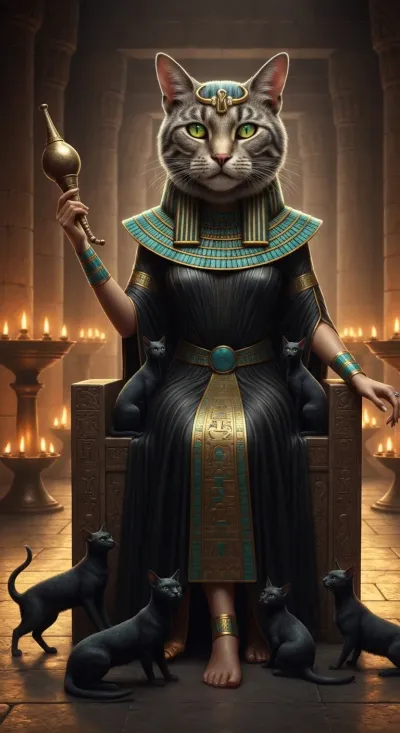
The cat-headed Egyptian goddess of joy, music, protection, and the home — daughter of Ra who embodies the tamed solar warmth, guards households and children, and governs all the pleasures of daily life.
Bastet (Egyptian Bast) began her theological life as a fierce lioness goddess — an aspect of the solar eye, the Eye of Ra, capable of the same destroying wrath as Sekhmet. Over the course of Egyptian history, she was gradually domesticated from lioness to cat, from solar destroyer to warm guardian, becoming in the Late Period and Greco-Roman era the beloved cat goddess of joy, music, fertility, and the protection of the home. This transformation is not a loss of power but a refinement of it: where Sekhmet is the killing heat of the noonday desert sun, Bastet is the warmth of sunlight on the household floor.
The great cat at the Ished tree
Book of the Dead Chapter 17 contains one of Bastet’s most ancient and potent mythological appearances: the great cat (identified as Ra himself in his nocturnal form, or as Bastet acting for Ra) who sits beneath the Ished tree at Heliopolis and slays the serpent Apep with a knife. In this role, Bastet is a cosmic defender — the solar force that destroys chaos at its root. This image endured through the entire Egyptian tradition as a symbol of the triumph of order over dissolution.
The Distant Goddess and the return
Ancient Egyptian Legends preserves the Distant Goddess myth: the solar Eye (identified variously as Bastet, Sekhmet, Hathor, or Tefnut) left Egypt in anger and journeyed to distant Nubia, taking her fiery power with her. Without her, Egypt withered. Thoth (or Shu) journeyed after her, told her stories and fables to soften her wrath, and gradually persuaded her to return. Her homecoming was celebrated with music, dancing, and the shaking of the sistrum — a festival of joy that reflected how desperately she had been missed. This myth explains why Bastet’s temples were places of music and celebration: every celebration was a re-enactment of the goddess’s joyful return.
Protector of homes and children
In household religion, Bastet was the guardian most likely to be found on the domestic shrine. Her small bronze figurines — a seated cat, or a woman with a cat’s head holding a sistrum and a basket — were among the most common votive objects in ancient Egypt. Egyptian Magic documents protective formulas invoking Bastet for the safety of mothers during childbirth, children against night dangers, and the household against evil. The cat’s nocturnal vigilance, its hunting of snakes and vermin, made it a natural embodiment of domestic protection.
Bastet in practice
Bastet is one of the most approachable deities for a new Kemetic practitioner. Her altar welcomes cat imagery, sistrums or small rattles, perfume, milk, music, and joy itself as an offering. Caring for cats is understood in Kemetic tradition as a form of Bastet devotion. The Book of the Dead Chapter 17 provides meditation material on Bastet’s solar and protective dimensions. She is invoked for protection of the home, for creativity and joyful expression, and for safe births.
Related Terms
Hathor
The Egyptian goddess of love, music, beauty, fertility, and the western sky — divine mother of Ra, protector of the dead, and the most joyful presence in the Egyptian pantheon.
KemeticHeka
The Egyptian principle of sacred, creative speech and magic — a primordial cosmic force older than the gods themselves, by which the universe was spoken into being and by which correctly spoken words carry genuine transformative power.
KemeticIsis
The Egyptian goddess of magic, healing, motherhood, and resurrection — she gathered the dismembered body of Osiris, mastered the secret name of Ra, and became the universal mother of the Greco-Roman world.
KemeticMa'at (goddess)
The Egyptian goddess personifying truth, justice, and cosmic order — her ostrich feather is the standard against which every human heart is weighed at death, and her presence sustains the universe.
KemeticRa
The self-created supreme solar deity of ancient Egypt, who sails the solar barque across the sky each day and through the underworld each night to be reborn as Khepri at dawn.
KemeticSekhmet
The lioness-headed Egyptian goddess of solar wrath, plague, and healing — the Eye of Ra who was sent to destroy humanity and then became the patroness of physicians who healed what her pestilence caused.