Kemetic Tradition
Nut
NOOT (Egyptian: Nwt)
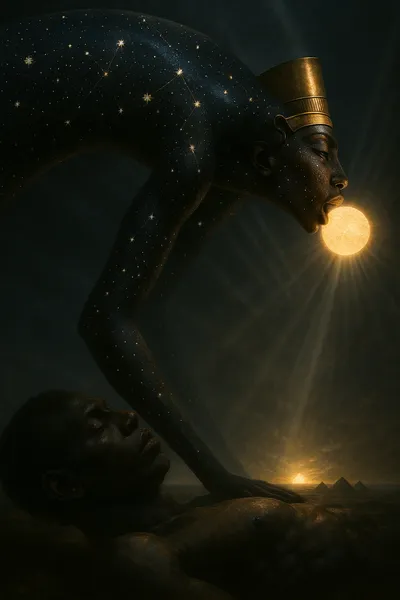
The Egyptian sky goddess whose star-spangled body arches over the earth as the vault of heaven — she swallows the sun each night and gives birth to it each morning, and shelters the dead in her embrace.
Nut (Egyptian Nwt) is the sky itself, arched over the earth in the form of a woman — her body spangled with stars, her hands and feet touching the four horizons, her belly the dark vault through which Ra travels. She is one of the most visually striking deities in Egyptian iconography, depicted in the famous elongated arch across the ceilings of coffins and burial chambers: the dead were enclosed literally within her body, gestating toward rebirth.
The arched sky and the separation of earth
Legends of the Gods preserves the Heliopolitan cosmogonic myth: at the beginning, Nut and her brother-husband Geb (the earth) lay locked together in primordial embrace, until their father Shu (air) was commanded by Ra-Atum to separate them. Shu lifted Nut high, her body becoming the sky; Geb lay below as the earth. This separation made room for all creation between them — the atmosphere, the waters, and the space in which living things could exist. Nut’s stretched body in art is always this moment: the divine mother holding the world up by holding herself away from the earth.
The birth of the gods
Ra had forbidden Nut to give birth on any day of the year. Thoth played dice with the moon and won enough moonlight to create five extra days — the Epagomenal Days, outside the official calendar — on which Nut could give birth. On these five days she bore Osiris, Horus the Elder, Set, Isis, and Nephthys: the primary deities of Egyptian mythological history. Development of Religion and Thought in Ancient Egypt examines how this birth narrative places the Ennead’s origin in a moment of divine cleverness overcoming divine prohibition.
Mother of the dead
The Pyramid Texts — the oldest religious texts in the world — invoke Nut repeatedly as the mother who receives the dead king into her body, as she receives the sun each evening, and who will give birth to him again as a new star. “Nut, you have spread yourself over your son… you place him at your side. He will not be far from you.” This maternal embrace became one of the central comforts of Egyptian funerary theology: death is not abandonment but re-entry into the divine body that first held all things.
Nut in practice
Nut’s image inside the coffin lid — looking down at the deceased — makes her one of the most intimate deities in Egyptian practice. She is honored in practices of grief and consolation, in contemplation of the night sky, and in meditations on cyclical renewal. The Book of the Dead Chapter 175 addresses her directly in the context of death and rebirth. Offerings include water, incense, and stargazing itself as a sacred act of recognition.
Related Terms
Duat
The Egyptian underworld — the realm of cosmic transformation through which Ra navigates each night in his barque and through which every human soul travels after death on the way to judgment and the Field of Reeds.
KemeticGeb
The Egyptian earth god who forms the ground beneath all life — husband of Nut the sky, father of Osiris, Isis, Set, and Nephthys, whose laughter shakes the earth and whose body is the black soil of Egypt.
KemeticIsis
The Egyptian goddess of magic, healing, motherhood, and resurrection — she gathered the dismembered body of Osiris, mastered the secret name of Ra, and became the universal mother of the Greco-Roman world.
KemeticNephthys
The Egyptian goddess of death, twilight, and the threshold between life and death — sister of Isis who mourned Osiris at the edge of the world and whose lamentation has the power to protect and restore the dead.
KemeticOsiris
The Egyptian god of resurrection, the afterlife, and divine kingship — first king of Egypt, murdered and dismembered by Set, restored by Isis, and made eternal judge of the dead in the Duat.
KemeticRa
The self-created supreme solar deity of ancient Egypt, who sails the solar barque across the sky each day and through the underworld each night to be reborn as Khepri at dawn.
KemeticSet
The Egyptian god of storms, the desert, and necessary chaos — murderer of Osiris and antagonist of Horus, yet also Ra's indispensable defender against the serpent Apep in the nightly underworld passage.