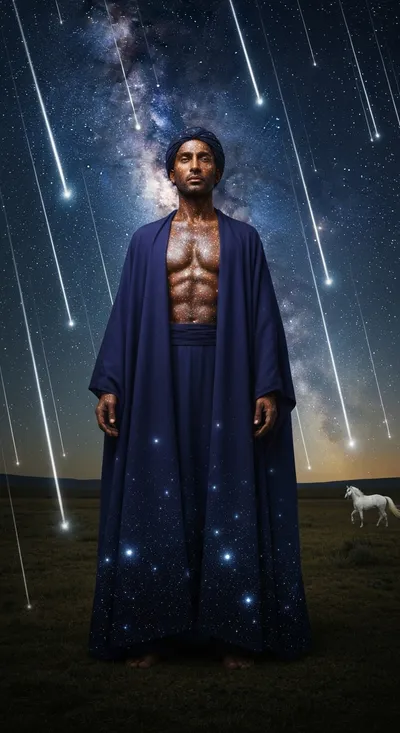
Zoroastrian Tradition
Tishtrya
TISH-tryah (Persian: Tir)
The Zoroastrian Yazata of the star Sirius and of the rains — who takes the shape of a white horse and battles the drought-demon Apaosha for three days and nights before the world's waters are released.
Tishtrya (Persian: Tir) is the Zoroastrian Yazata of the star identified with Sirius, and the divine power behind the coming of the seasonal rains. His yasht — the eighth of the twenty — is one of the most narratively vivid in the whole collection, staging a cosmic battle for the water on which every living creature in Zoroastrian cosmology depends.
Tishtrya’s rise and the world’s longing
The Tishtar Yasht opens not with abstract praise but with anxious anticipation: “long flocks and herds and men” look for Tishtrya’s rising, asking “when shall we see him rise up, the bright and glorious star Tishtrya? When will the springs run with waves as thick as a horse’s size and still thicker? Or will they never come?” This framing — creation itself waiting on a single star’s return — establishes Tishtrya’s stakes before the narrative of his battle even begins.
The battle with Apaosha
Ten nights into his rising, Tishtrya “mingles his shape with light,” appearing as “a white, beautiful horse, with golden ears and a golden caparison,” and descends to the cosmic sea Vouru-Kasha to gather the rains. There “rushes down to meet him the Daeva Apaosha, in the shape of a dark horse, black with black ears, black with a black back, black with a black tail, stamped with brands of terror.” The two meet “hoof against hoof” and fight for three days and three nights — and at first Apaosha, the demon of drought, “proves stronger… he overcomes him.” Tishtrya’s own explanation for this defeat is theological rather than martial: he laments that men have not worshipped him “with a sacrifice in which I had been invoked by my own name,” and so lacked the strength that due honor would have given him.
Ahura Mazda’s intervention and Tishtrya’s victory
Ahura Mazda himself then offers the sacrifice Tishtrya was owed, bringing him “the strength of ten horses, the strength of ten camels, the strength of ten bulls, the strength of ten mountains, the strength of ten rivers.” Strengthened, Tishtrya returns to the sea and this time overcomes Apaosha by noon. His cry of victory follows immediately: “Hail unto me, O Ahura Mazda! Hail unto you, O waters and plants!… The life of the waters will flow down unrestrained to the big-seeded corn fields.” The Yasht then describes the vapors rising as clouds, driven by the wind “along the ways which Haoma traverses,” down to “the seven Karshvares of the earth” as rain.
Tishtrya and ritual dependency
The Tishtar Yasht’s theology is unambiguous about why the drought-demon nearly wins: Tishtrya’s cosmic strength is not automatic but is sustained by human sacrifice offered in his own name. The myth makes the ordinary Zoroastrian’s fidelity to ritual observance cosmically consequential — the rain that waters the “big-seeded corn fields” depends, in this account, on a chain running from the sacrifices offered at the fire to the strength of a star fighting a demon at the edge of the world’s sea.
Related Terms
Ahura Mazda
The supreme deity of Zoroastrianism — the uncreated Wise Lord who embodies Asha (cosmic truth), created the universe in goodness, and stands in eternal opposition to Angra Mainyu, the principle of darkness.
ZoroastrianAnahita
The Zoroastrian Yazata of all waters — the immaculate divine presence who purifies the seed, sustains fertility, and whose sacred waters are invoked in the Padyab-Kusti purification rite at the beginning of every day.
ZoroastrianAsha
The foundational Zoroastrian principle of cosmic truth, righteousness, and right order — the living law that structures reality and the standard against which all human thought, word, and deed is measured.
ZoroastrianYazata
The venerable divine beings of Zoroastrianism — spiritual powers worthy of worship who serve Ahura Mazda, govern aspects of creation, and are addressed in the prayers and five daily watches.