🔥 The Zoroastrian Path
Zoroastrianism
One of the world's oldest revealed religions — Ahura Mazda, the sacred fire,Asha (truth and cosmic order) — as the Avesta, the Yasna liturgy, and Ferdowsi's Shahnameh preserve it, and as Zoroastrian practitioners keep it today.
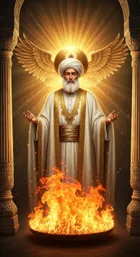




Zoroastrianism was founded by the prophet Zarathustra (Greek: Zoroaster), who composed theGathas — seventeen hymns preserved within the Yasna, the central liturgical text of the Avesta. The Gathas are among the oldest surviving Indo-Iranian religious poetry, presenting a theology of two opposing principles: Spenta Mainyu (the Bounteous Spirit) and Angra Mainyu (the Destructive Spirit), and the supreme deity Ahura Mazda — the Wise Lord — who governs through Asha (cosmic truth, order, righteousness). The practice data on this path — worship guides, prayers, and offering lists — derives from the Avesta's Visperad, the Vendidad, and the hymns to individual Yazatas (divine beings worthy of worship) preserved therein.
The six Amesha Spentas (Holy Immortals) — Vohu Manah (Good Mind), Asha Vahishta (Best Truth), Khshathra Vairya (Desirable Dominion), Spenta Armaiti (Holy Devotion), Haurvatat (Wholeness), and Ameretat (Immortality) — extend Ahura Mazda's nature into the world and are invoked in the daily Zoroastrian prayers: the Ahuna Vairya, the Ashem Vohu, and the Yenghe Hatam. These prayer names appear in the practice data on this site, drawn directly from the Avestan liturgical tradition.
Ferdowsi's Shahnameh (Book of Kings, c. 1010 CE) — the Persian national epic — weaves Zoroastrian cosmology through the legendary histories of Iran's ancient rulers, preserving the mythic layer of the tradition in narrative form. The sacred calendar features Nowruz (New Year at the spring equinox), the six Gahambars (seasonal thanksgiving festivals), and Sadeh (the festival of fire in winter). Every page on this path cites its sources by name.
The Divinities
Ahura Mazda & the Yazatas
All 8 Zoroastrian divinities — worship, symbols, and sources.
The Rites
Fire & Prayer
6 complete ritual guides — materials, words, and steps.
The Year
The Sacred Calendar
Nowruz, the Gahambars, and the holy days of the Zoroastrian year.
The Library
Primary Texts
The Vendidad, the Yashts, the Yasna, and the Bundahishn — fully readable in translation.